Welcome, GR RL!
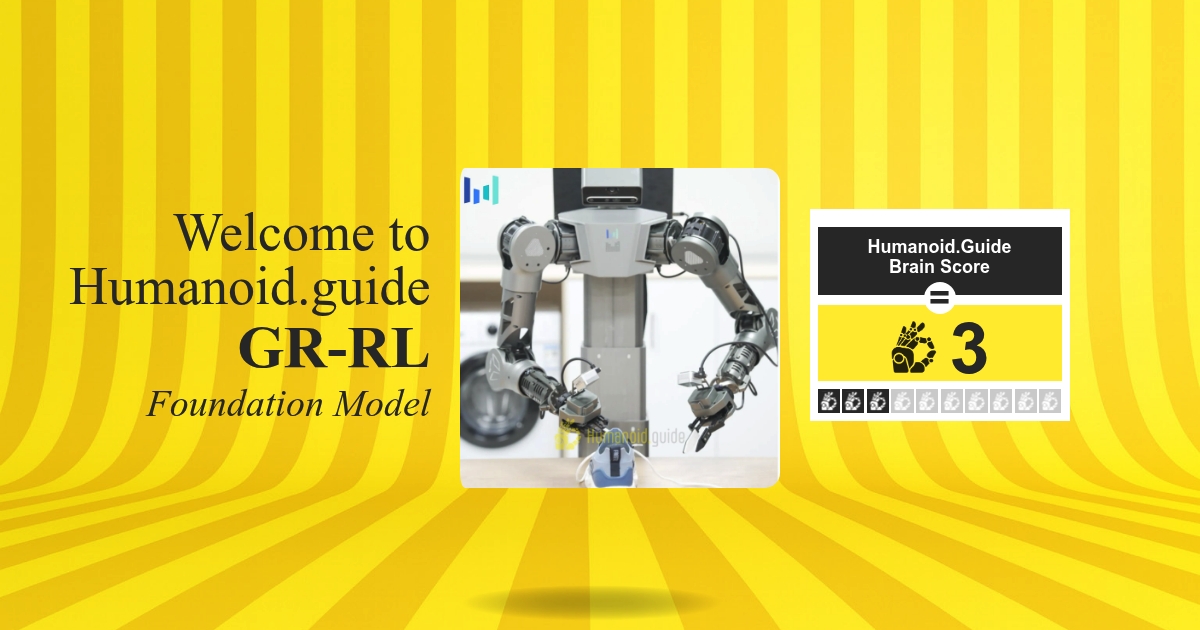
GR RL is a robot foundation model developed by ByteDance Seed, the AI research team within ByteDance, the parent company of TikTok. Introduced in December 2025, it builds on GR 3, the team’s general vision language action model. Its development centers on a training problem: demonstrations collected from people can contain noise, inconsistent execution, and imperfect examples. Rather than treating imitation as the entire learning process, the project combines demonstration training with reinforcement learning through subsequent robot practice. The reported training sequence has three stages: filtering poor demonstrations, mirroring retained examples to expand the training data, and introducing practice guided by results. This makes GR RL a software research effort concerned with how robot policies are trained and refined, rather than a physical robot product. Its Humanoid.Guide Brain Score is 3 out of 10, placing it in the developing range. The model provides a concrete example of ByteDance Seed’s work on combining different learning methods within a robot foundation model.
The technical distinction lies in the relationship between demonstration data and subsequent reinforcement learning. Demonstrations provide the initial training material, but their quality is treated as something to improve before further learning begins. Filtering removes poor examples, while mirroring increases the amount of training material drawn from the retained demonstrations. The final practice stage then introduces feedback from results instead of relying exclusively on copied examples. These are separate parts of the reported training procedure, not interchangeable descriptions of a single step. For evaluating the research, that distinction matters: data selection, data augmentation, and reinforcement learning each occupy a defined place in the development process.
GR RL is listed on Humanoid.Guide with a displayed price of zero dollars and an availability status of backorder. The listing includes an interest option and an ordering interface, while ByteDance Seed maintains a dedicated project webpage through its official website. Those listing details should be distinguished from software distribution terms: a catalog price is not itself a license or a statement about access to model weights. More broadly, the project reflects attention to training quality within robotics research, particularly the relationship between human demonstrations and learning through practice. Its developing score provides useful context alongside the project description, keeping the overall assessment proportionate rather than presenting it as a mature, universally applicable robotics platform.