Welcome, ByteDexter!
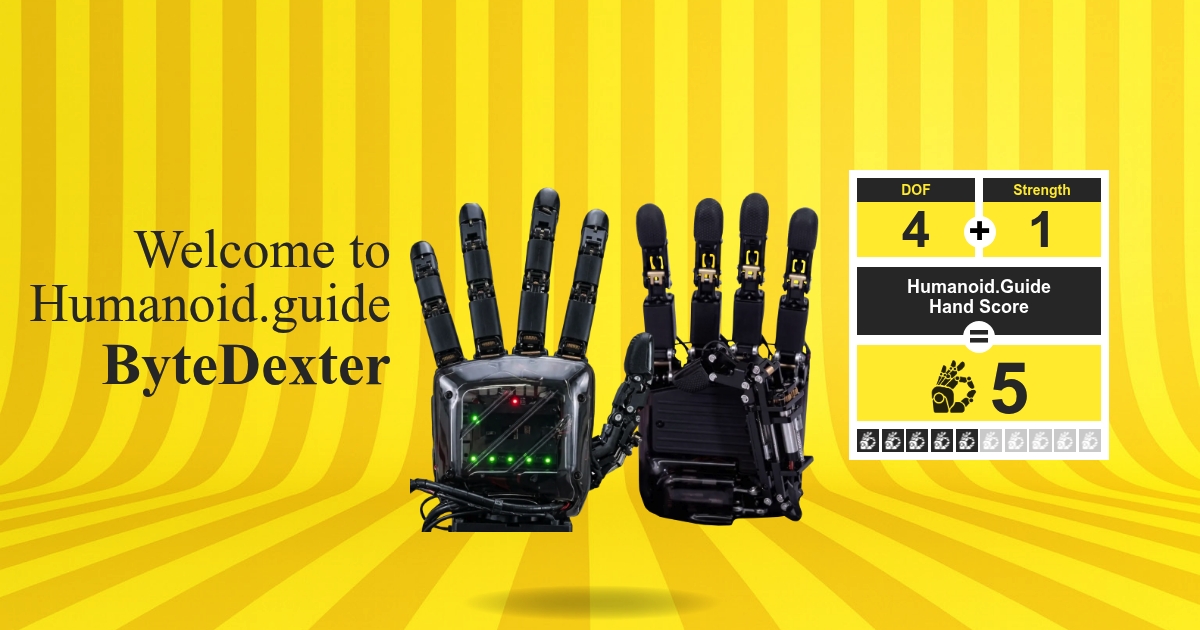
ByteDexter is a five finger robotic research hand developed by ByteDance Seed, the AI research team within ByteDance. It is designed around dexterity, compact mechanical integration and tactile sensing, with electric motors housed inside the palm rather than distributed through an external assembly. Its linkage transmission moves the fingers through rigid mechanical connections, while passive fingertip joints use coupled four bar linkages. The second version adds an extra thumb joint and reduces the overall size, refining the hand for research involving manipulation. The listed dimensions are 219 millimeters in height and 108 millimeters in width, with a weight of 0.97 kilograms. High density piezoresistive tactile arrays cover the tips, pads and sides of all five fingertips to measure normal force. Its overall Hand Score is 5 out of 10, placing it in the developing category. The component ratings emphasize a stronger degrees of freedom profile alongside a lower strength tier, making the distinction between articulation and force central to understanding its design.
ByteDexter receives 4 out of 5 for Degrees of Freedom and 1 out of 5 for Strength. These ratings describe separate aspects of the hand rather than interchangeable measures of performance. The degrees of freedom rating places articulation toward the upper end of the scale, while the strength rating places force in the lowest tier above zero. The overall score therefore reflects an uneven profile rather than uniformly high performance. For technical evaluation, dexterity and grip strength deserve separate consideration: a favorable articulation rating does not establish equally strong force performance. ByteDexter’s developing status is best understood through that contrast, with its stronger dexterity rating balanced against its lower strength rating.
ByteDexter is listed as a prototype, with a published price of 20,000 USD and an inquiry option for prospective customers. Its developer, ByteDance Seed, places the project within a broader effort to train AI systems for robots equipped with humanlike hands. The hand is associated with the GR Dexter research project, connecting its hardware development to research on robot learning through human demonstrations and teleoperation data. That context distinguishes ByteDexter from a general consumer accessory or an established industrial product line. Its broader significance lies in the connection between specialized robotic hardware and AI training research, while its prototype availability and developing overall score keep expectations grounded in its current stage of development.