Welcome, REX G1!
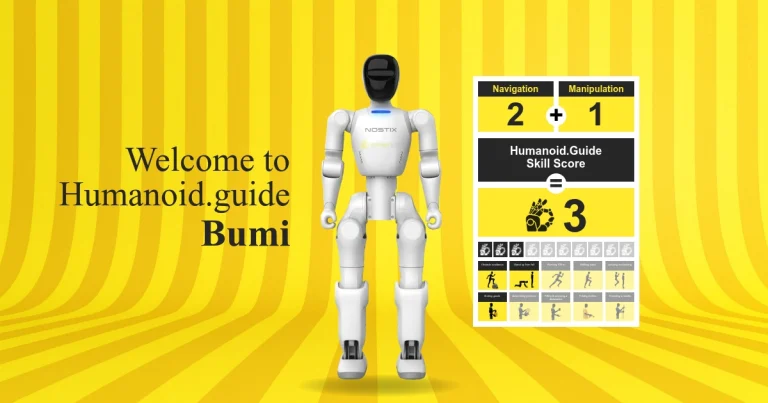
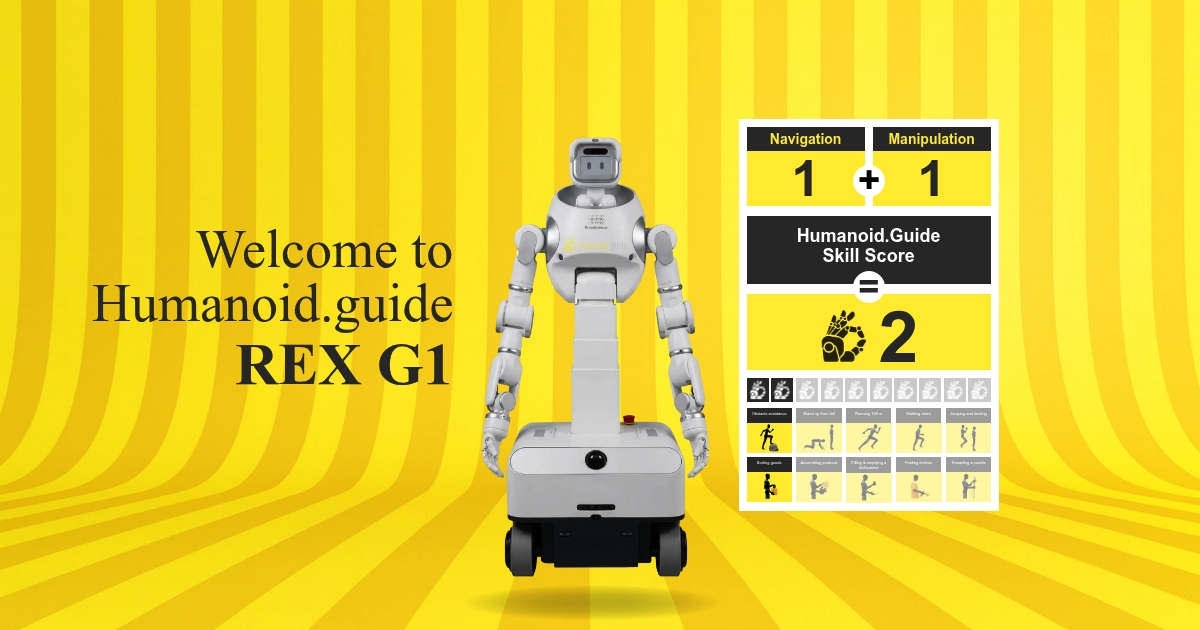
REX G1 is RoboScience’s first wheeled humanoid robot, designed for environments including logistics facilities, factories, retail spaces and homes. Standing 170 cm tall and weighing 80 kg, it combines a mobile base with an adjustable torso and two articulated arms. Its 22 degrees of freedom include seven in each arm, while the arms together support a stated load of 10 kg. The lifting torso provides a working reach spanning 0.1 to 2 metres, giving the platform access to different working heights. Maximum travel speed is 5 km/h, and the listed operating time is four hours per charge. Electric joint actuators provide movement, with brakes on all joints contributing to its safety provisions. REX G1 has an overall skill score of 2 out of 10, placing it at an early stage of development. Navigation and manipulation are each rated 1 out of 5. Its demonstrated capability set centres on obstacle avoidance and sorting goods, rather than a broad repertoire of advanced physical tasks.
Obstacle avoidance and sorting goods connect REX G1’s mobility and manipulation functions to practical material handling scenarios. Its 360 degree stereo vision system includes adaptive fill lighting, providing visual coverage around the platform. Onboard compute is specified at 2,070 TFLOPS, supporting RoboScience’s Visics embodied AI system. Visics uses a Vision Language Object Action architecture alongside an embodied world model and a manipulation model with more than one billion parameters. Natural language commands provide an interface for directing tasks. For goods sorting, the combination of articulated arms, adjustable working height and visual sensing supplies the relevant hardware foundation. The low navigation and manipulation ratings remain important context: these functions represent preliminary capability, not evidence of mature performance across complex operating environments.
REX G1 is listed as a prototype, with a stated price of USD 38,000. RoboScience, formally Beijing Jike Future Technology Co., Ltd., launched the robot on August 17, 2026. The Chinese company was founded in December 2024, and REX G1 marks its first robot platform. Founder Tian Ye studied at Stanford’s AI Lab under Andrew Ng and later led AI platform technology at Apple. The platform brings together wheeled mobility, articulated manipulation and an internally developed embodied AI model. Its broader significance lies in that integrated approach to physical automation. For prospective buyers, prototype availability and the early skill rating are central considerations when evaluating its fit for logistics, retail or factory settings.