Welcome, Xiao Di!
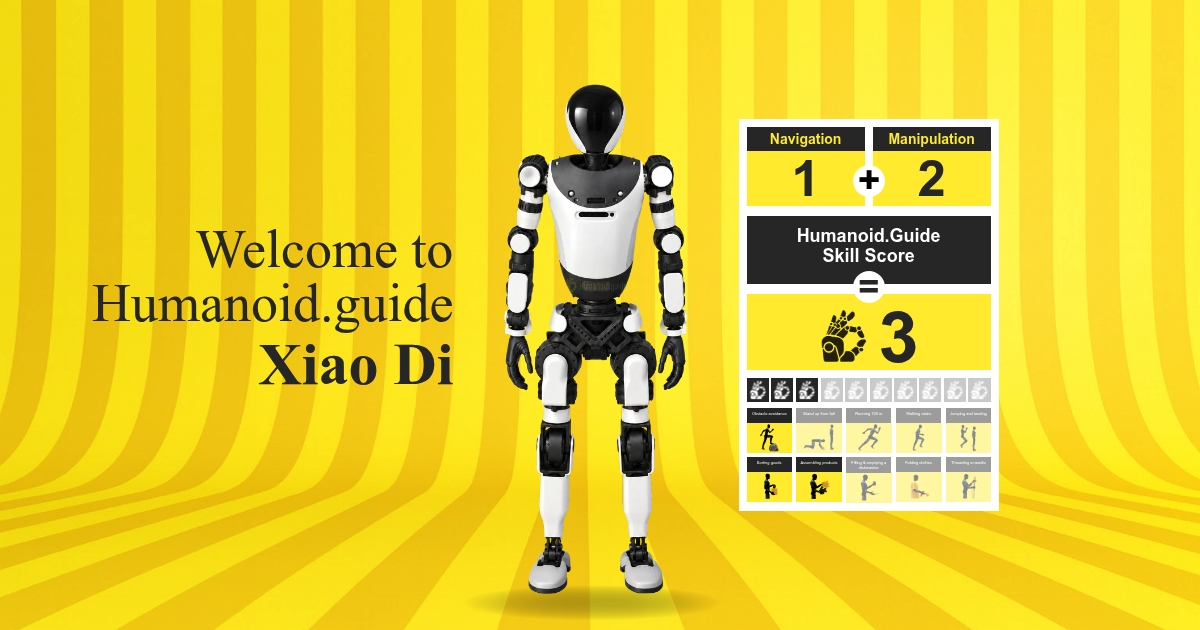
Xiao Di is BYD’s first self developed humanoid robot, designed primarily for customer facing environments such as car dealerships. It stands 161 cm tall, weighs 58.5 kg, and combines a black and white body with rounded styling and prominent joints at the shoulders, elbows, hips, and knees. Its specifications list 31 degrees of freedom and two hands with five fingers each. Maximum speed is listed as 4 km/h, runtime per charge as four hours, and handling strength as 2 kg. Xiao Di has an overall Humanoid.Guide Skill Score of 3 out of 10, placing it in the developing range rather than among mature general purpose systems. Its category ratings are 1 out of 5 for Navigation and 2 out of 5 for Manipulation. These ratings distinguish its comparatively stronger manipulation profile from its more limited navigation rating. Its listed capabilities include obstacle avoidance, sorting goods, and assembling products, connecting the humanoid design to practical movement and object handling tasks.
Obstacle avoidance is Xiao Di’s listed navigation capability, while sorting goods and assembling products define its manipulation profile. Together, these functions connect movement through a workspace with tasks involving physical objects. Sorting goods is relevant to organizing materials or separating items within a defined workflow. Product assembly points toward structured work in which object handling contributes to a larger production process. The listed 2 kg handling strength is an important constraint when considering suitable objects and task requirements. Its five finger hands provide a humanoid hand layout, but that configuration should not be confused with proven fine manipulation performance. With Navigation rated at 1 out of 5 and Manipulation at 2 out of 5, task selection should remain aligned with its developing capabilities.
Xiao Di is listed as a prototype, with a displayed price of USD 25,000 and an option to inquire about pricing. Its manufacturer is BYD Company Limited, the Chinese automaker, and its stated target markets include car dealerships, education, industrial uses, and service settings. BYD established a dedicated embodied AI research team in 2022, placing the robot within a broader effort to develop physical AI systems. The project’s significance lies in an automotive manufacturer extending its development activity into humanoid robotics, with both customer facing settings and industrial applications in view. Prototype status remains central to understanding that ambition: Xiao Di represents a developing platform, not an established deployment offering with demonstrated performance across every proposed market.