Welcome, Y2-P!
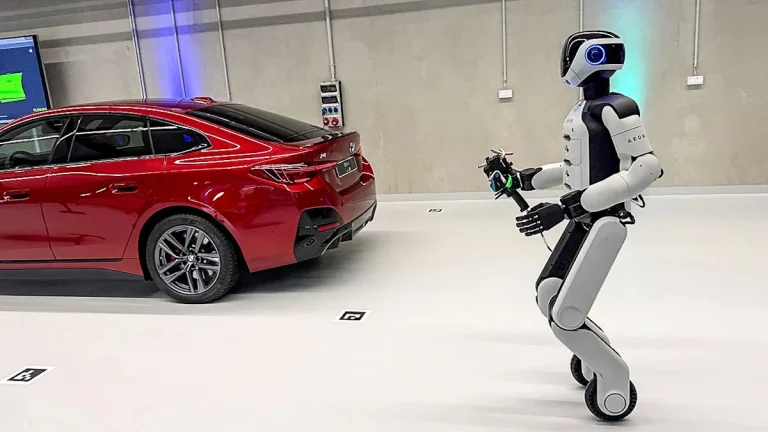
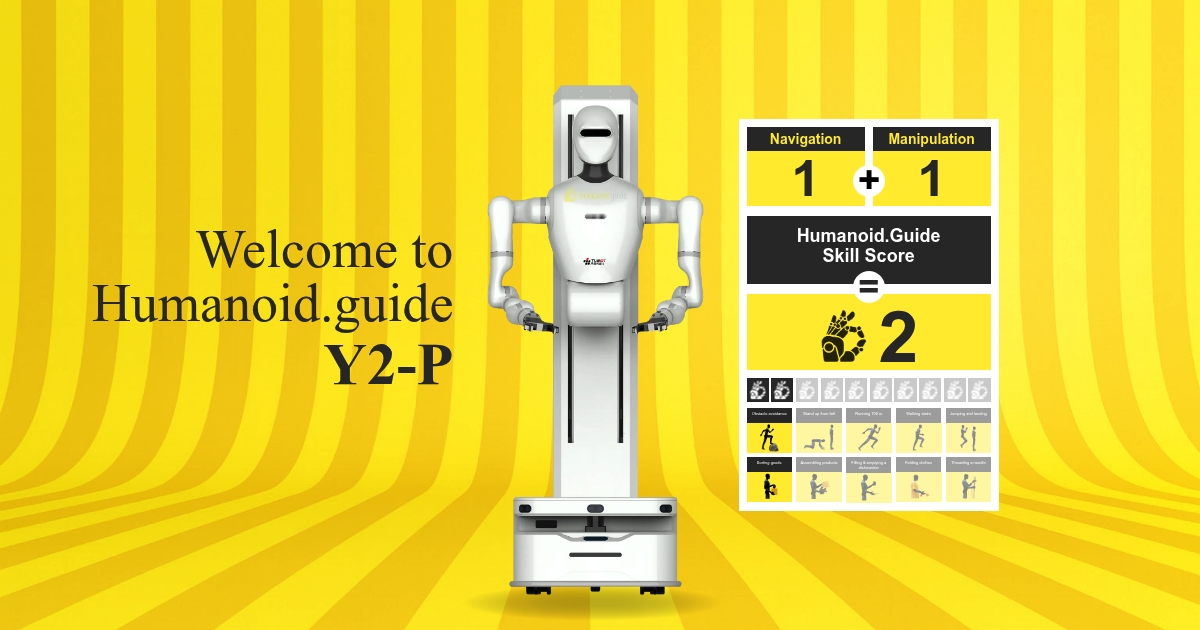
This wheeled humanoid robot from Tlibot combines two arms with a torso that lifts vertically and pitches forward, providing an adjustable working posture for sorting goods. Its 700 mm torso lift and 2.19 m working range support access across different heights, while each arm carries a payload of 5 kg. The platform stands 156.5 cm tall, weighs 95 kg, and reaches a maximum travel speed of 4.3 km/h. A stated runtime of eight hours per charge supports extended research sessions and operational trials. LiDAR provides obstacle avoidance, and two finger gripping claws serve as its end effectors. Computing hardware includes an NVIDIA Jetson Orin NX with 16 GB of memory and a 512 GB SSD. ROS 2 and API support provide software integration options. Its overall skill score of 2 out of 10 places it in the preliminary capability tier, with navigation and manipulation each rated 1 out of 5. These ratings distinguish its basic demonstrated capabilities from more advanced robotic performance.
Obstacle avoidance and sorting goods define the robot’s supported capability set. LiDAR supports detection of obstacles around the mobile platform, while the adjustable torso and paired arms provide a physical configuration suited to sorting at different working heights. The combination of vertical lift and forward torso pitch offers more positioning flexibility than a fixed torso arrangement. Each arm’s 5 kg payload sets a practical constraint when selecting goods for sorting trials. For researchers developing these workflows, ROS 2 and API support offer integration routes, complemented by Ethernet, HDMI, two USB 3.0 ports, and WiFi connectivity. Its navigation and manipulation ratings remain at the entry tier, so obstacle avoidance should not be equated with comprehensive safety assurance.
The robot is in production and carries a listed price of USD 36,000. Its manufacturer, Tlibot, formally Sichuan Tianlian Robot Co., Ltd., is based in Mianyang, China, and develops its own robot joints and arms. This internal hardware development is a notable aspect of the platform’s industrial background. Within the Y2 family, the robot combines lifting and pitching torso mechanisms in a single mobile configuration. Its broader significance lies in providing a commercially listed platform for research and goods sorting experiments rather than demonstrating mature general purpose autonomy. Buyers evaluating deployment should distinguish its stated hardware specifications from its preliminary skill rating and assess obstacle avoidance within the requirements of their intended environment.