Welcome, TLIBOT T1!
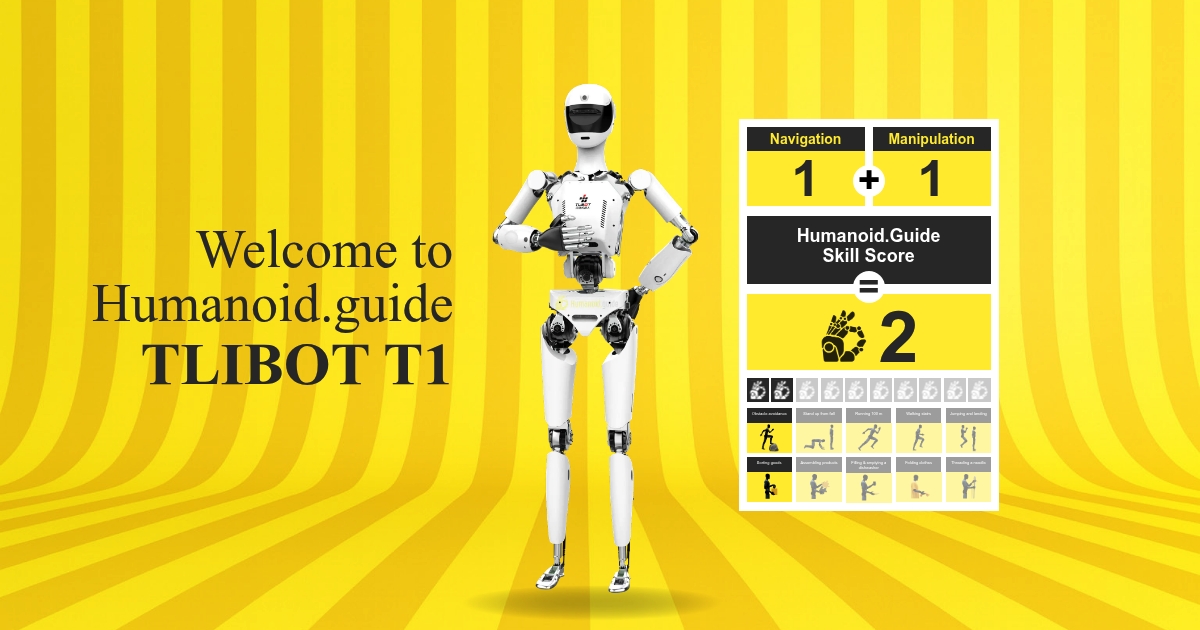
TLIBOT T1 is a bipedal humanoid research platform developed by Tlibot, formally Sichuan Tianlian Robot Co., Ltd., in Mianyang, China. Standing 160 cm tall and weighing 43 kg, it combines a relatively light body with 41 body degrees of freedom, excluding its hands. Its joint modules deliver torque ratings of 450 newton meters at the hip, 281 at the knee, and 148 at the ankle. The platform lists a 10 kg arm payload and a weighted deep squat capacity above 100 kg, figures that describe different aspects of its physical performance rather than interchangeable lifting limits. A 1,110 watt hour battery supports a listed runtime of three hours, while maximum travel speed is 3 km per hour. Each hand has five fingers. Its Humanoid Guide Skill Score is 2 out of 10, with Navigation and Manipulation each rated 1 out of 5. These ratings place its demonstrated functional capabilities in an early stage, despite the substantial mechanical specifications.
Obstacle avoidance and sorting goods are the T1 capabilities identified for practical evaluation. Obstacle avoidance provides a starting point for studying navigation around objects in controlled research spaces. Sorting goods offers a concrete manipulation use case for assessing how the robot handles and organizes items. Together, these activities give research teams distinct ways to evaluate mobility and manipulation without assuming a broader repertoire of autonomous tasks. The low Navigation and Manipulation tier ratings remain important context: these are preliminary capabilities, not evidence of mature general purpose autonomy. For laboratory evaluations, repeatability, object variety, environmental consistency, and the amount of operator assistance are useful criteria when measuring progress in these two activities.
T1 is listed as in production, with a displayed price of USD 40,000 and an inquiry option for prospective buyers. Its stated markets include research and development and general purpose humanoid applications. Computing is customer supplied rather than included, with a recommended configuration using an x86 computer, an Intel Core i5 1340P processor, and at least 16 GB of RAM. This purchasing detail matters when planning the full platform budget and integration effort. Tlibot also develops its own robot joints and arms, giving T1 a place within the company’s broader hardware portfolio. Its broader significance lies in pairing substantial joint specifications with an early stage humanoid platform for continued research and evaluation.