Welcome, eHand-6!
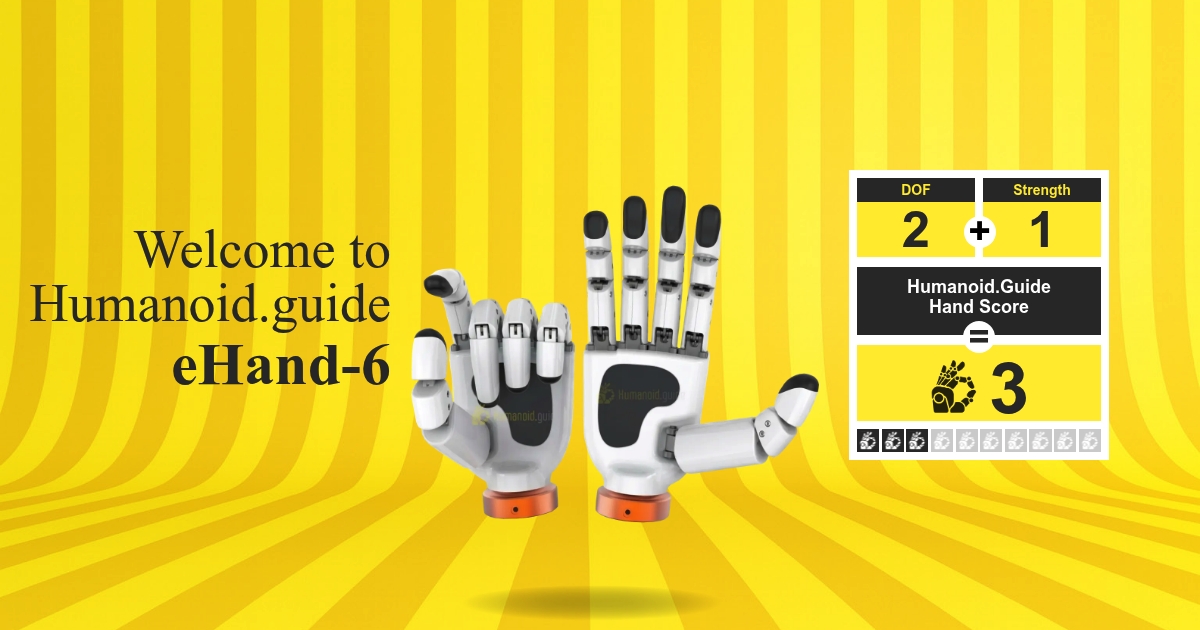
The eHand 6 is an industrial robotic hand from Hitbot, also known as Huiling Technology, a Shenzhen manufacturer of robot arms and electric grippers. Introduced in May 2025 at a listed price of $420, it emphasizes affordability within a product category often associated with substantial hardware costs. Its overall Humanoid Guide score is 3 out of 10, placing it in the developing range rather than among mature or leading systems. The component ratings are 2 out of 5 for Degrees of Freedom and 1 out of 5 for Strength. These ratings distinguish its relative positioning in dexterity and grip strength without representing physical measurements. The combination of an accessible price and modest ratings makes cost an important part of its identity, but not a substitute for assessing application requirements. For prospective buyers, the central consideration is whether this developing hand offers an appropriate balance between acquisition cost and the performance their work demands.
The technical assessment centers on degrees of freedom and strength, two distinct considerations when evaluating a robotic hand. Its Degrees of Freedom rating of 2 out of 5 is below the upper tiers, while its Strength rating of 1 out of 5 places that category in a lower tier. Neither rating specifies a joint count, lifting capacity, or measured gripping force. They provide a comparative framework rather than a complete engineering specification. For application planning, dexterity requirements and force requirements should therefore remain separate questions. A task that prioritizes economical hardware does not automatically require the same performance profile as one that prioritizes demanding manipulation or substantial grip strength.
The hand is listed as in production, with Hitbot identified as its manufacturer in China. Hitbot is part of the Xiaomi ecosystem, a corporate context that should not be confused with a separate product endorsement or a specific deployment partnership. Its stated approach to affordability includes developing key components, drivers, and control software internally while reusing established modules from its broader automation portfolio. The listed $420 price is central to the product’s broader significance: it introduces a relatively inexpensive option into the industrial dexterous hand market. Its developing score keeps that accessibility in perspective, separating a low acquisition price from claims of advanced overall performance.