Welcome, Gaia Hand 20!
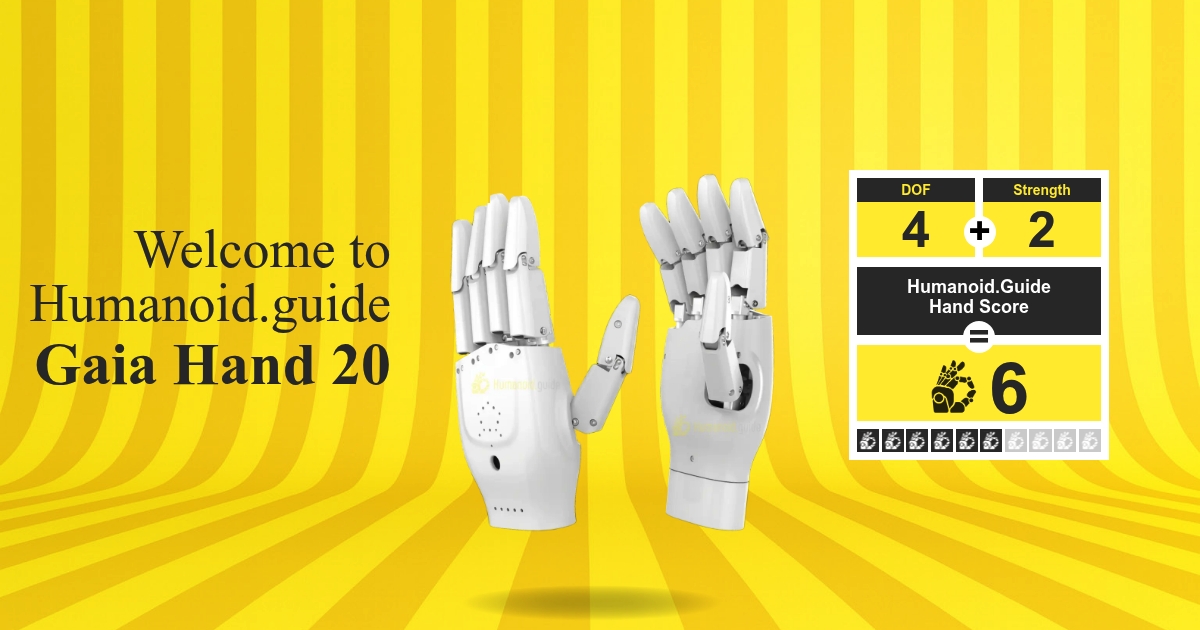
Gaia Hand 20 is a robotic hand from Stella Robot, a Chinese robotics company based in Shenzhen. It occupies the capable category with an overall Humanoid.Guide Hand Score of 6 out of 10. Its rating profile places greater emphasis on dexterity than strength: Degrees of Freedom receives 4 out of 5, while Strength receives 2 out of 5. These are comparative tier ratings, not measurements of joint count or lifting capacity. The distinction matters when assessing the hand for a particular project, because a strong dexterity rating does not automatically imply an equally strong grip strength rating. Gaia Hand 20 is positioned as an affordable platform for embodied AI research, giving it a clear identity within the robotic hand market. Its overall score describes a capable product rather than a state of the art leader. For prospective buyers, the most useful starting point is its combination of a relatively high Degrees of Freedom rating and a lower strength tier.
The technical evaluation centers on the balance between degrees of freedom and grip strength. Gaia Hand 20 earns its stronger assessment in Degrees of Freedom, with a rating of 4 out of 5. Its Strength rating of 2 out of 5 places that category below its dexterity assessment. This makes the score profile more informative than the overall total alone: two hands with the same total score can have different category strengths. For research planning and product comparison, these ratings provide a concise way to organize requirements without mistaking a score for a physical specification. Selection should distinguish the importance of dexterity from the importance of force, rather than treating hand performance as a single interchangeable quality.
Gaia Hand 20 is listed as in production, with an advertised price of USD 4,600 and an option to inquire about pricing. Stella Robot provides its company website at www.stella-robot.com for further commercial information. The company was founded by a team with roots at Tsinghua University and Harbin Institute of Technology, placing the product within Shenzhen’s robotics startup landscape. Its broader significance lies in its positioning as an affordable research platform in a market where acquisition cost influences access to robotic hardware. For laboratories and development teams comparing purchases, the listed price and production status offer practical starting points alongside its capability ratings. Those commercial details complement the score without changing what the individual rating categories mean.