Welcome, StarBot Nova!
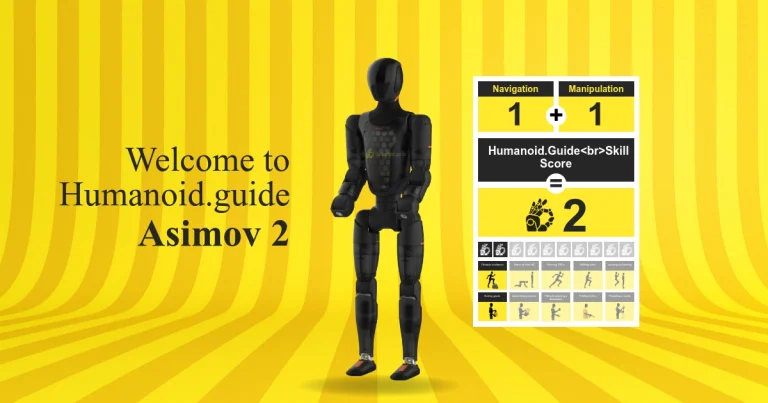
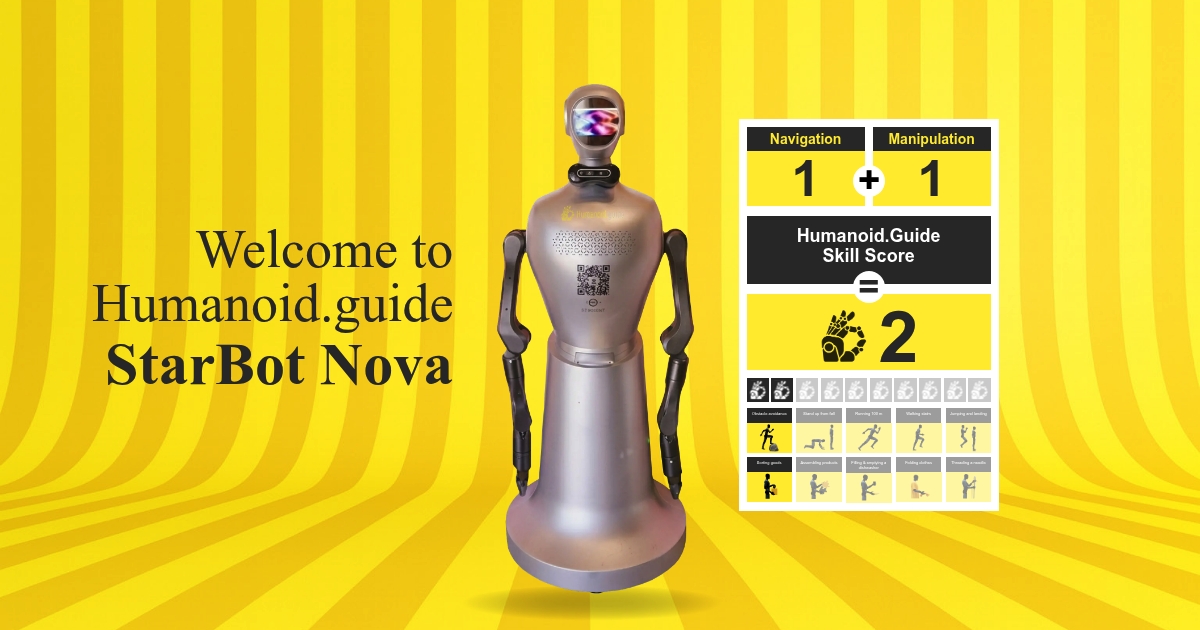
StarBot Nova is a wheeled service humanoid developed by StarBot USA in Santa Barbara, California, for restaurant, hospitality and retail environments. Standing 152 centimeters tall and weighing 32 kilograms, it combines a differential drive base with two articulated arms, each offering seven degrees of freedom. Its wheeled configuration provides mobility without relying on a legged walking system. Listed specifications include a maximum speed of 4.3 kilometers per hour, a strength rating of 5 kilograms and a runtime of 10 hours per charge. Nova has an overall skill score of 2 out of 10, placing it in the early stage category. Navigation and manipulation are each rated 1 out of 5, indicating preliminary performance in both areas rather than mature general purpose autonomy. Its confirmed physical capabilities include obstacle avoidance and sorting goods. The robot uses electric motors and includes depth cameras described as Intel RealSense class, alongside an RGB camera. Its grey exterior and humanlike upper body are paired with a mobile base intended for commercial indoor settings.
Obstacle avoidance and sorting goods define Nova’s confirmed capability set. For navigation, its safety provisions include real time obstacle avoidance, speed limiting in crowds and an emergency stop, with safety confirmation handled per deployment. These provisions are particularly relevant in restaurant, hospitality and retail settings, where people and objects share limited floor space. Sorting goods provides a manipulation use case for its paired arms, although the manipulation rating remains at the preliminary tier. The combination makes Nova relevant to evaluations of mobile sorting tasks in commercial interiors. Its navigation and manipulation scores should be considered separately: each is rated 1 out of 5, and neither rating establishes advanced performance. Deployment planning should therefore center on clearly bounded tasks and appropriate safety review.
Nova is listed as a prototype, with a published price of USD 20,000 and an option to inquire about pricing. StarBot launched it in December 2025 as its first generation service robot, and the company has tested it in a busy restaurant dining room. That commercial context gives the platform a concrete setting for development, but its prototype status and early stage skill score remain important considerations for prospective buyers. Its broader significance lies in pairing a wheeled base with two articulated arms in a service oriented humanoid format. For organizations considering this category, Nova represents an early platform for assessing obstacle avoidance and goods sorting within a specific site, rather than evidence of mature, broadly adaptable robotic labor.