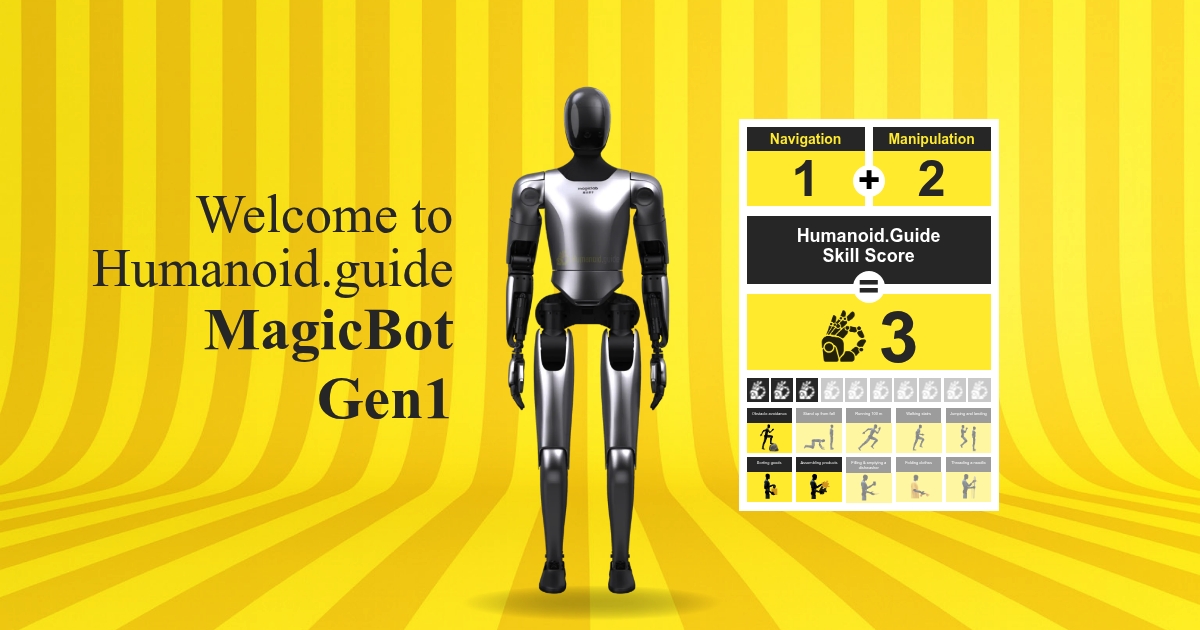
Welcome, MagicBot Gen1!
MagicBot Gen1 is a full size humanoid robot from MagicLab, a robotics company based in Wuxi, China. Designed as a general purpose platform for research, manufacturing and service settings, it combines a bipedal body with articulated arms and optional tactile hands. The robot stands 174 cm tall, weighs 70 kg and has 42 active degrees of freedom. Its electric servo joint modules are developed internally, with maximum joint torque specified at at least 350 newton meters. Planetary and harmonic reducers form part of its actuation architecture. An eight core CPU and an AI processor rated at 100 TOPS provide onboard computing, while LiDAR and depth vision support obstacle avoidance. Its overall skill score of 3 out of 10 places it in the developing category, with navigation rated 1 out of 5 and manipulation rated 2 out of 5. Supported capabilities include sorting goods and assembling products, giving the platform a practical focus on basic material organization and assembly tasks rather than advanced general autonomy.
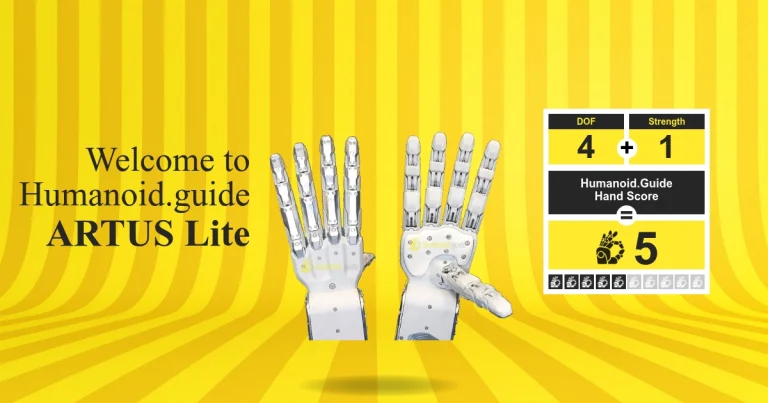
Obstacle avoidance, sorting goods and assembling products define MagicBot Gen1’s supported task set. LiDAR and depth vision provide environmental sensing for obstacle avoidance, a relevant function in spaces shared with equipment and people. Its safety designation is partial, so obstacle sensing should not be equated with unrestricted operation around humans. For sorting and assembly applications, the robot combines articulated arms with hands featuring five fingers each, with an optional tactile hand configuration offering 11 degrees of freedom. The listed strength specification is 15 kg. These features make goods organization and product assembly relevant areas for evaluation, while its developing manipulation rating calls for task specific testing rather than assumptions about precision, consistency or production throughput.
MagicBot Gen1 is listed as in production, with a published price of USD 50,000 and an inquiry option for purchasing discussions. Its stated markets include education, entertainment, hospitality, manufacturing and research, although its supported practical capabilities remain obstacle avoidance, sorting goods and assembling products. For prospective buyers, the broader significance lies in a single humanoid platform that brings together internally developed actuation, onboard AI computing and multiple sensing technologies. Connectivity includes 5G, Bluetooth 5.2 and WiFi 6, supporting integration planning for laboratory or industrial environments. A listed runtime of five hours per charge is another consideration when planning evaluations. Its current score positions it as a developing platform for structured trials, not a substitute for validating application requirements.