
China accelerates research into military humanoid robots
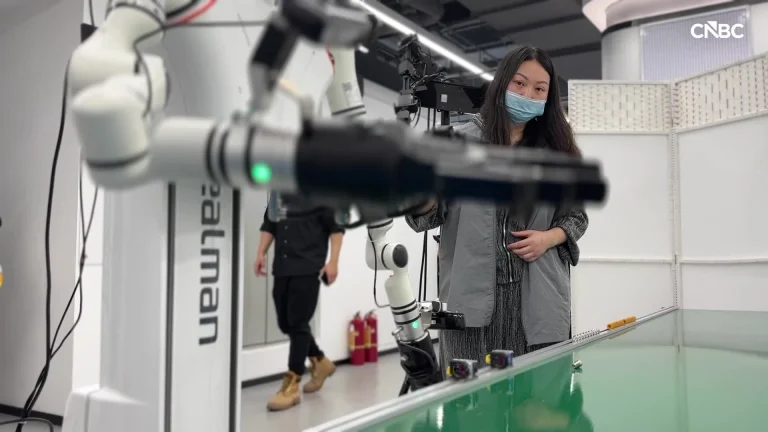
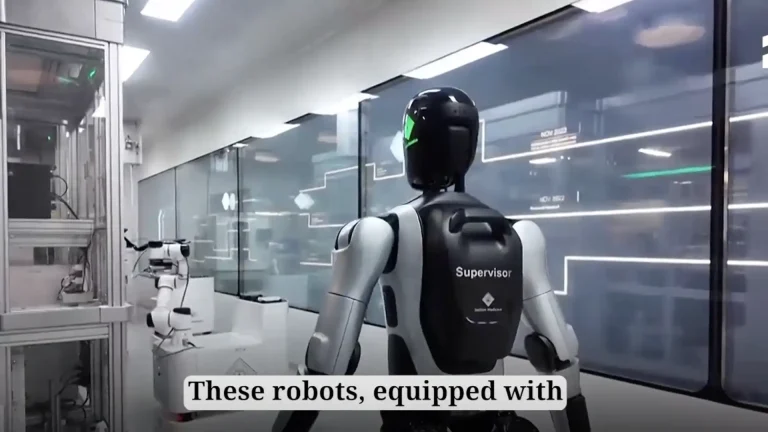
China’s defense establishment is accelerating research into military humanoid robots, with procurement records and academic studies pointing to work on perception, dexterous manipulation, training data and operations alongside troops. Reuters found no evidence that an armed humanoid has been deployed with an operational People’s Liberation Army unit.
The findings come from a Reuters review of more than 100 Chinese military procurement notices, patents, studies, government records, official publications and defense company materials. Activity increased during 2025 and 2026, although current humanoids remain energy intensive and unreliable outside controlled demonstrations.
China’s large commercial robotics sector gives military researchers a substantial domestic supplier and engineering base. BofA Global Research estimated that Chinese manufacturers accounted for about 95% of global humanoid shipments in 2025.
Procurement targets perception and dexterous operation
Chinese military interest became more visible in 2024, when the National University of Defense Technology and the Academy of Military Sciences hosted a forum session covering military applications for humanoid systems.
In June 2025, an NUDT competition included a simulated infiltration task in which robots entered an area, mapped it and located targets. Other scenarios covered identity checks, discipline inspections and security patrols at military bases. The university described the event as a proving ground for humanoids intended eventually to reach battlefield settings.
A PLA tender issued in May 2025 sought a humanoid robot together with installation and technical training. Four months later, another procurement notice, which listed an NUDT email address as its contact, requested an “embodied humanoid robot intelligent perception and dexterous operation system.” Reuters could not determine whether either tender was filled or which platforms might have been supplied.
In June 2026, the PLA budgeted about $300,000 for a system to collect and label camera, radar and motion data for humanoids, including information about traversable terrain. The request shows interest extending beyond robot bodies to the data infrastructure needed to train perception and control systems.
NUDT researchers have also modeled humanoids inside an urban assault force. An August 2025 paper described six combat robots, potentially including humanoids, quadrupeds and unmanned vehicles, divided between two teams clearing an occupied building floor by floor and room by room. The authors projected that the required equipment could become available within five to 10 years, but did not specify weapons, rules of engagement or how the robots would respond to civilians.
Norinco pairs Fuxi with remote operation
Norinco, China’s state owned defense conglomerate, has disclosed one of the clearest hardware examples. Company materials described its full size Fuxi humanoid as suitable for sentry duty, all weather reconnaissance, patrols and dangerous tasks.
Fuxi can be connected to a Norinco teleoperation system, allowing a human operator to control it remotely. Teleoperation reduces the autonomy burden in unpredictable environments, although it introduces requirements for reliable communications and sustained operator awareness.
Humanoid morphology could be useful inside buildings, tunnels and ships, where stairs, doors and human designed tools favor two legs and two arms. Juo-Min Chou of Taiwan’s Institute for National Defense and Security Research told Reuters that wheeled, tracked or quadruped systems would generally remain cheaper and easier to deploy for simpler reconnaissance and logistics missions.
The United States is examining similar applications. The U.S. Army launched a competition for militarized humanoid capabilities covering reconnaissance, security, obstacle clearing, hazardous materials work and urban offensive or defensive missions. Up to 10 finalists were due to test systems with military experts in 2026, with as much as $1.25 million available for follow on contracts.
The documentary evidence supports sustained institutional interest, not current battlefield readiness. Wang Yonghua of China’s Academy of Military Sciences wrote that unresolved problems in movement, perception and intelligence, along with manufacturing cost and production scale, still stand between experimental humanoids and widespread military use.
Sources: Reuters, Modern Diplomacy, arise.tv