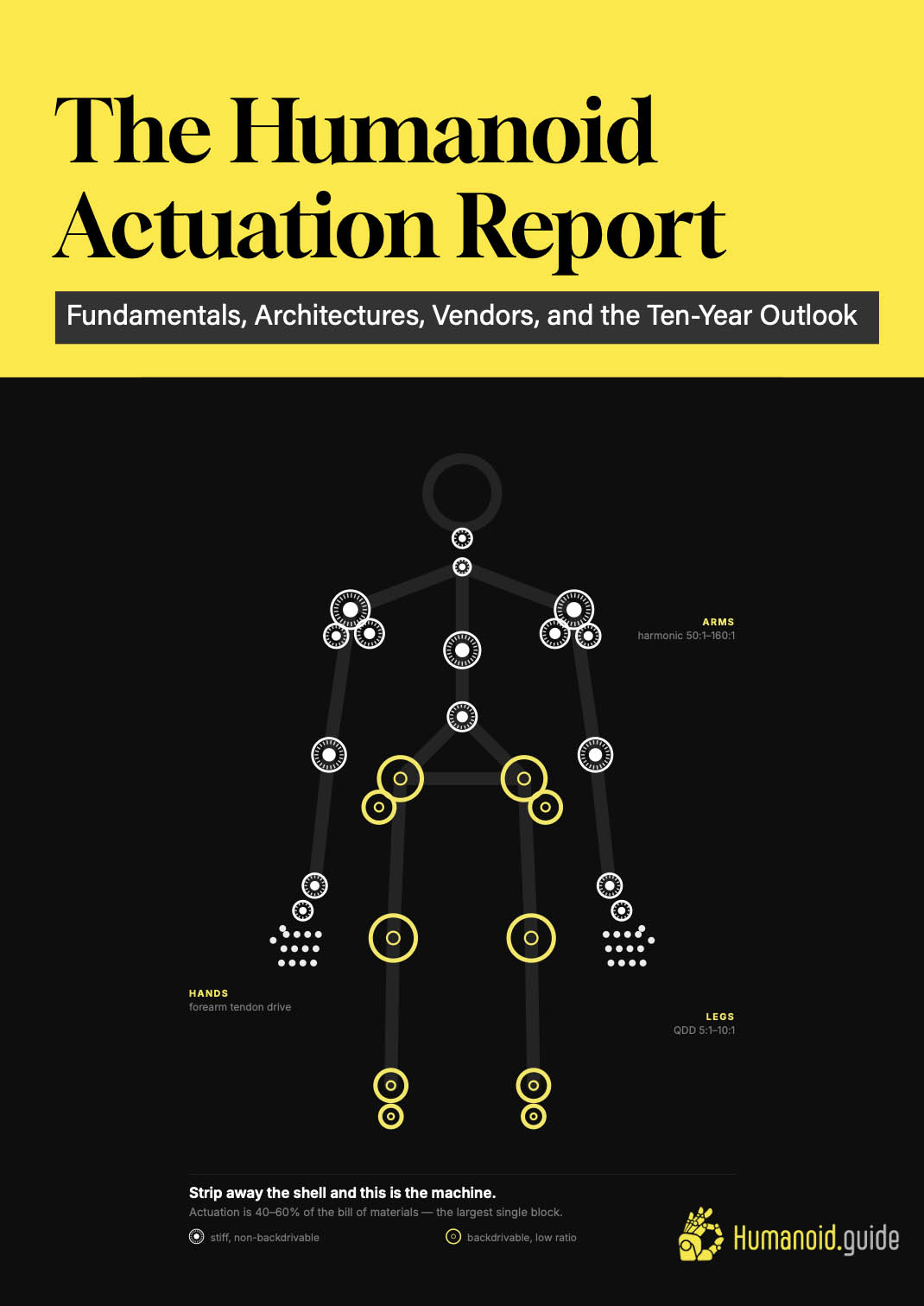
A humanoid robot is, mechanically, a collection of actuators with a computer attached. Between 28 and 44 of them decide what the machine can lift, how long it runs and what it costs to build – and they carry 40 to 60 per cent of the bill of materials. This 249-page report takes the joint apart layer by layer: the physics, the five competing transmission architectures, the vendors behind every major platform, and the five cost curves that gate adoption to 2036.
frontpage_report.jpg vises når du åpner fila lokalt
How the report is built
Six layers decide what a joint costs
Every humanoid joint is the same stack of components in a different order of priority. The report is organised the same way – each layer gets the chapter it deserves, with the vendors who supply it and the price curve it is on.
Motor
The scaling laws that set torque density – and the one specification the industry markets hardest that measures something else entirely.
Ch. 2–3
Transmission
Strain-wave, planetary, cycloidal and quasi-direct drive are all co-dominant. What converged was a map of the body, not a ranking.
Ch. 4
Linear screw
Planetary roller screws own the payload leg – and one grinding operation decides who is allowed to supply them at all.
Ch. 5
Bearings
Bearing count is an architectural invariant, not a design variable. One row in the table is the leading indicator for when the rest tips.
Ch. 7
Encoders & torque sensing
Force sensing has split into two economies – one you buy for $1,000 a joint, one you get for nothing. Your gearbox chose for you.
Ch. 7
Drive electronics
Module torque density flattened, so the contest moved one layer down – into the power stage feeding the winding.
Ch. 8
Yellow layers mark where the report finds the supply position most concentrated – the two chokepoints where a single manufacturing capability, not a patent, decides who can supply.
The organising claim
The industry split into two actuation species
Not one winner and one loser – two physically distinct answers that each own the body zones where their physics is superior. The report names the single zone where the contest is still genuinely open, and the one place both camps have already converged on the same answer.
Species A
Rotary
Frameless torque motor into a strain-wave, planetary or cycloidal reducer. Compact, backdrivable at low ratios, and the default everywhere torque matters more than raw force. Its transmission patents expired – and what replaced the legal moat is not cheap labour.
Owns: arms, shoulders, wrists, most of the torso
Species B
Linear
Motor driving a planetary roller screw, pushing kilonewtons through a short stroke. Superior where load is brutal and stroke is short – at the price of three structural costs, including a sensor bill that cannot be engineered away.
Owns: knees, ankles and the payload-oriented leg
Table of contents
Executive summary, 15 chapters and an appendix
Every chapter is built the same way: the mechanism first, the evidence second, and an explicit note wherever the sources genuinely disagree.
00
Executive SummaryThe whole argument in one sitting, closing with ten canonical figures, each with its confidence tier and source.
01
The Humanoid Actuation ProblemWhy actuation decides the machine, the 2025 shipment base, and the evidence rules the report holds itself to.
02
Electric Motor FundamentalsThe electromagnetic scaling laws behind every visible design choice – and fifteen real motors benchmarked under one convention.
03
Emerging Topologies & ThermalAxial-flux, coreless hand motors, and the unglamorous constraint that is the cheapest performance multiplier left.
04
Rotary Gearing TechnologiesHarmonic, planetary, cycloidal and quasi-direct drive across eleven axes, verified against sixteen platforms.
05
Linear ActuationPlanetary roller screws, the hardest manufacturing operation in the chain, and a market estimate reconciled across an order of magnitude.
06
Alternative ParadigmsTendon, series elastic, hydraulic and pneumatic – which residual niches are worth entering and which are closed.
07
Bearings, Encoders, Torque SensingA hundred line items nobody discusses, two of them at the sharpest points of the bottleneck.
08
Drivers, Controllers, Power ElectronicsA transition compressed into eighteen months, and the specification most robot datasheets never mention.
09
Dexterous Hand ActuationThe architecture fork, the component that decides the hand cost curve to 2030, and the metric being padded vendor by vendor.
10
Tesla Optimus Deep DiveThe 14+14 architecture reconstructed from primary sources, with the arithmetic on the target price everyone quotes.
11
Western Humanoid OEMsFigure, Boston Dynamics, Apptronik, Agility, Sanctuary, 1X – and how little of the joint record is actually public.
12
Chinese Humanoid OEMsUnitree, Agibot, UBTECH, Fourier, Kepler, EngineAI, and the merchant module layer that is the real moat.
13
The Component Vendor LandscapeFour supply blocks scored on utilisation and margin direction, with three corrections to claims circulating widely.
14
Market Sizing & BOM EconomicsThe same robot under two price decks, and the five cost curves that decide everything else.
15
Ten-Year Outlook 2026–2036Predictions by mechanism, each with a dated trigger indicator that would falsify it.
A
Appendix51-term glossary, four master tables, a 75-supplier directory and 30 canonical numbers with confidence tiers.
Inside the report
24 figures, 49 tables, one evidence convention
Filled markers are measured or published. Open markers, hatching and dashed rules mark anything constructed, forecast or calculated by us. You can always see which is which without reading a footnote.
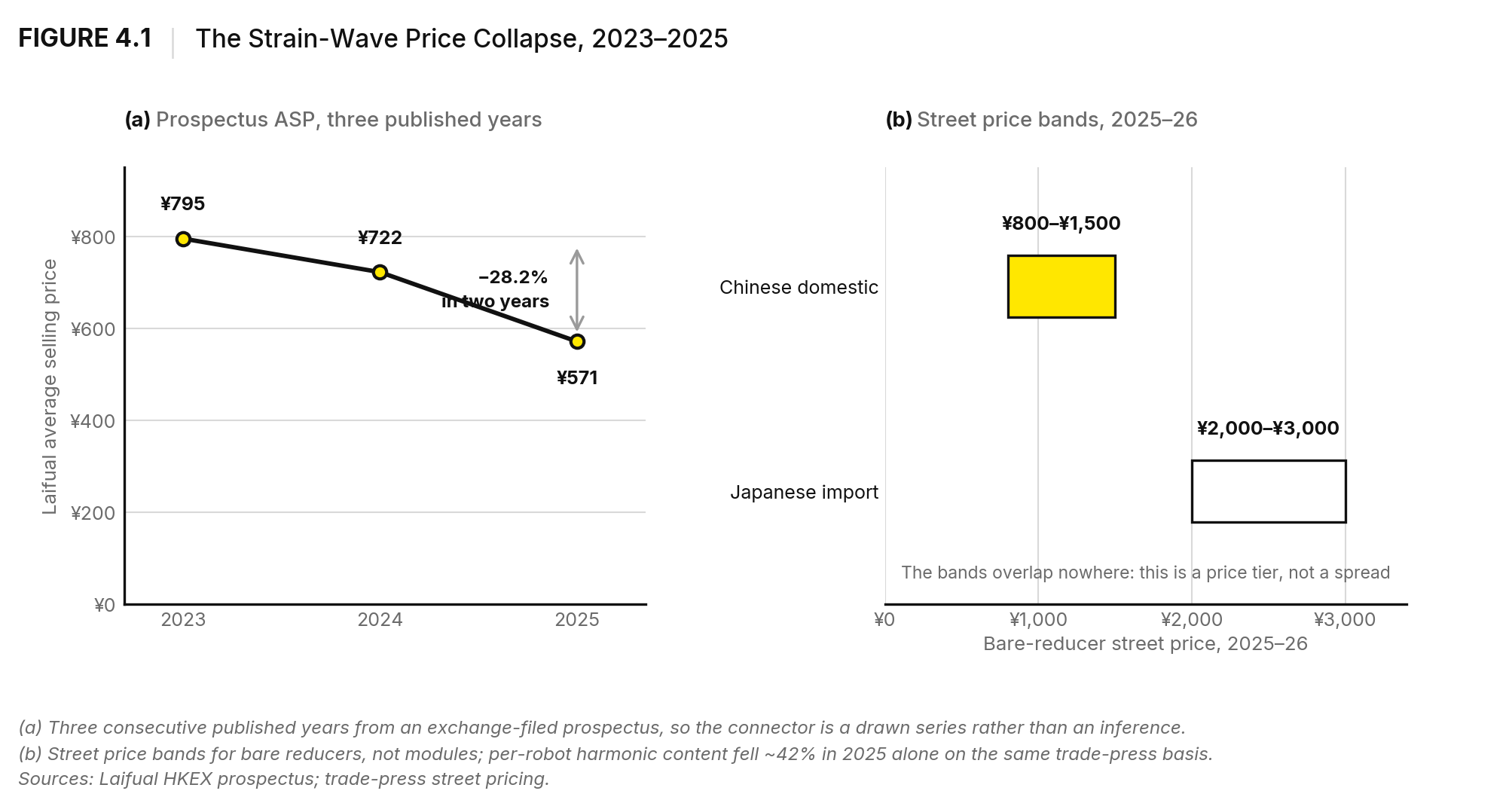
Figure 4.1 · Rotary gearingStrain-wave reducer prices collapsing, 2023–2025: one vendor’s own prospectus against imported Japanese and domestic Chinese street prices.
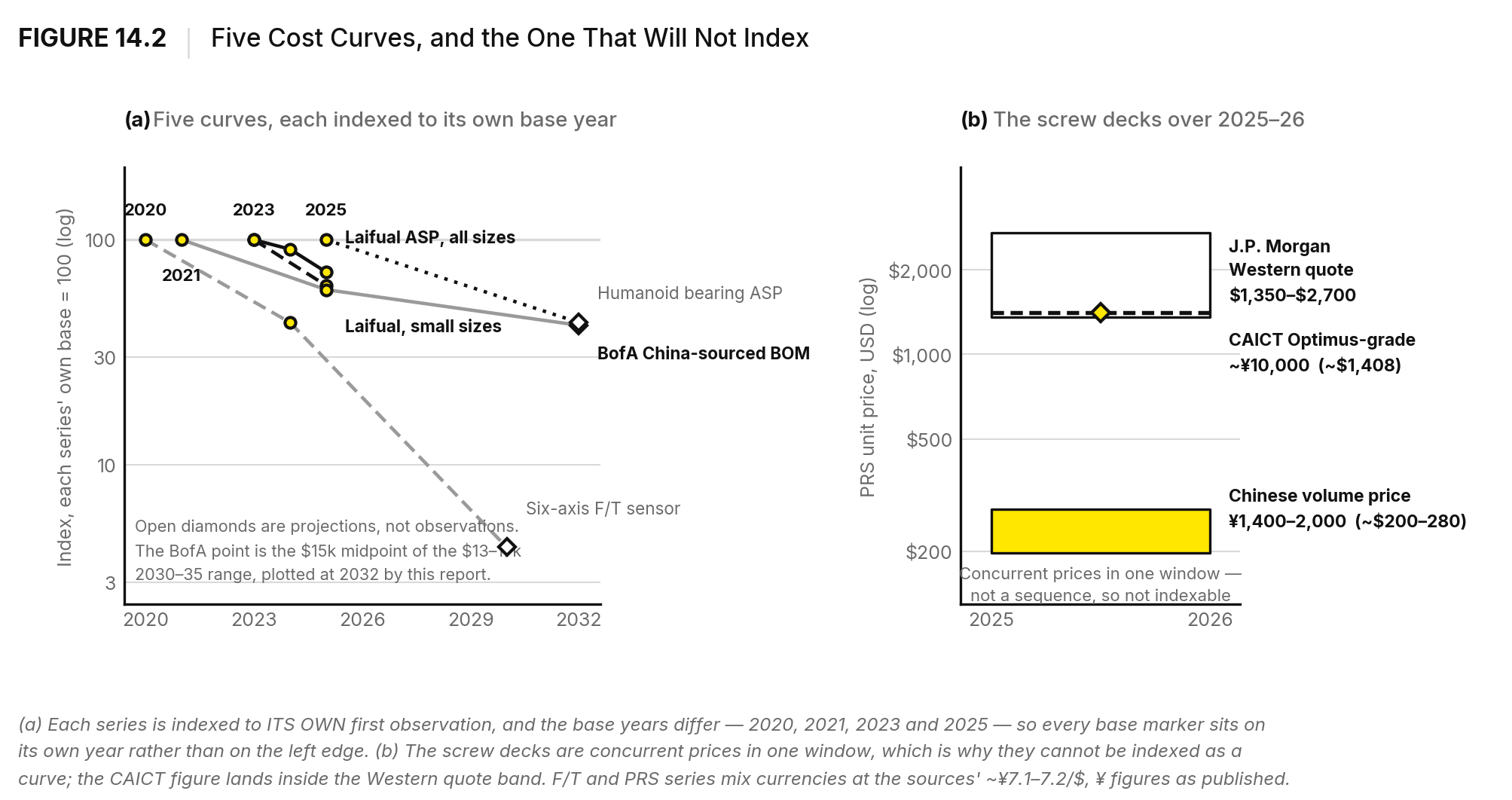
Figure 14.2 · Cost curvesThe five component price curves that gate adoption, indexed on a log scale — reducers, bearings, force sensors and whole-robot BOM.
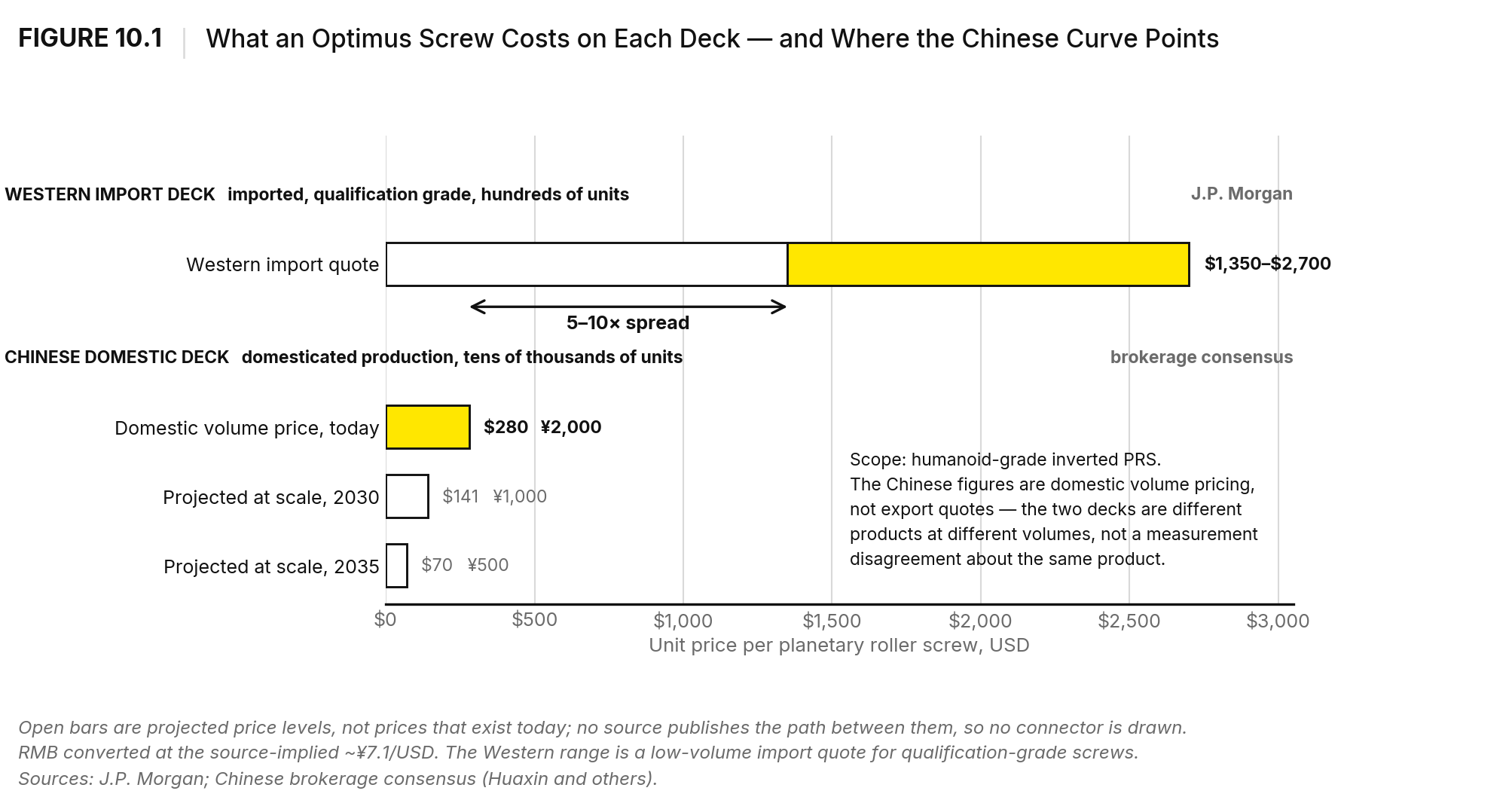
Figure 10.1 · Linear actuationPlanetary roller screw pricing: the Western import deck against Chinese street prices, and the path brokers project between them.
Get the free preview
A 37-page preview: what every chapter covers, which questions it settles, and how many tables and figures it carries. No sales call – just the PDF, and a short note by email when the report updates.
Single user for individual engineers, analysts and consultants. Enterprise for engineering organisations, procurement teams and investors who need it across the firm.
Single user licence terms · Enterprise licence terms — By purchasing, you agree to the terms of the licence you select. Questions? human@humanoid.guide
By purchasing, you agree to the terms of the license you select. Questions? human@humanoid.guide
Questions
Before you buy
How many actuators does a humanoid robot have?
Between 28 and 44 in a full-size platform, depending on how many degrees of freedom the design gives the hands and the waist. The hands push the count up fastest: the report tracks designs moving from a handful of motors per hand toward four times that, and explains which component decides whether that is affordable.
What share of a humanoid robot’s cost is actuation?
Between 40 and 60 per cent of the bill of materials — the largest single block, ahead of compute, sensing and structure. The spread is wide because published estimates draw the boundary in different places; chapter 1 shows why five sources that appear to disagree are measuring the same thing at different boundaries.
Rotary or linear — which does a humanoid leg use?
Both, depending on the platform. Rotary drivetrains own the arms and torso; planetary roller screws own the payload-oriented leg. Chapter 4 maps which architecture each of thirty platforms uses, and names the one body zone where the contest is still genuinely open.
Who is this report for?
Engineers specifying or sourcing joints, component vendors deciding where to place capacity, OEM procurement teams qualifying suppliers, and investors doing diligence on the actuation supply base. It assumes you can read a torque figure – but it defines every convention it uses, so you do not need a motor design background.
How is this different from your Supply Chain and Market reports?
The Supply Chain report maps who supplies what across the whole robot. The Market report sizes demand. This one goes down one subsystem – actuation – and stays there for 249 pages: the physics, the architectures, the component vendors and the cost curves. They are complementary, and the chapters cross-reference where they meet.
Where do the numbers come from?
625 indexed sources, primary-first: filings, prospectuses, patents, datasheets and teardowns before press summaries. Every figure carries a confidence tier. Where credible sources genuinely disagree, both are reported rather than editorially resolved – and the appendix states which market-circulating claims the report refused to publish, and why.
Do I get updates?
Yes. Free updates throughout the 2026 cycle, delivered to the email you purchase with. Chapters 13 and 14 in particular track fast-moving supplier financials.
Can I see a sample first?
Yes – the free preview above is a 37-page chapter-by-chapter walkthrough of what the report covers. If you need a specific table or figure to evaluate it against an internal question, write to human@humanoid.guide and ask.
Do you do custom research?
Yes – supplier deep dives, architecture benchmarking and internal briefings. Write to human@humanoid.guide with what you need to decide.
The AI is not the bottleneck. The joint is.
Component cost curves, not robot announcements, are the primary adoption variable. This is the report that reads them.
198 pages of exclusive insight from global robotics experts — uncover funding trends, technology challenges, leading manufacturers, supply chain shifts, and surveys and forecasts on future humanoid applications.
Featuring insights fromAaron Saunders, Former CTO ofBoston Dynamics, now Google DeepMind