Unitree G1 Humanoids Perform Live Laparoscopic Surgery
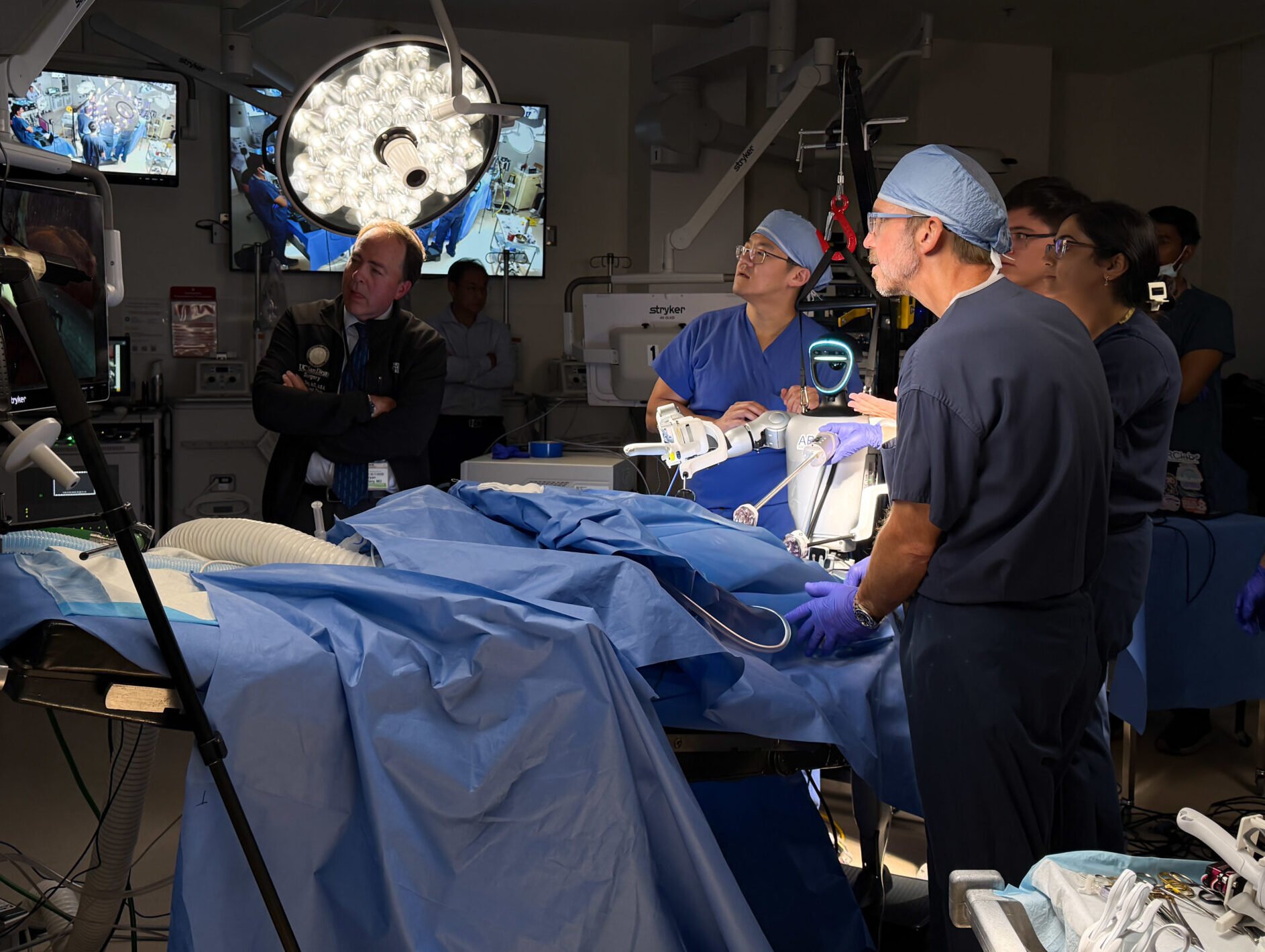
Surgeons and engineers at the University of California, San Diego have demonstrated two teleoperated Unitree G1 humanoid robots performing live laparoscopic gallbladder removal surgeries on large mammals that were not primates, according to Thomasnet. The report, citing UC San Diego, describes the work as a world first for live surgery using teleoperated humanoids.
The surgeries were not performed on human patients, which keeps the result in the preclinical category. Even so, the demonstration is unusually concrete for humanoid robotics: two full body platforms using standard surgical tools in a live operating setting, rather than a staged manipulation task on a bench.
Key facts
- Robots used: Two teleoperated Unitree G1 humanoids
- Procedure: Live laparoscopic gallbladder removal on large mammals that were not primates
- Robot size: 5 ft tall and 60 lb
- Comparison cited: Specialized robotic surgery systems such as da Vinci weigh 1,800 lb
Humanoids handled standard laparoscopic tools
The G1 robots, nicknamed “Surgie,” were fitted with specially designed adapters and standard laparoscopic instruments. Thomasnet reports that the systems retracted tissue, dissected delicate anatomy, clipped structures, and removed the gallbladder while being guided remotely by UC San Diego surgeons.
The setup is a different proposition from purpose built surgical robot platforms. Instead of a large fixed surgical system with multiple robotic arms and proprietary hardware, the customized humanoids were positioned as compact mobile machines that can work with instruments already found in hospitals.
The source also identifies real technical limits. The robots had to be recalibrated multiple times to maintain accurate positioning, and latency introduced a slight delay between the surgeon’s hand movements and the robot response. For surgery, those are not minor engineering details. They go directly to precision, predictability, and the operator’s ability to control tissue interaction safely.
A smaller footprint, but a long validation path
Thomasnet contrasts the 5 ft, 60 lb Unitree G1 humanoid configuration with specialized systems such as da Vinci, which it says weigh 1,800 lb, cost a fortune, require multiple robotic arms, use proprietary hardware, and need large support teams. The argument for humanoids in this setting is not that they are better surgical robots today. It is that their form factor could reduce installation burden in operating rooms that cannot accommodate large capital equipment.
UC San Diego’s stated primary use case is minimally invasive surgery in hospitals. The same versatility is also being framed for isolated rural communities, disaster response, military battlefields, and medical search and rescue. Those settings remain prospective based on the report. The evidence presented so far is a live animal surgery demonstration, with meaningful operator control issues still visible.
For humanoid robotics, the work is a credible extension of teleoperation into a domain with unusually high precision requirements. The next question is whether the calibration and latency problems can be reduced enough for repeatable performance under surgical constraints.
Source: thomasnet.com