Welcome, Robotera M7!
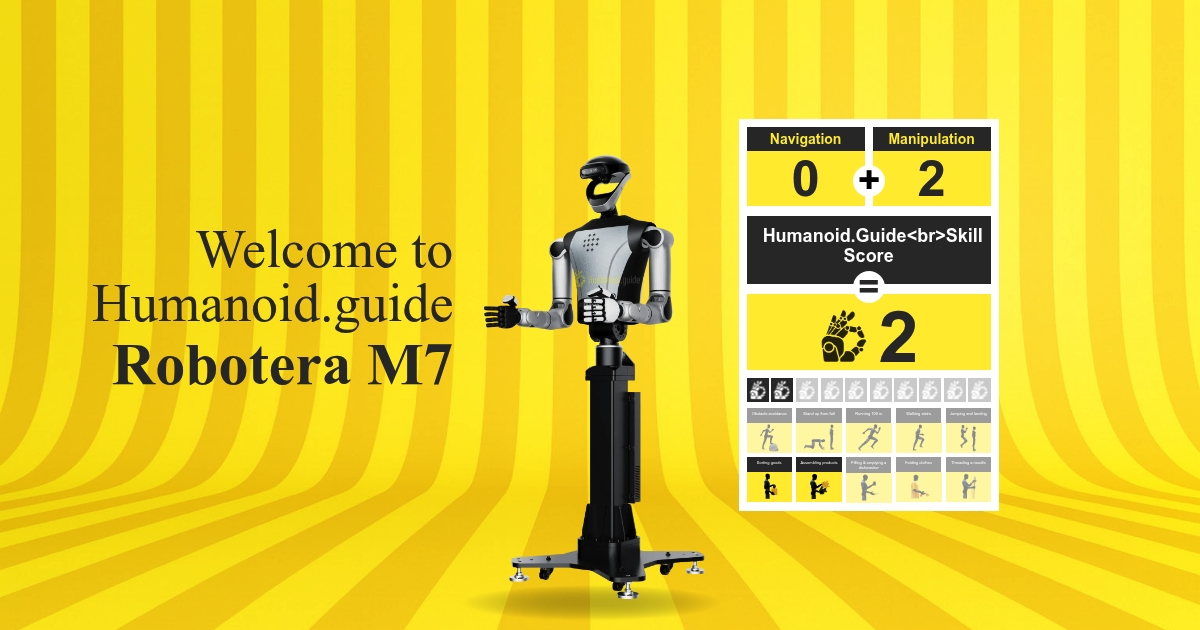
Robotera M7 is an upper body humanoid robot designed for embodied AI research, teleoperation, and dexterous manipulation in laboratory and industrial settings. Rather than pursuing full body locomotion, it concentrates on arm and hand performance, giving developers a compact platform for interaction, data collection, and controlled task execution. The robot stands 119 centimeters tall, weighs 43 kilograms, and integrates 43 degrees of freedom across its body, including 24 in the hands, with 10 fingers for two handed work. Its structure uses aluminum alloy and engineering composites, and its actuation combines electric servo drives with harmonic reducers and precision robotic joints. Stereo RGB vision supports perception, while Ethernet, USB, and WiFi provide connectivity. The software environment is built on Linux and ROS, and it is compatible with Robotera embodied AI and VLA models. With a Humanoid Guide score of 2, the M7 sits in an early stage capability tier overall. Its navigation rating is 0 out of 5, while its manipulation rating is 2 out of 5, reflecting a platform centered on upper body experimentation rather than mobile autonomy.
In practical deployments, the M7 is best aligned with manipulation focused workflows such as sorting goods and assembling products. Its stereo vision, dexterous hands, and teleoperation support allow operators and researchers to train grasping, handoff, and object placement routines with close control over motion quality. The combination of 24 hand degrees of freedom, humanlike arm geometry, and a Linux and ROS software stack also makes it useful for collecting training data for embodied AI systems that must learn structured industrial actions. LLM compatibility extends its value for higher level task planning and instruction following, helping teams connect language driven commands with physical execution during sorting and assembly studies in research labs, pilot production cells, and robotics development programs.
Robotera lists the M7 as in production, with a quoted price of 100000 USD, positioning it as a commercial research and development platform rather than a conceptual prototype. Built in China and aimed at AI development, logistics, manufacturing, and research, it reflects a broader shift in humanoid robotics toward specialized systems that prioritize useful upper body work before tackling full locomotion. That focus gives universities, industrial developers, and automation teams a practical route into teleoperation, perception, and robot learning without the added overhead of a walking machine. Its human safe design and compatibility with modern embodied AI software also make it relevant for organizations building the next generation of interactive robotic applications.