IEEE Humanoids 2026 puts factory labor at center of agenda
The IEEE-RAS International Conference on Humanoid Robots has closed paper submissions for its 25th edition, setting up a December 6 to 9 program in Santa Clara focused on “Humanoids and the Future of Work,” according to Tech Times.
That theme is a pointed choice for a research meeting that has long centered on walking, balance, manipulation and whole body control. This year’s agenda puts labor conditions, safety certification and economic impact alongside the technical program, reflecting the fact that humanoid systems are now being discussed as operational factory and logistics equipment, not only as research platforms.
Key facts
- Conference: 25th IEEE-RAS International Conference on Humanoid Robots
- Dates: December 6 to 9, 2026
- Venue: Santa Clara Convention Center in Santa Clara, California
- Theme: Humanoids and the Future of Work
- Expected attendance: More than 1,200 attendees from over 70 countries
- Paper submissions: More than 200, with acceptance decisions due October 6
Commercial deployments frame the research agenda
Tech Times points to several commercial humanoid programs that will shape the conversation around IEEE Humanoids 2026. Boston Dynamics shipped its first commercial Atlas units to Hyundai’s Robotics Metaplant Application Center and Google DeepMind in 2026, according to the article. Figure AI deployed 40 Figure 03 units at BMW’s Spartanburg plant after an 11 month Figure 02 pilot that supported production of more than 30,000 BMW X3 vehicles.
Agility Robotics’ Digit is also cited as working commercial shifts at Toyota Motor Manufacturing Canada and at a GXO Logistics warehouse in Flowery Branch, Georgia. Apptronik, meanwhile, opened Robot Park in Austin, a nearly 90,000 square foot facility where Apollo 2 robots perform production tasks to generate training data under a research partnership with Google DeepMind.
The conference’s special topic chairs, Gary Bolles and Nell Watson, are expected to shape programming around deployment governance, worker impact and certification questions. For operators, that is the part of the program likely to be as relevant as the papers themselves. The technical barriers are still substantial, but the harder procurement questions now include liability, data rights, task allocation and how much autonomy is acceptable on a live floor.
Loco-manipulation gets a public benchmark
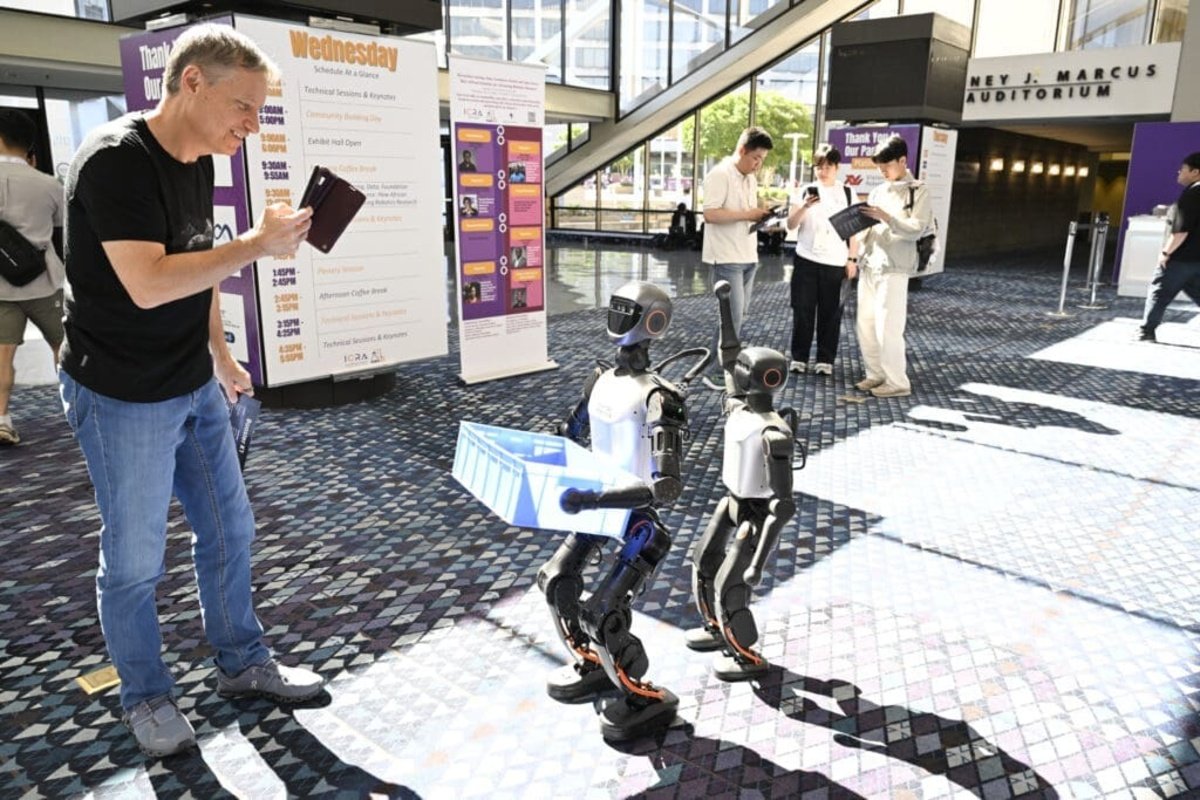
The Loco-Manipulation Challenge is likely to be one of the most closely watched parts of IEEE Humanoids 2026. The event will bring 10 to 15 teams through a task circuit covering mobility, manipulation and dexterity, and reasoning.
Loco-manipulation is the combined control problem that sits between impressive demos and useful industrial work. A humanoid has to walk through a real environment, handle objects, keep balance as loads change, and adapt to contact conditions that rarely match simulation. The source describes the core barrier as whole body control, with robots coordinating gait and arm motion through a unified policy rather than treating walking and grasping as separate steps.
The competition is also designed to compare academic robots and commercial humanoid platforms on the same tasks. Scoring will reward autonomy while still granting points for teleoperated performance, an acknowledgement that partial autonomy remains commercially useful and that the field still needs clearer public measurements of where autonomy breaks down.
VLA models move into the conference conversation
The article also gives substantial attention to vision language action models, or VLA models, as a driver of current humanoid development. In this framing, the robot uses visual input and language instructions to generate actions, rather than relying only on narrow controllers written for a specific operation.
Figure AI’s Helix model is described as a VLA architecture running on Figure 03. Google DeepMind’s Gemini Robotics models are being paired with Boston Dynamics Atlas hardware, while Apptronik’s Robot Park is intended to feed real production task data back into model training. The practical implication is that humanoid vendors are competing over both hardware and robot training data, since useful generalization depends on exposure to varied physical tasks.
The paper program spans biomechanics, actuators, dexterous hands, model predictive control, reinforcement learning, humanoid faces, benchmarks and ethical challenges of deployment. Workshop and tutorial proposals, competition team proposals, and supplementary videos for accepted paper submissions are due August 3. Early registration closes October 16, with camera ready papers due October 26.
Source: techtimes.com