Georgia Tech humanoid handles rough terrain with faster training
Georgia Tech researchers have tested a machine learning controller that let a full size humanoid robot walk over sand, gravel, soggy grass, slopes, stairs and slippery indoor surfaces using a faster reinforcement learning recipe, according to Interesting Engineering.
The work was presented at the IEEE International Conference on Robotics and Automation and centers on a framework called Learn to Teach. Instead of training a teacher model first and then using it to train a student model, the Georgia Tech humanoid project trains both at the same time.
Concurrent training for humanoid locomotion
In the conventional teacher and student reinforcement learning setup described by the researchers, the teacher has access to detailed simulation data and is trained before passing its policy to the student, which controls the real robot. Lead researcher Feiyang Wu said that sequence takes too long and leaves useful teacher data underused.
“You don’t have to wait for the teacher to be an expert for it to begin teaching the student,”Feiyang Wu, lead researcher
In Learn to Teach, the teacher begins transferring knowledge as it learns. The team also allowed the teacher to learn from the student’s experiences, a design choice meant to reduce the teacher and student imitation gap that appears when the student encounters conditions outside the teacher’s idealized simulation.
The source does not provide training time, GPU counts or a quantified cost reduction, so the compute claim remains directional rather than benchmarked. The core technical point is still clear: the researchers are trying to reduce the sequential overhead in sim to real locomotion training while preserving robustness on unfamiliar terrain.
One controller across mixed surfaces
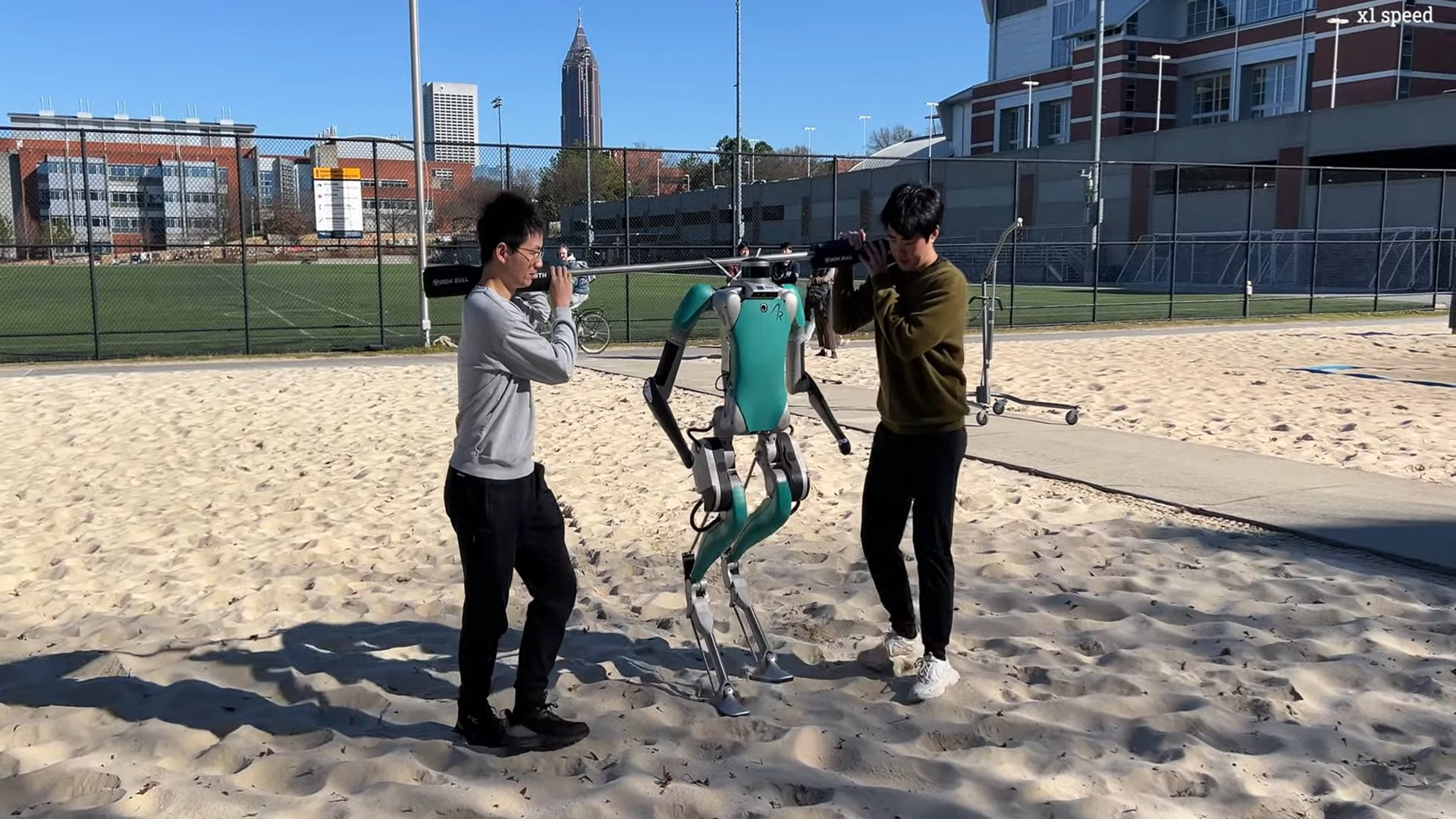
The controller was deployed in the lab of Associate Professor Ye Zhao on a full size humanoid robot. The article does not identify the robot model or manufacturer, but says the platform is bulky and very tall.
During tests, the same controller handled outdoor rough terrain and slippery indoor surfaces without requiring separate controllers for each environment. The team also pushed and pulled the robot, and it adjusted its gait to stay stable.
Zhao said the controller outperformed the software supplied by the robot’s manufacturer. That is a useful comparison if reproduced under controlled conditions, though the source does not describe the manufacturer controller, test protocol or metrics behind the comparison.
The researchers say Learn to Teach could be adapted beyond humanoid walking to other robots and tasks that require reliable motion in unpredictable environments.
Source: interestingengineering.com