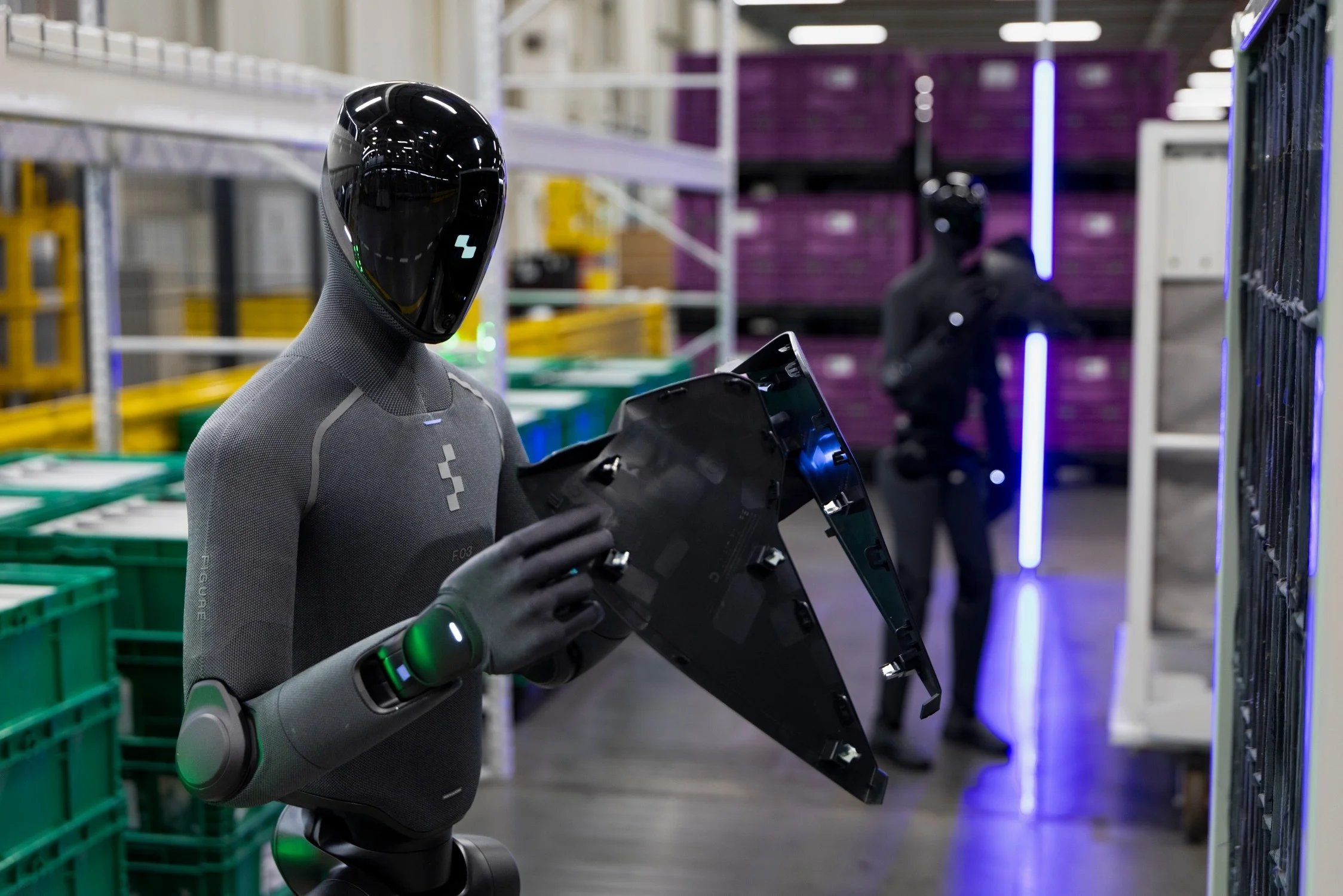
BMW deploys Figure 03 humanoid for Spartanburg logistics
BMW Group is deploying Figure AI’s Figure 03 humanoid robot for logistics sequencing at Plant Spartanburg in South Carolina, according to AI Insider. The robot will sort unsorted components into sequencing trolleys for delivery to assembly operations, following an earlier Figure 02 body shop pilot at the same plant.
The assignment is more operationally specific than many humanoid announcements. Parts arrive in larger containers in an unsorted state, BMW said, and Figure 03 will pick components and place them into a trolley in the order required for vehicle assembly. The trolley then goes to a collection point before an automated tugger train or Smart Transport Robot carries the parts to the installation area.
“Plant Spartanburg is the birthplace of humanoid robotics in BMW Manufacturing’s operational day-to-day activities. Having already successfully completed a pilot with Figure 02 in our body shop, we are now looking forward to deploying Figure 03 for a sequencing use case in logistics,”Ulrich Wieland, vice president of production control and logistics for BMW Manufacturing
A sequence logistics task with scale potential
BMW describes the process as a just in sequence logistics application, where components arrive at the line in the order needed for a specific vehicle build. The company said the process is common in automotive production logistics and could offer room for further development and scaling.
The earlier use case was in the body shop, where Figure 02 inserted sheet metal parts for welding. BMW said that task was repetitive and physically demanding, with requirements for speed and accuracy under real production conditions. The new logistics work gives Figure a different class of problem: varied part handling tied to production flow rather than a fixed body shop loading station.
What BMW says changed with Figure 03
BMW said Figure 03 adds soft components intended to improve safety, wireless charging to support higher availability, audio functions for speech-to-speech communication, and improved hands with tactile sensors and palm cameras. The company did not give payload, cycle rate, robot count, commercial terms, or a deployment schedule for the new logistics operation in the report.
Figure AI said the prior Spartanburg deployment produced hardware and reliability lessons that were carried into Figure 03. Figure 02 recorded minimal hardware failures, according to the company, but its forearm was the top failure point because of tight packaging, dexterity demands, and thermal constraints. For Figure 03, Figure redesigned the wrist electronics to remove a distribution board and dynamic cabling, allowing each wrist motor controller to communicate directly with the main computer.
Figure 02 pilot data reported by Figure AI
- Program length: 11 month deployment at BMW Group Plant Spartanburg.
- Production context: supported production of more than 30,000 BMW X3 vehicles.
- Runtime: more than 1,250 hours.
- Parts handled: more than 90,000 parts loaded.
- Work pattern: shifts of 10 hours, Monday through Friday, running every working day.
- Task target: cycle time of 84 seconds, load time of 37 seconds, more than 99% successful placement per shift, and a target of zero human interventions.
The Figure 03 project sits inside BMW’s iFACTORY program at Plant Spartanburg, including the expanded Hall 52 where BMW X3 variants are assembled and where the electrified BMW iX5 is planned to be built. BMW said it uses virtual 3D simulations for production planning and process optimization, including simulations of human movement sequences for ergonomics and manual process design.
AI Insider also reported that BMW is deploying humanoid robots at its Leipzig plant in Germany as part of a European pilot focused on Physical AI in vehicle production. For Figure, the Spartanburg logistics project gives the Figure 03 humanoid a defined factory task to test against production requirements rather than a generic demonstration brief.
Source: theaiinsider.tech