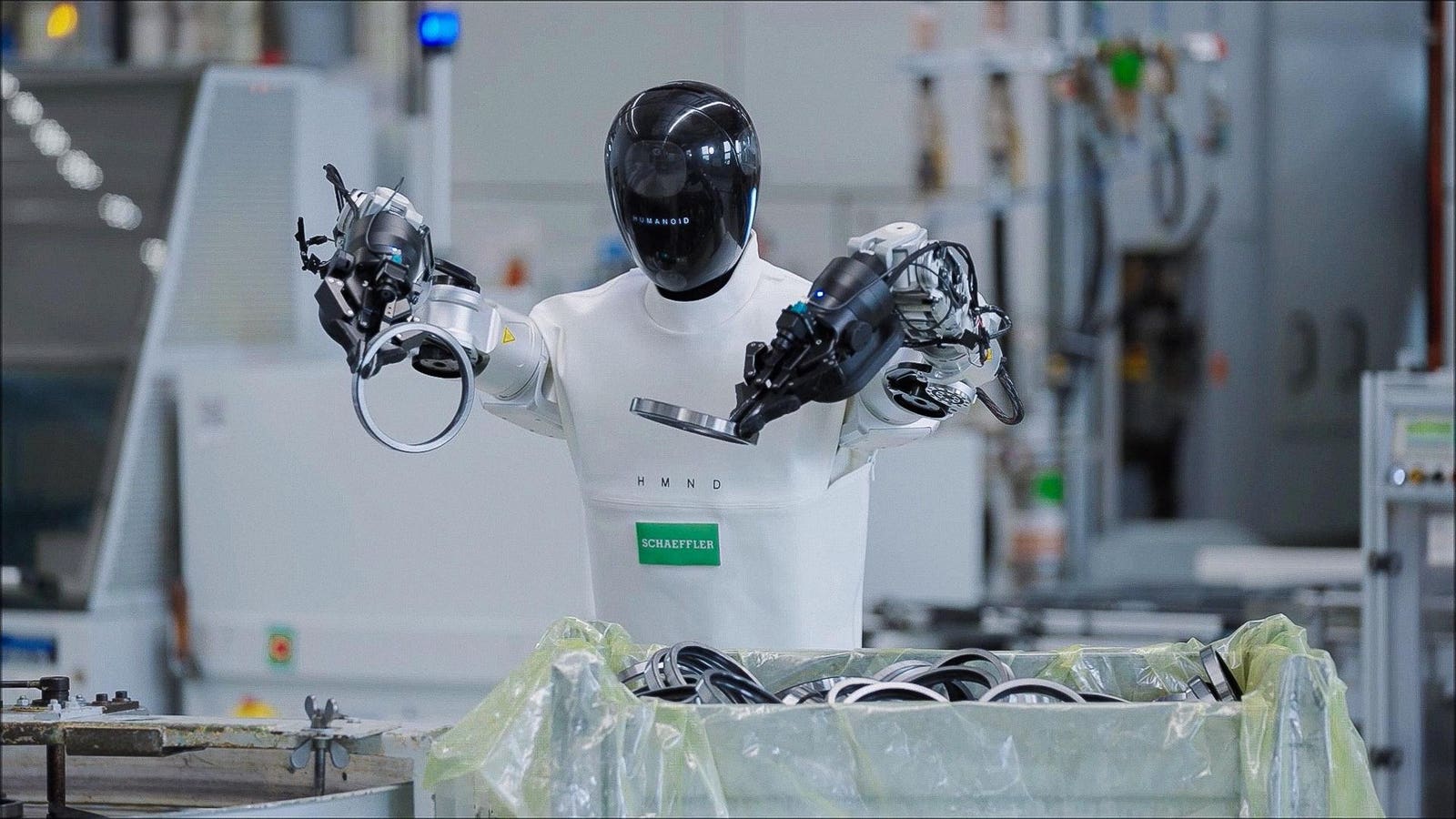
Humanoid expands Schaeffler humanoid deployment to 1,000 robots
Humanoid’s Schaeffler humanoid deployment has expanded from a previously announced plan for several hundred units to at least 1,000 wheeled robots for live manufacturing operations in Germany. The agreement, reported by Forbes on May 13, is one of the largest disclosed industrial humanoid rollouts so far and pairs factory deployment with a long-term actuator supply pact that could point to much higher production volumes across Humanoid’s wider customer base.
How the Schaeffler humanoid deployment is structured
The updated agreement covers what the companies describe as a four-digit number of humanoid robots, with the full rollout window extending to 2032. Four months earlier, the two sides had said they planned to place several hundred humanoids into Schaeffler factories over the next five to six years, so the new commitment marks a clear increase in scale.
Phase one runs from December 2026 through June 2027 across two German sites. At Herzogenaurach, Humanoid will focus on box handling in a live production environment, while the Schweinfurt site starts with a three month capability demonstration and integration test, followed by three months of on-site validation aimed at stable, continuous operation near full production scale.
The commercial model is structured as Robot-as-a-Service. Under that arrangement, Humanoid is responsible not only for the robots themselves but also for fleet management software, maintenance, 24/7 support, and ongoing performance management.
Why the actuator agreement matters
The deployment contract is only part of the story. As Forbes reports, Schaeffler will also become Humanoid’s preferred supplier for more than 50% of the startup’s demand for joint actuators on its wheeled platforms through 2031, with the partnership expected to translate into a seven-digit number of actuators.
That figure is what led Forbes to infer a much larger shipment plan than the Schaeffler rollout alone. Based on the HMND 01 Alpha’s configuration, the article estimates that Schaeffler-relevant joint actuators could number roughly 18 to 22 per wheeled robot, implying that a million-plus actuators at 50% supply coverage could correspond to around 100,000 robots over five years. That is an analytical estimate, not a unit target directly stated by Humanoid or Schaeffler.
The supply arrangement also reinforces a point that is becoming more visible across industrial deployments: the Schaeffler program is focused entirely on wheeled humanoids. Humanoid’s HMND 01 Alpha is a 220 cm wheeled industrial platform with close to 30 active degrees of freedom, excluding end effectors, and Schaeffler has signaled that flat factory floors reduce the need for legs in many production tasks.
What it says about industrial humanoid demand
The agreement gives Schaeffler a dual role in the market, both as an adopter of humanoid systems and as a component supplier to the companies building them. According to the source text, Schaeffler CEO Klaus Rosenfeld recently said the company is engaged with roughly 45 humanoid robotics players worldwide and expects its humanoid robotics division to build an order book in the hundreds of millions of euros by 2030.
Schaeffler’s broader activity suggests that this is not an isolated bet on one vendor. The article notes that the company is already committed to buying at least 1,000 humanoid robots from Hexagon Robotics under an April 2026 deal, and has a separate partnership with Neura Robotics that could extend to 4,000 to 6,000 of Neura’s 4NE1 models.
For Humanoid, the Schaeffler contract is also a credibility test. The company, legally SKL Robotics Ltd., was founded in 2024, unveiled the HMND 01 Alpha in September 2025, and is operating on $50 million in founder-led capital with roughly 200 engineers across London, Boston, and Vancouver. Moving from proof of concept to stable production work at Schaeffler’s sites will provide a clearer measure of whether its platform can sustain industrial uptime, not just demonstrate task completion.
The next milestones are operational rather than promotional: box handling in live factory conditions, continuous performance across two German plants, and evidence that the service model can support larger fleets. If those steps succeed, the industry discussion is likely to move beyond pilot counts toward supply chain capacity, actuator availability, and how quickly wheeled humanoids can be integrated into routine manufacturing workflows.
Source: forbes.com