Zhejiang Humanoid lands 2,000 garment humanoid robots order
Zhejiang Humanoid Robotics Innovation Center said on May 12 that it has signed a strategic partnership with Jack Technology and an order for 2,000 garment humanoid robots customized for garment manufacturing. According to Gasgoo, the company described the deal as the first mass deployment of humanoid robots in the global apparel industry. The announcement matters because garment handling combines flexible materials, tight tolerances, and repetitive production steps that have been difficult to automate with general purpose humanoids.
Garment humanoid robots face a hard manufacturing test
The source article frames apparel production as a demanding proving ground for embodied AI systems. Fabrics vary in material and shape, and they can wrinkle, shift, and deform during handling. Zhejiang Humanoid said alignment deviations for cut pieces such as collars and pockets must be kept within plus or minus 2 mm, while cutting and sewing tasks require motion precision of 0.3 to 0.5 mm.
Those constraints help explain why garment production has remained a difficult target for advanced automation. Unlike fixed parts in structured industrial cells, fabric requires continuous perception and adjustment during manipulation. That makes the reported order notable not just for its size, but for the type of work it is aimed at performing.
NAVIAI development for garment production
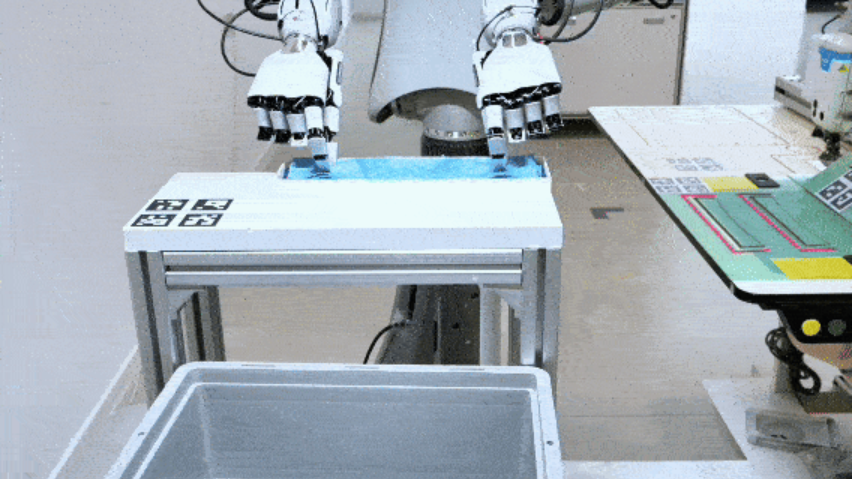
Zhejiang Humanoid said it began specialized research and development for its NAVIAI humanoid robot in September 2024, focusing on core template machine processes along garment production lines. By July 2025, the company said its template machine operation scheme had passed proof of concept validation. As Gasgoo reports, that covered a full workflow including opening and closing templates, manipulating fabric, stacking, and unloading.
The company attributed that result to its in house hardware and software stack and to a proprietary sensing and control system for embodied intelligence. In the article, Zhejiang Humanoid said the system delivers precise perception and fine manipulation during fabric handling, with a flexible fabric separation success rate that exceeds the industry average. That performance claim is presented by the company, and the source does not provide a comparative benchmark or third party validation.
Teleoperation and training data strategy
One of the more important details in the report is the use of remote teleoperation for data collection. Zhejiang Humanoid said this has created a full chain pathway for long term data accumulation in garment manufacturing scenarios. For humanoid developers, that matters because deformable materials are difficult to model in advance, and learning from repeated real world operations is often central to improving manipulation performance.
The company also said targeted training methods allow NAVIAI to handle fabrics of different sizes and materials, ranging from polo shirts to denim. In the reported results, the robot completes single step operations in under 10 seconds and maintains stacking alignment accuracy of less than 2 mm across multiple fabric layers. Those figures point to an effort to move beyond isolated demos toward repeatable cycle times and tolerances that can be measured on a production line.
What the 2,000 unit order signals
The reported deal stands out because it ties humanoid deployment to a specific industrial workflow rather than a general narrative about future labor automation. If the rollout proceeds at the stated scale, it would place humanoids in a manufacturing environment where material variability is the norm and precision errors can quickly affect downstream quality. That is a more demanding test than simple transport or bin handling tasks.
At the same time, several operating details remain unclear from the source article, including deployment timing, the number of production sites involved, and how much of the process will be handled autonomously versus under supervision. The economics are also not disclosed. Those unanswered questions will matter for assessing whether the order becomes a repeatable template for apparel manufacturing or remains a highly customized project.
Even with those gaps, the announcement shows that humanoid suppliers are targeting sectors beyond automotive and warehouse settings. Apparel production offers a useful benchmark because success depends on controlled manipulation of soft goods at industrial speed and accuracy. If Zhejiang Humanoid can translate its proof of concept work into stable field performance, the broader industry will have a clearer reference point for where humanoids fit in precision manufacturing.
Source: autonews.gasgoo.com