Unitree G1 Humanoids Perform Teleoperated Pig Surgery
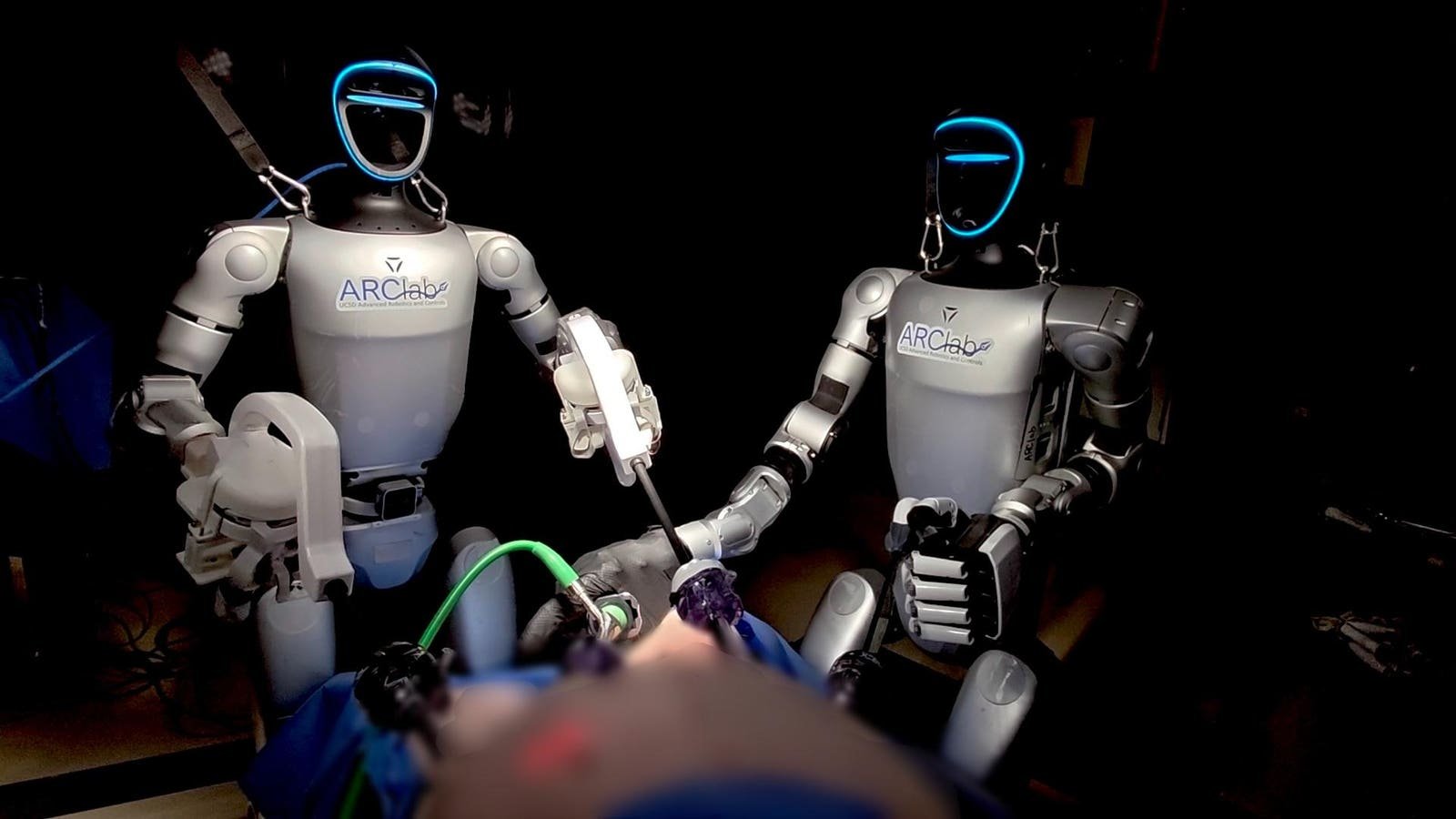
Researchers at UC San Diego used two teleoperated Unitree G1 humanoid robots to perform laparoscopic gallbladder removal on a live pig, according to Forbes. The robots handled surgical steps including tissue retraction, dissection, clipping and lifting the gallbladder out of the liver bed.
The claim is narrow but meaningful. This was not autonomous surgery, and it was not performed on a human patient. Trained human surgeons fully controlled the robots, and the machines were tethered to prevent a fall into the operating area. Even with those caveats, the work puts a commodity humanoid platform into one of the most demanding manipulation settings available.
Off the shelf humanoids in an operating room task
The UC San Diego team, including researchers from the university’s school of medicine and ARClab, did not build a custom surgical robot for the experiment. Forbes reports that the group used two Unitree G1 humanoids, a small platform roughly four to five feet tall and about 70 pounds, with versions available for under $20,000.
The article says the specific robots likely used Unitree’s Dex3 dexterous hands, with thumb, index and middle fingers and multiple actuated joints. It also points to extra wrist and waist articulation, plus 3D LiDAR and a depth camera, as relevant hardware for tool handling and surgical scene interaction.
The benchmark in this domain is not another humanoid. It is Intuitive Surgical’s da Vinci system, a fixed surgical robot installed in thousands of operating rooms and designed around minimally invasive procedures. A humanoid is a less specialized instrument, but it is also built around a different premise: operation in human designed environments, with tools and workflows originally meant for people.
Still far from clinical deployment
The researchers framed the work as an evaluation of whether humanoid robots could extend medical care where surgeons are not physically present. In their project overview, quoted by Forbes, the team wrote: “Humanoid form factors offer unique potential, particularly for assisting with surgical tasks.” They also noted that it remains unclear how close current humanoid systems are to the precision, control and safety requirements of minimally invasive surgery.
The Nature paper cited in the Forbes article states that “key technical challenges” remain before clinical deployment. That is the practical reading of the result. The G1s completed a real surgical procedure on living tissue, but only under close human control and with physical safeguards in place.
For humanoid robotics, the useful signal is not that a low cost biped is ready to replace a surgical platform. It is that a general humanoid, with suitable hands and teleoperation, could manipulate surgical tools well enough to complete a defined laparoscopic procedure in an animal study. The open question for operators and researchers is whether that capability can be made repeatable, safe and precise enough outside a controlled experiment.
Source: forbes.com