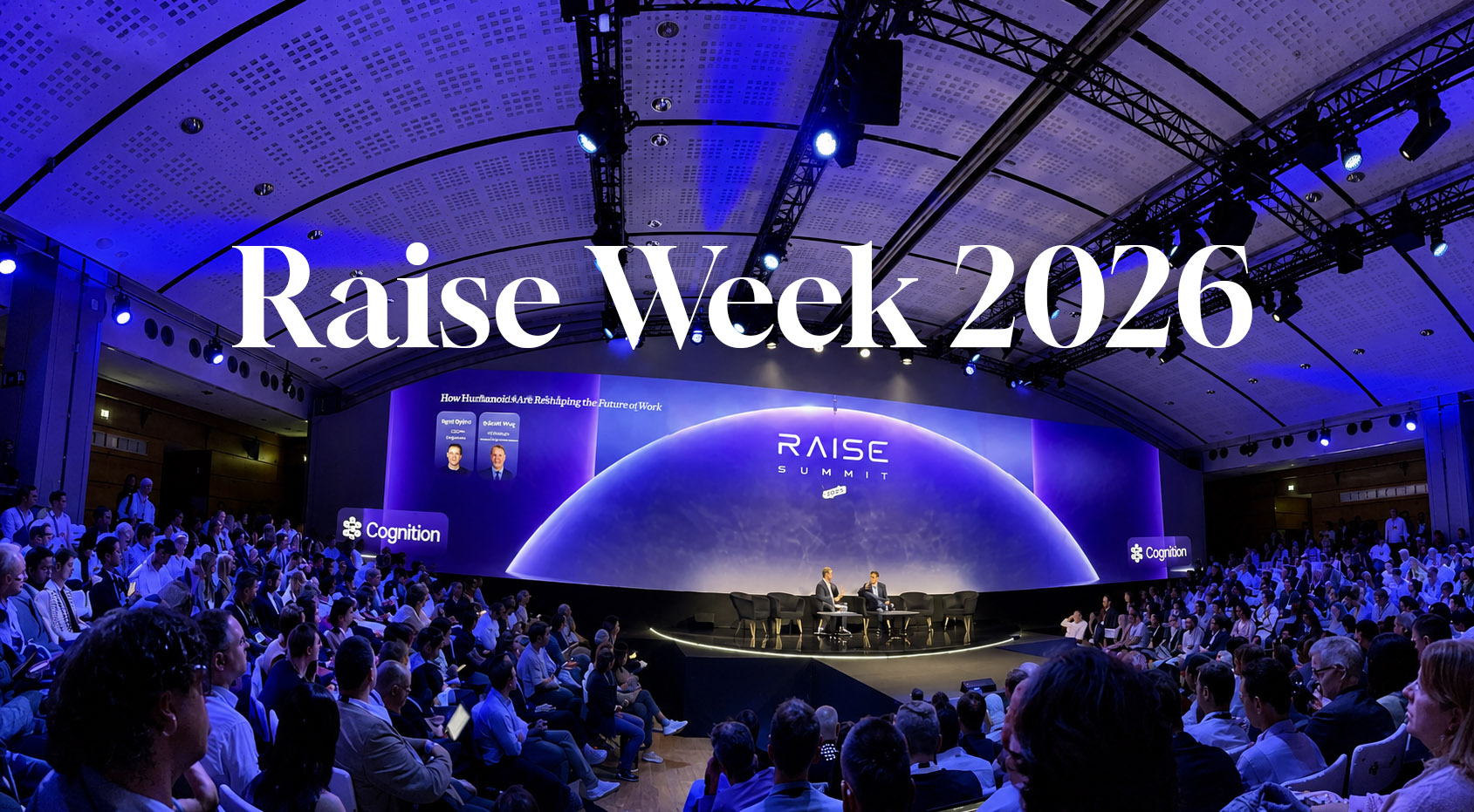
Raise Week 2026
What is a humanoid-robotics guide doing at Raise Week 2026, the AI-infrastructure week in Paris? Listening. Agents that may soon train robots, compute that will feed them, and one Nordic night where NVIDIA and Strawberry shared a stage.
Why would a humanoid-robotics guide cover an AI-infrastructure summit? Because the connections kept surfacing. Raise Week 2026 filled Paris with the people building the agent economy: the model labs, the neoclouds, the coding-agent companies. Listen closely and much of what they described sounded like the stack robotics could run on next. Not everyone in Paris buys that future – more than one voice called the industry inflated – which made it all the more worth listening. Here is what we brought home.
The Nordic Night · NVIDIA Meets Strawberry
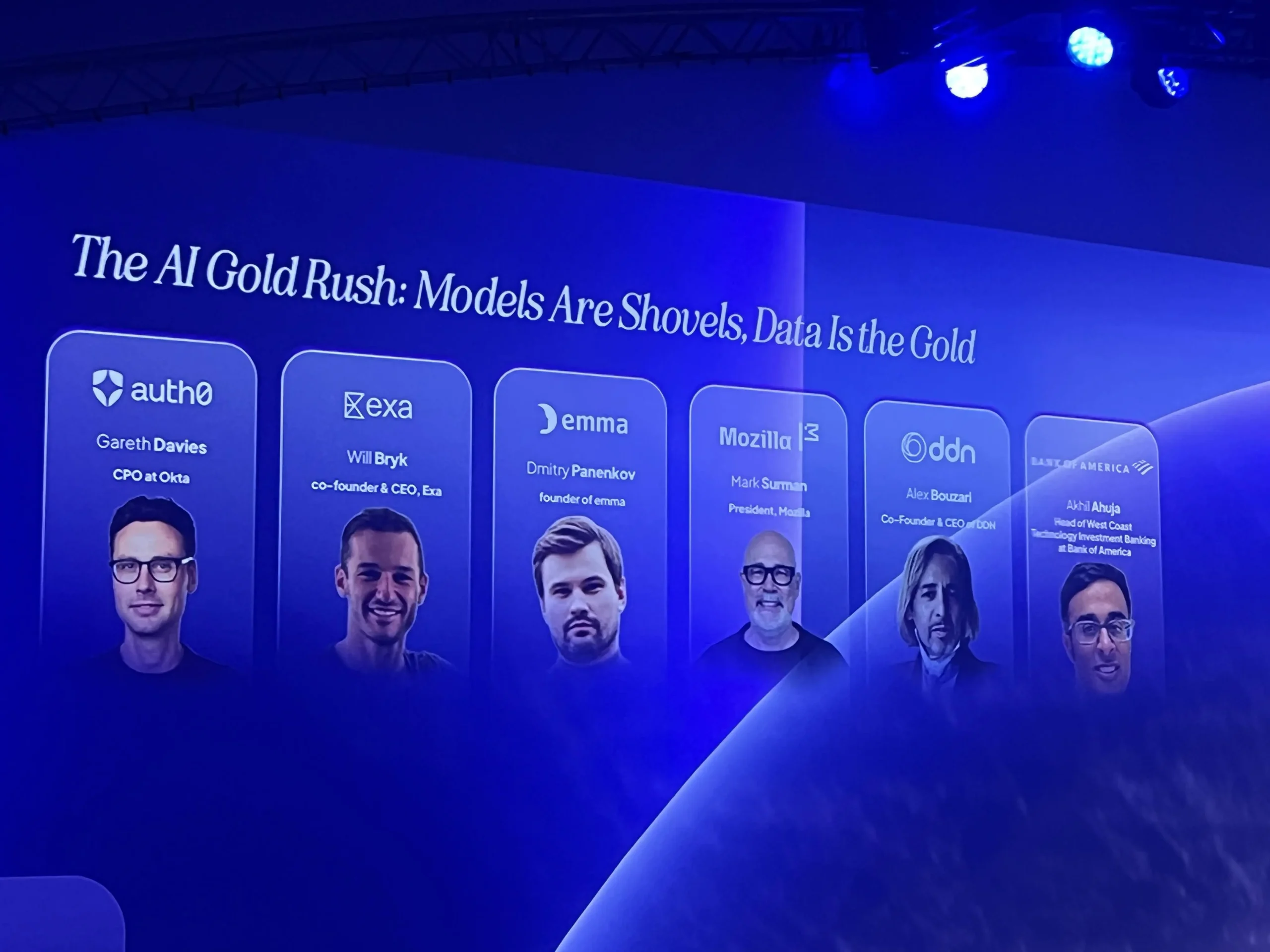
One of the conversations that stayed with us longest happened away from the main programme, at the Nordic party hosted by Nebius, where David Hogan, VP Enterprise at NVIDIA, and Charles Maddock, founder and CEO of Strawberry, sat down alongside Peter Sarlin – the Silo AI founder now building PostScriptum and NestAI – with Oliver Molander (Inception Fund) and Minna Sandberg (Swenode.AI) moderating. Two speakers, two ends of the same story: the man who sold AI for NVIDIA before anyone wanted to buy it, and the founder young enough to have grown up inside the world that bet created.
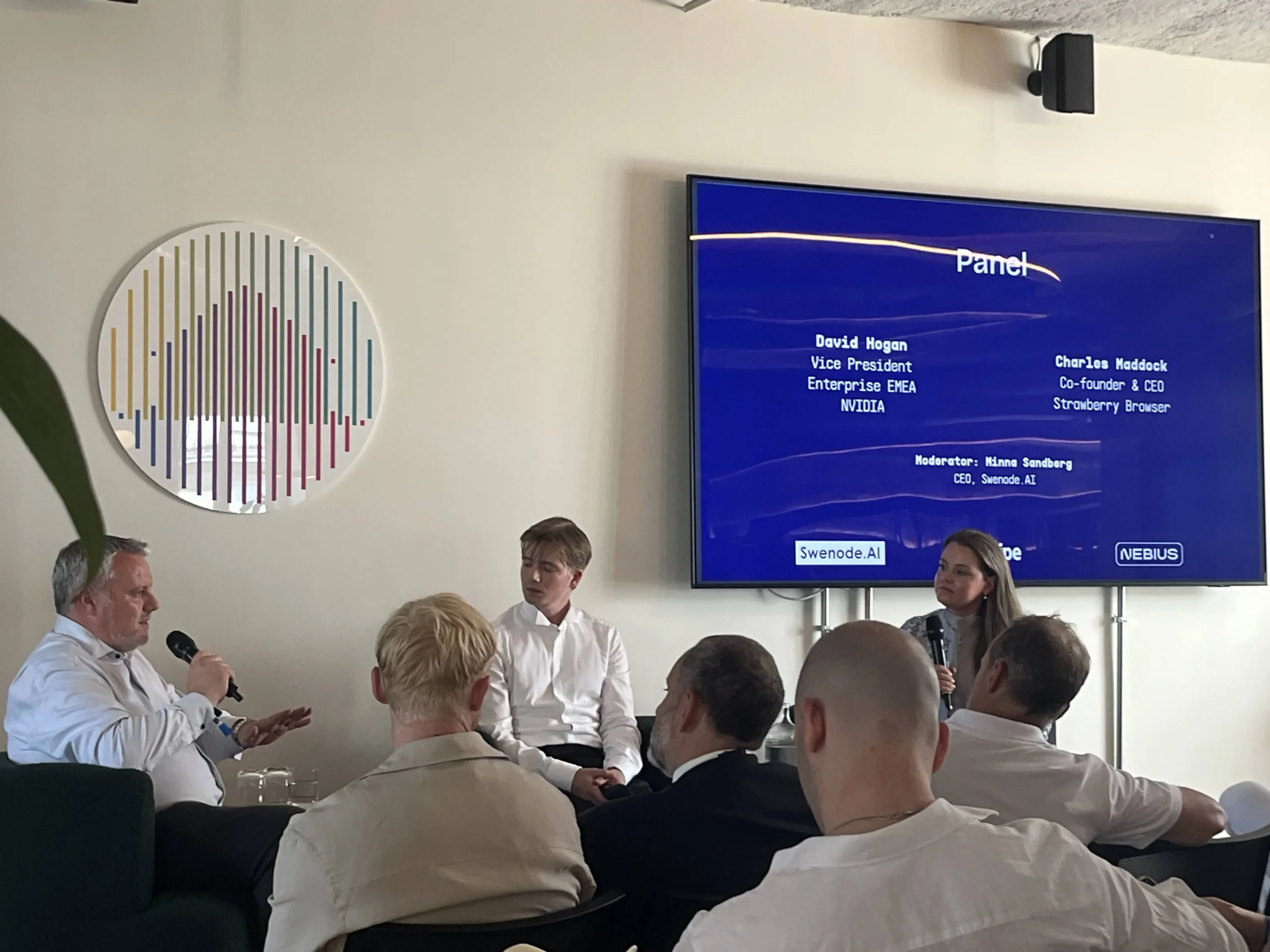
NVIDIA meets Strawberry · on stage at the Nordic night hosted by Nebius, Raise Week 2026
Hogan joined NVIDIA back in 2016, after two decades at BT, Virgin Media and NetApp, when Jensen Huang had decided to build AI before there was a market for it. His job description was a question: how do I sell AI? Jensen's answer: "I have no idea – that's your job." No one wanted to take his calls. What worked was finding the organisations that saw the value and wanted to do the journey with them – partner and grow together. Ten years later he runs enterprise sales across EMEA and helps European governments stand up their AI programmes, and he insists NVIDIA still acts like a startup: first the use case, then the right platform, then the right model. Never the other way around.
Maddock is the other end of the arc. He started programming at eleven, earned the nickname "the LLM-whisperer" among his co-founders, and built Stockholm-based Strawberry – an agentic browser with AI companions that automate real work – together with Arian Hanifi and Sebastian Thunman. His diagnosis on stage: Europe still has no general autonomous platform – no Claude Code, no Gemini. Strawberry wants to fill those shoes and become the first choice for a general AI platform inside European companies. Why does he do it? "Why does Usain Bolt want to be the fastest man?" Young people in their prime, he argued, should be building the next Apple or Microsoft now – and the Minecraft generation of Stockholm, backed by funds like Inception, is starting to believe it can. (The week also gave the phrase "elevator pitch" a literal workout: we caught Maddock in the lift and pitched him Kinetic Blocks before the doors opened.)
On the frontier question, the two converged on the same place – our place. Hogan: it is close to impossible to beat the frontier labs at general LLMs now, so the next domain is physical AI – world models that have to understand physics, and Europe's industrial companies will have to pivot to physical AI to survive. Maddock agreed on the premise but not the surrender: DeepSeek showed what a room of focused quants can do without American GPU stockpiles. Bring the kids together, focus on post-training, and Europe gets small, intelligent models – "VCs don't call founders naive; they have a reality distortion field."
"Optimise for the biggest possible thing and never, ever give up – even if it means getting up and only working two hours that day. Lock in."
Hogan's version of the same advice, from the seller's side: be clear about the problem you solve – "startups want to cure hunger" and confuse the customer. Find one friendly customer, develop them into a partner, and let them teach you the market.
Strawberry raised $6 million in a round led by General Catalyst and EQT Ventures – with backing from the founders of Lovable, Hugging Face and Supabase. The first 10,000 beta sign-ups got in free.
New! 2026 Humanoid
Robot Market Report
198 pages of exclusive insight from global robotics experts — uncover funding trends, technology challenges, leading manufacturers, supply chain shifts, and surveys and forecasts on future humanoid applications.

now Google DeepMind
Agents All the Way Down · Cursor, Nokia, Cognition
The main-stage conversation we took the most robotics notes from was ostensibly about the ROI of AI: Jordan Topoleski, COO of Cursor, and Pallav Mahajan, CTO of Nokia, in conversation with Bloomberg's Peter Elstrom. Cursor's engineers now run five to six agents at the same time, and the company has invented a new role – deployed ROI specialists who roam the organisation (and its customers) telling the story of what the AI shift is worth. Topoleski's map of how it got here:
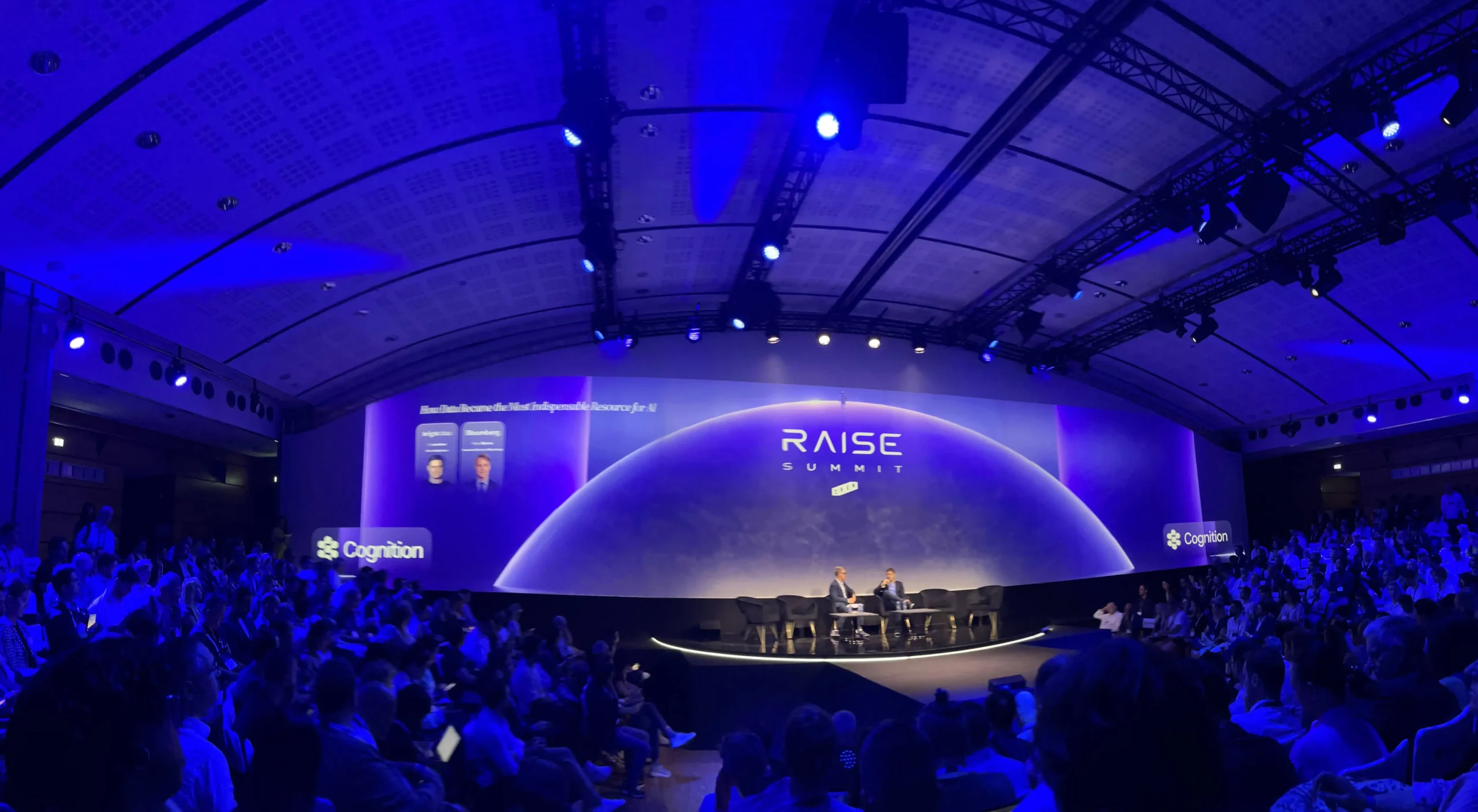
Raise Week 2026 · scenes from Paris
-
2024 · AutocompleteCursor Tab and code completion – the assistant finishes your line. Adoption scales linearly with developers.
-
2025 · Agents as colleaguesEngineers hand whole tasks to an AI colleague. People write 50% more code with AI. Still scales linearly.
-
2026 · Multi-agent systemsSystem focus: multi-agent flows as the models get far more capable. From phase two to three you cannot scale linearly anymore – the question becomes how agents attach to the system, and what business value they create.
Nokia's counterpoint was organisational: networks must become AI-native for the coming super cycle, and AI is not a tooling change but a new muscle. Mahajan's rules – do not wait for perfection, empower the engineer (soft token quotas: exceed them and you get an email, but you judge your own tasks), and reinvent management as job titles collapse. "You are a port builder."
Then Scott Wu, CEO of Cognition – the company behind Devin, the AI software engineer used by Mercedes and Goldman Sachs – put numbers on where this goes. Model coding ability doubles every seven months. Agents now run 16 hours of work unattended and close the loop themselves. Shipped software at Cognition is up 10x in six months, and – the line that stuck – Devin starts Devin: agent-initiated work has outstripped human-initiated work inside the company. Token counts and lines of code no longer matter as metrics; business impact does.
"What would you do with an infinite army of software engineers? The question is really – what do you want to build?"
Why we care as robot-watchers: robot training increasingly looks like a software pipeline – data curation, simulation, evaluation, retraining. If that holds, the multi-agent flows Cursor and Cognition described are its blueprint – and much of tomorrow's robot training may be done by agents.
The OpenAI Keynote · From Agents to Compute
If Cursor and Cognition gave the outside view, OpenAI brought the inside one. Sachin Katti, OpenAI's Head of Industrial Compute, walked the Raise stage through what the agent shift looks like from within the company building them – a deck that reads as one argument in four acts: the trajectory arrived on schedule, agents took over the work, the flywheel sped up, and compute has to answer for it. Watch the moments we caught from the floor – then read the slides, re-set below.
From the OpenAI keynote · RAISE Summit 2026
From the OpenAI keynote · RAISE Summit 2026
From here the natural question is what all that compute should learn – which is exactly where the frontier-lab panel picked up.
The Physical AI Thread · Field AI at the Frontier-Lab Panel
The training-at-scale panel – Shubho Sengupta (Axiom Math), Frank Hutter (Prior Labs), Eiso Kant (Poolside) and Ali Agha (Field AI), moderated by Felicis' Feyza Haskaraman – could not agree on the bottleneck: compute, architecture, energy or synthetic data. That disagreement was the most honest moment of the week.
For robotics, Ali Agha was the essential voice. Field AI builds foundation models for robots operating in complex, safety-critical environments like construction sites, and his argument cut against the scaling orthodoxy: robotics does not have internet-scale data and never will. All the teleoperation in the world is a drop in the ocean, and generalisation in the physical world is multi-dimensional – not the one-dimensional, word-based kind LLMs solved. Simulation data, video data, teleop data – Field AI uses everything it can get – but data alone will not produce general-purpose robots. His unlock: a next generation of transformers with built-in physics, architectures that need less data because they already know how the world behaves.
"Architecture is a moat around your data. You land-grab the market, you create a data flywheel – the architecture gives you the head start."
Raise Week 2026 · impressions from the summit
Eiso Kant of Poolside grounded the other end: model capability is limited by compute, but the real bottleneck turned out to be data centres and energy – 200 MW costs about $3 billion before power – so Poolside started building its own. And inference has to get faster: robots and agents need models that stream 10,000 tokens per second, not 30–40.
Frank Hutter's Prior Labs works on tabular foundation models – and there are only about 50,000 tabular datasets available online. Not every corner of AI has an internet to scrape. Robotics knows the feeling.
Compute Is Destiny · The Raise Week 2026 Infrastructure Track
The infrastructure sessions – Cloudflare, Vast Data, Credo, Clockwork, Solidigm, moderated by SemiAnalysis' Jordan Nanos – shared one refrain: everyone is sold out. Demand for compute looks endless; the hesitation is only about whether the exponential can continue. There is no lack of capital – the question is what margin you can charge, and whether the end users ("offtake") keep subscribing.
Two details stood out. Cloudflare says half the traffic on its network is now agentic, and it has gone all-in on isolates instead of containers – think flexible workspace instead of office space – to squeeze ten agents per worker out of ten billion CPUs. And the neoclouds are learning the hard way: 100,000 GPUs mean 100,000 km of fibre with no time to test it, GPUs rented at $6 an hour on leverage, and service rates on GPUs as high as 20% – a thousand GPUs can lose one to four hours a day to unutilised capacity and infrastructure failures. Reliability, as Credo put it, is the north star.
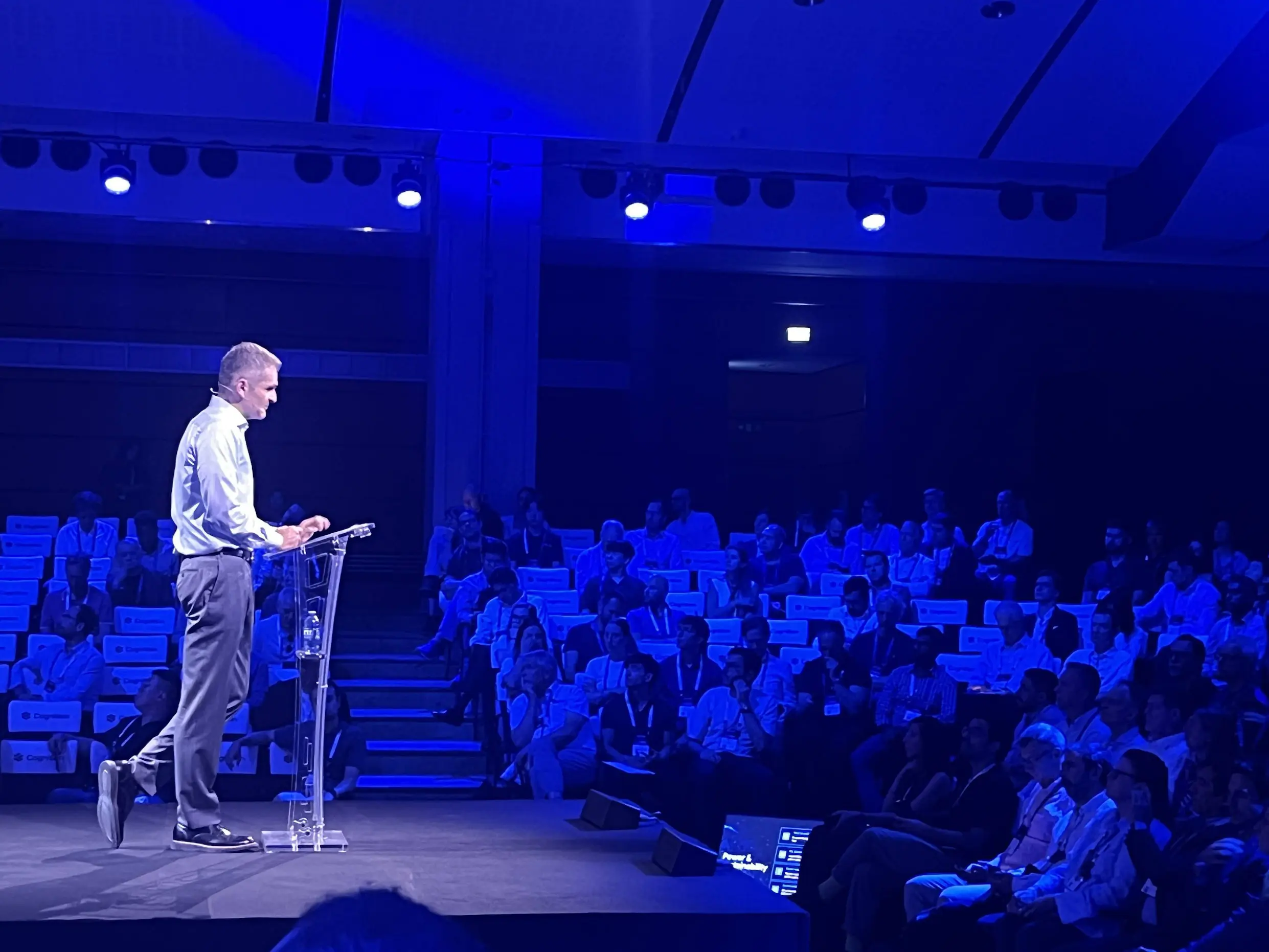
Raise Week 2026 · from the floor in Paris
The robotics read: this is the layer robot foundation models will be trained on. When the people selling the shovels say demand is endless and one GPU in five needs service, a good part of the price and pace of robot-brain training is being set right here.
We went to Raise Week to listen for robots – and kept hearing the stack being built beneath them.
Agents that may train them, architectures that could run them, compute that will feed them – and a Nordic night that showed Europe intends to be in the game. Whether the boom is real or running hot, as some in Paris argued, this is the layer to watch. Read our Machina 2026 field report from Station F and Jim Fan in Three Minutes from the same week in Paris.
New! 2026 Humanoid
Robot Market Report
198 pages of exclusive insight from global robotics experts — uncover funding trends, technology challenges, leading manufacturers, supply chain shifts, and surveys and forecasts on future humanoid applications.
now Google DeepMind