Lightning wins Beijing humanoid robot half-marathon in 50:26
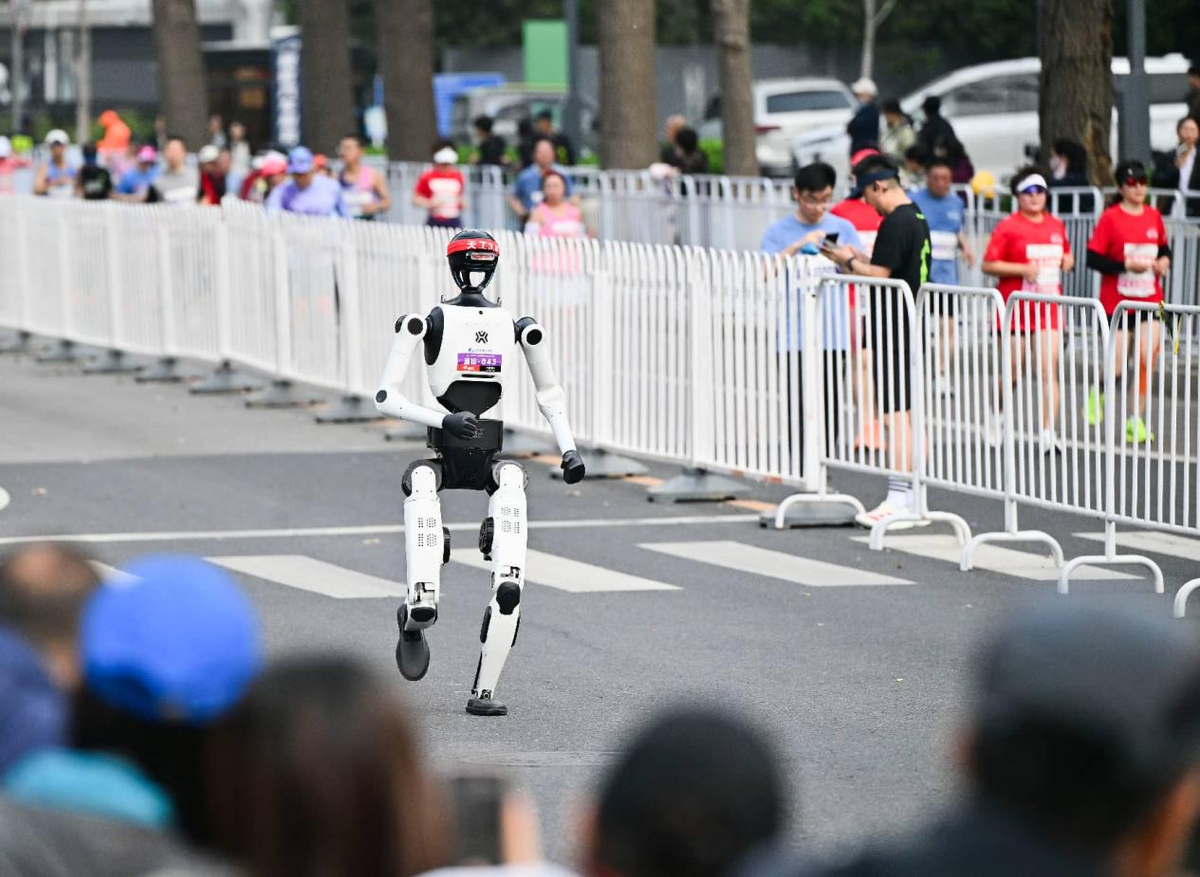
Lightning, a humanoid robot developed by the Qitian Dasheng Team, won the Beijing humanoid robot half-marathon at the 2026 Beijing E-Town Half-Marathon on April 19, finishing in 50 minutes and 26 seconds. The result stands out as a practical benchmark for current humanoid running performance, showing how quickly developers are improving speed, endurance, and autonomy under real operating conditions.
According to Alwihda Info, citing reporting by People’s Daily, the event drew more than 100 teams this year, up from 20 in 2025. The source also says Lightning’s finishing time surpassed the current men’s half-marathon world record, underscoring the scale of the performance claim attached to this year’s race.
Beijing humanoid robot half-marathon becomes a tougher benchmark
The competition appears to be evolving from a publicity event into a repeatable systems test for humanoid developers. Liang Liang, deputy secretary-general of the Chinese Institute of Electronics, said nearly 40 percent of teams achieved autonomous navigation this year, suggesting that running performance is no longer the only metric attracting attention.
Completion times improved sharply in one year. Teams that needed more than two hours to finish in 2025 were replaced this year by machines finishing in under one hour, a shift that participants attributed to gains in material durability, system reliability, and joint heat resistance.
Last year’s winner, Tiangong Ultra, returned with what the source described as steady strides and coordinated arm movement without human guidance. That matters for practitioners because long-distance running at higher speed compresses perception and decision windows, making balance recovery, gait planning, and power management harder to coordinate in real time.
Hardware changes drive the faster times
Several teams framed the race primarily as a hardware stress test. Xu Zhiyuan, head of motion control at the Beijing Innovation Center of Humanoid Robotics, said tens of thousands of virtual robots logged a combined 27,300 hours of running in simulation and went through more than 100,000 iterations before the event.
Xu said near-professional human running speeds reduce the time available for perception and decision-making, which in turn raises demands on power systems, algorithms, and overall responsiveness. That connection between locomotion speed and system integration is one reason running events are useful beyond spectacle: they expose failure points that slower indoor demos can hide.
Thermal control emerged as one of the clearest engineering themes. The Taishan Team from Shandong said its 1.38-meter humanoid, Xingzhe Taishan, had been training at marathon intensity since March, running a half-marathon every day. Yobotics, the robot’s developer, said it introduced a liquid cooling system and reinforced key materials to address overheating and mechanical fatigue.
Battery handling also improved. Xing Boyang, technical director at Humanoid Robot (Shanghai) Co., Ltd., said battery swaps that previously took several minutes and required a reboot can now be completed in under 10 seconds without interrupting operation. Teams also reported combining liquid and air cooling to bring joint temperatures down from 70 to 80 degrees Celsius to around 60, while battery upgrades extended continuous operation.
Shared platforms, different software results
One of the more revealing details from this year’s field was that many teams used the same robot base model but produced very different results. That points to software optimization, controls tuning, and systems integration as major differentiators, even when underlying hardware is similar.
The source described these participants as secondary developers, including companies, research institutions, university teams, and independent enthusiasts. Dou Yuhan, a doctoral student from Huazhong University of Science and Technology, said his team built its own algorithms on the Tiangong 3.0 platform, arguing that broader participation is important to advancing humanoid robotics.
The international mix also widened. Five international teams entered for the first time, and the source says all five chose Chinese-made base models, reflecting a pattern it summarized as Chinese hardware and global intelligence. For the humanoid sector, that combination suggests a supply chain in which base platforms may standardize faster than the software stacks running on top of them.
The Beijing race does not answer the larger commercial questions around humanoid deployment, but it does provide unusually visible data on locomotion reliability, thermal management, and autonomous operation under stress. If future editions keep expanding, they may become a useful benchmark for comparing not just raw speed, but how well humanoid platforms hold up when hardware, controls, and energy systems are pushed together at the same time.
Source: alwihdainfo.com