China Expands Humanoid Robot Training Centres
China is accelerating efforts to move humanoid robots from staged demonstrations into practical employment by building a nationwide network of dedicated robot training centres. The initiative, now active across multiple provinces, is designed to generate the large scale, high fidelity datasets required to commercialize next generation humanoid systems.
From Showcase to Deployment
The push follows a high profile humanoid showcase at the Spring Festival gala earlier this year. Since then, provinces including Anhui, Zhejiang and Shandong have opened training hubs in rapid succession. These facilities focus on preparing humanoid robots for real world tasks in manufacturing, logistics, home assistance and eldercare.
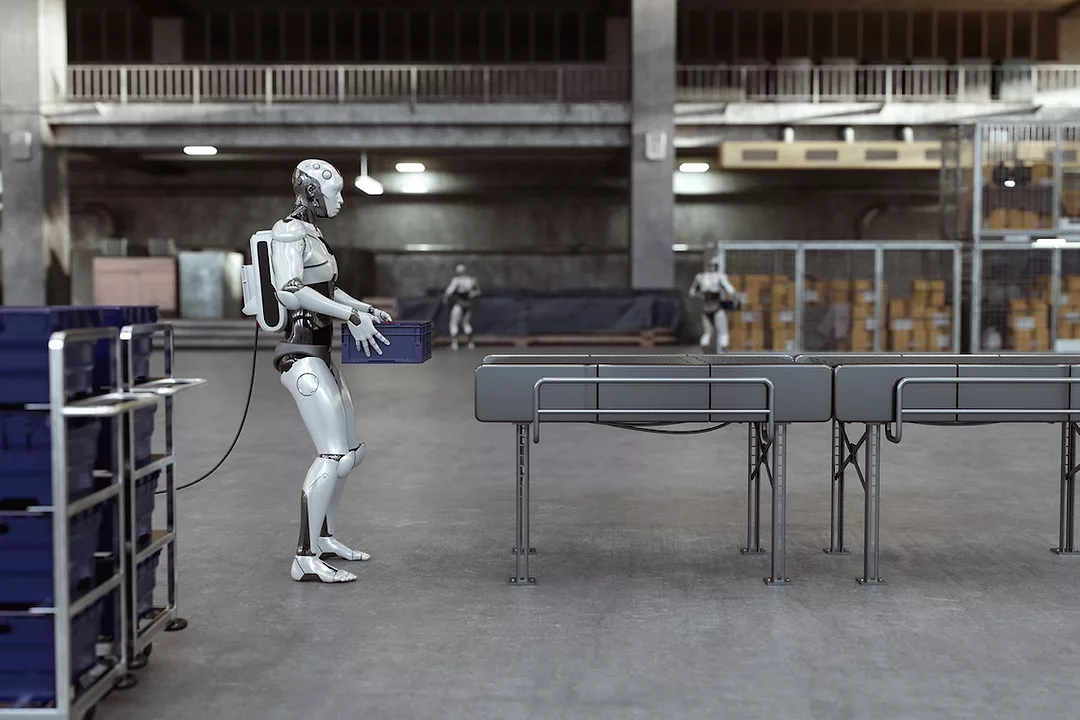
In Shandong, engineers train dozens of humanoid robots on basic physical operations such as carrying trays, folding clothes and retrieving items from shelves. Human operators perform the same actions alongside the machines to capture precise motion data. This approach allows developers to build structured datasets tailored to embodied intelligence rather than relying on internet sourced information.
Physical Data at Industrial Scale
Unlike large language or vision models trained on web scale corpora, humanoid robots require direct interaction data. Training datasets include joint movement parameters, speed and rotation metrics, as well as visual input, tactile sensing, pressure readings and force feedback. These multimodal inputs are critical for safe and reliable operation in dynamic physical environments.
China has reportedly established more than 40 state backed robot data centres, with 24 already operational. Many of these sites span thousands of square metres and house dozens of humanoid platforms. Workers repeatedly execute standardized tasks to record detailed action sequences, enabling faster iteration and refinement of control systems.
Simulated Environments and Task Expansion
Leju, a humanoid robotics firm operating a training centre in Hebei, has built simulated environments that replicate assembly lines, smart homes and eldercare settings. The site runs 16 separate training programs for humanoid systems. Some robots also use virtual reality and motion capture tools to complete assigned tasks such as sorting materials, returning empty boxes and packaging goods.
According to the report, one centre produces approximately 6 million data entries annually. Engineers indicate that trained humanoids now perform more than 20 distinct functions, with task success rates reaching about 95 percent in controlled settings.
Another facility in Hubei operates around 100 humanoid robots in continuous training cycles. Machines repeatedly fold clothes, iron fabric and clean surfaces to improve consistency and precision. This repetitive, high volume task exposure is intended to close the gap between laboratory performance and operational reliability.
Commercial Impact and Early Adoption
The training network is already contributing to revenue growth for robotics firms. Data centres in Jiangxi, Guangxi and Sichuan have reportedly driven significant sales increases. One major robotics company cited humanoid system sales of 566 million yuan.
Industry leaders emphasize that real world validation remains essential for progress. Executives note that supportive government policies are enabling faster deployment and experimentation, particularly in sectors where repetitive labor dominates workflows.
Manufacturing and logistics are expected to be among the first large scale adopters. These environments offer structured tasks that can be standardized and measured, making them suitable for early humanoid integration. At the same time, demographic pressures and labor shortages provide additional incentives for automation.
The rapid build out of physical training infrastructure signals a strategic focus on embodied AI capabilities. By concentrating on data collection, controlled task benchmarking and scaled experimentation, China is positioning humanoid robotics as an industrial platform rather than a demonstration technology.
Source: mugglehead.com