Welcome, AIRoA-0!
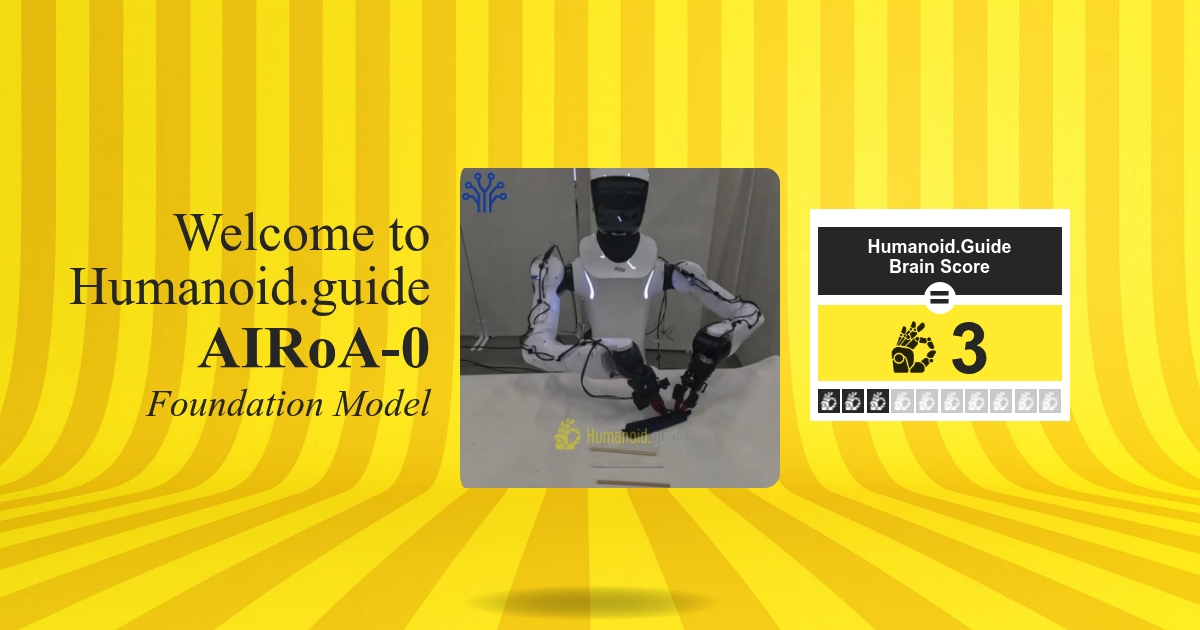
This robot foundation model comes from AIRoA, Japan’s AI Robot Association, a Tokyo based organization backed by the Ministry of Economy, Trade and Industry. It belongs to the vision language action model category, connecting research in artificial intelligence with robot control. Its defining research choice concerns training data: the team used human recordings rather than collecting demonstrations through robot operation. More than 16,000 hours of everyday activity were recorded using YUBI, a handheld gripper developed with Toyota’s involvement. This collection strategy puts the emphasis on making demonstrations easier and less expensive to gather, rather than requiring a robot for every recording session. The model receives a Humanoid Guide Brain Score of 3 out of 10, placing it in the developing category rather than among mature or leading systems. Its research identity centers on an alternative route to building robot training datasets, alongside an open distribution approach intended to support further research and development.
The central technical distinction is the relationship between the recording interface and the training dataset. YUBI provides a handheld tool for collecting human demonstrations, giving the project a data collection workflow separate from conventional robot demonstration pipelines. The reported dataset exceeds 16,000 hours, but dataset volume alone should not be treated as a measure of general intelligence or deployment readiness. Likewise, the overall score of 3 describes a developing model, not a guarantee of performance in a particular application. For researchers, the project provides a concrete subject for examining demonstration collection costs, dataset construction, and the role of human recorded activity in robot foundation model development.
AIRoA lists November 6, 2026 as the release date and identifies its model website as airoa.io through a dedicated project subdomain. The model and code are described as openly shared for research and development. The commercial listing displays a price of zero and a backorder status, which should be distinguished from the terms governing access to software and research materials. Toyota’s involvement concerns the YUBI recording device, while the association’s institutional backing comes from Japan’s Ministry of Economy, Trade and Industry. Together, these connections place the project within Japan’s broader robotics research ecosystem. Its broader significance lies in exploring a less robot dependent approach to gathering training demonstrations.