Welcome, Fengxing-001!
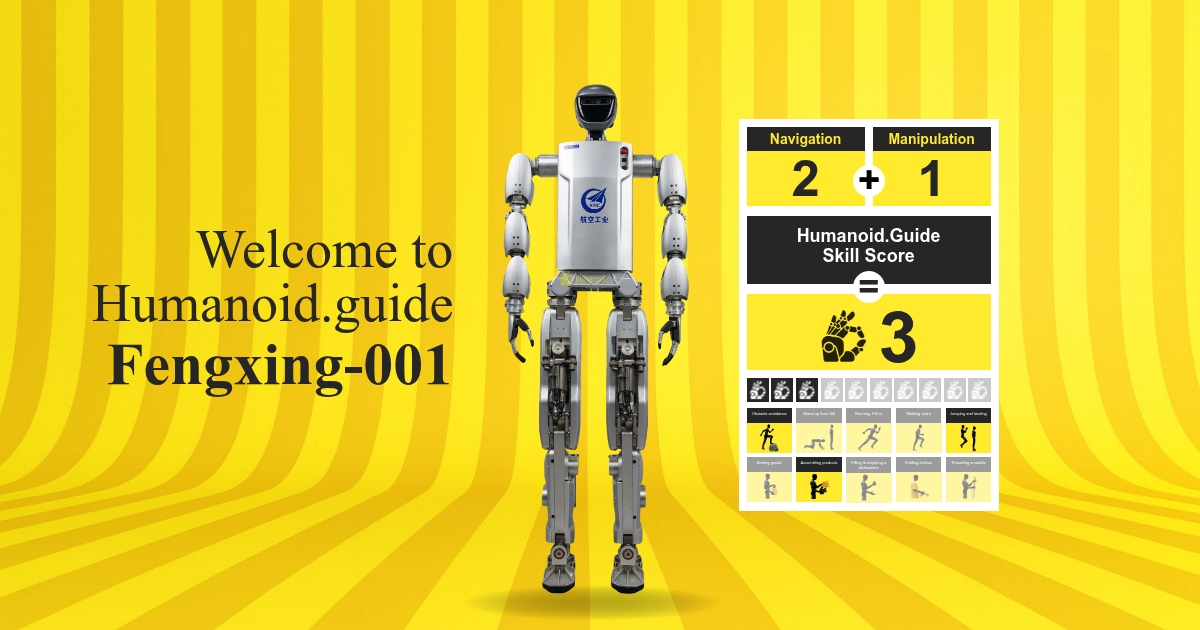
AVIC’s Fengxing is a full size humanoid prototype designed for aviation manufacturing, aircraft maintenance and support work. Developed by the Aviation Industry Corporation of China, it stands 180 centimeters tall, weighs 80 kilograms and carries 20 kilograms while walking. Its listed maximum speed is 3 kilometers per hour. The robot combines an electrohydraulic hybrid drive with compact leg motors derived from aero engine technology, bringing aviation engineering into a humanoid platform. Its hands have five fingers each. Development began in 2024, and AVIC presented the prototype at the 2026 World Robot Conference in Beijing. Its demonstrated capability set includes obstacle avoidance, jumping and landing, and assembling products. A total skill score of 3 out of 10 places it in the developing category, with navigation rated 2 out of 5 and manipulation rated 1 out of 5. These ratings describe a platform still progressing toward broader practical competence, rather than a mature general purpose worker ready for unrestricted deployment.
Obstacle avoidance and jumping and landing are the central mobility capabilities in this robot’s current profile. Together, they give its navigation development a physical scope beyond manipulation alone. The electrohydraulic drive and aviation derived leg motors are key technical features of that platform, although its navigation rating remains 2 out of 5. Assembling products is its listed manipulation capability and connects directly with AVIC’s intended aviation manufacturing applications. Its manipulation rating of 1 out of 5 keeps that capability in an early development tier. For prospective industrial users, assembly is therefore the clearest task category to examine, alongside obstacle avoidance and jumping and landing, when assessing how the prototype’s capabilities align with a specific production environment.
Fengxing remains a prototype, with a listed price of USD 150,000 and an inquiry option for prospective customers. That status distinguishes the published price from a claim of established commercial deployment. AVIC’s role as a Chinese state owned aerospace and aviation group gives the project a specific industrial context: the robot is aimed at aviation work rather than domestic service or retail settings. Its broader significance lies in transferring technologies associated with aircraft programs into humanoid robotics, particularly through its drive system and leg motors. The project illustrates an industry specific development path in which a manufacturer builds around its existing engineering expertise and intended workplace, while the robot’s developing skill ratings keep expectations grounded.