ARMAR-7
75 000 USD

Karlsruhe Institute of Technology (KIT), H²T Lab
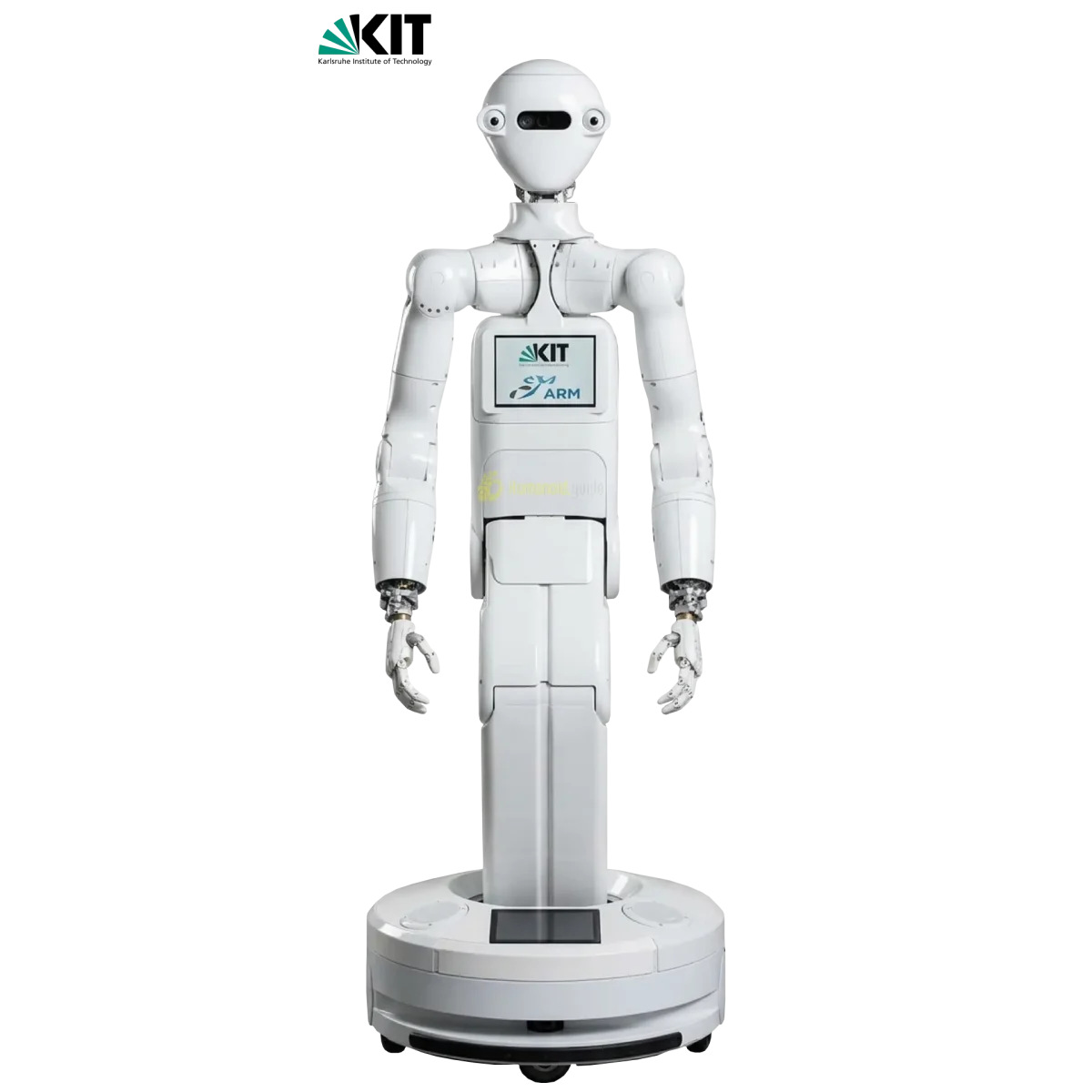
ARMAR-7 is KIT’s 2024 humanoid assistance robot for homes and care facilities. It combines two 8-DoF torque-controlled arms, underactuated hands with built-in cameras, a 3-DoF head, a bowing torso and an omnidirectional base, and it learns tasks from spoken instructions.
Skill Score
 3
3

Specifications and details:
| Availability | Prototype |
|---|---|
| Nationality | Germany |
| Website | https://h2t.iar.kit.edu/ |
| Height [cm] | 175 |
| Max speed (km/h) | 3 |
| Strength [kg] | 12 |
| Weight [kg] | 120 |
| Runtime pr charge (hours) | 3 |
| Safe with humans | Yes, designed for it: torque-controlled arms for compliant interaction; built for homes and care facilities |
| CPU/GPU | N/A |
| Ingress protection | N/A |
| Camera resolution | RGB camera in each hand; several integrated camera systems in the head |
| Connectivity | N/A |
| Operating system | N/A |
| LLM integration | Linux with KIT’s open-source ArmarX cognitive architecture |
| Latency glass to action | N/A |
| Motor tech | Improved integrated sensor-actuator-controller (SAC) units: electric motor, gear, sensors and electronics in one module |
| Gear tech | N/A |
| Main structural material | N/A |
| Number of fingers | 10 (5 per hand) |
| Main market | household and nursing-care assistance, Research |
| Color | White |
| Manufacturer | Karlsruhe Institute of Technology (KIT), H²T Lab |
Description
ARMAR-7 is a humanoid assistance robot from the High Performance Humanoid Technologies Lab (H²T) at the Karlsruhe Institute of Technology (KIT) in Germany. Professor Tamim Asfour leads the lab, which has built the ARMAR family since 2000, one of Europe’s longest-running humanoid programs. KIT developed ARMAR-7 in 2024 as the newest member of the family. It succeeds ARMAR-III, the famous kitchen robot that KIT now counts among the 100 objects that represent its history. ARMAR-7 rolls on a wheeled base but has a humanlike torso, head, arms and hands.
KIT designed ARMAR-7 to help people in everyday human spaces. For example, it can work in homes or nursing facilities and provide assistance where needed. Its human-sized proportions let it use the same doors, cabinets and appliances that people use. In addition, it can bow and adjust its torso height, which helps it reach both low and high places. Its omnidirectional base lets it move in any direction without turning first.
New! 2026 Humanoid
Robot Market Report
198 pages of exclusive insight from global robotics experts — uncover funding trends, technology challenges, leading manufacturers, supply chain shifts, and surveys and forecasts on future humanoid applications.

now Google DeepMind
The robot also learns and communicates naturally. People simply tell it what they need in spoken language. ARMAR-7 then completes the task on its own or works together with the person. Moreover, it learns new tasks from humans and adapts to each user’s preferences. At the same time, KIT designed it to keep sensitive personal data private.
I’m Olivia, Humanoid Analyst at Humanoid.Guide
My mission, together with the team, is to help your organization understand the landscape, compare solutions, and move toward successful robot deployments.
ARMAR-7 already performs a range of practical skills. These include opening doors, loading a dishwasher and handing objects to people. It shares its cognitive software, ArmarX, with KIT’s industrial ARMAR-6 and decontamination robot ARMAR-DE. Therefore, researchers can transfer new methods from one robot to another. In short, ARMAR-7 carries forward more than two decades of KIT research toward truly helpful humanoid assistants.
Download the Humanoid Robot Market Report here
Website: https://h2t.iar.kit.edu/397.php