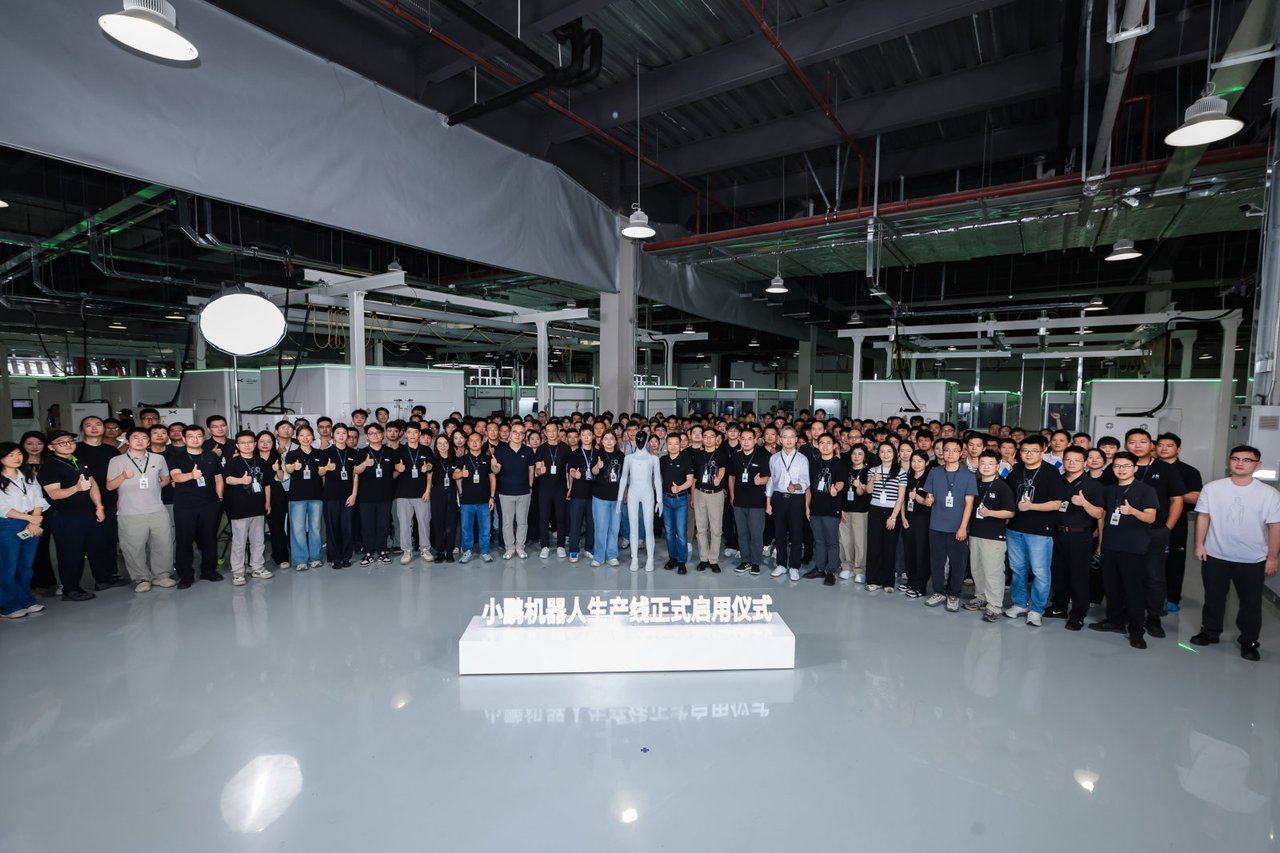
XPeng commissions production line for IRON humanoid robot
XPeng has commissioned a dedicated production line for its IRON humanoid robot and completed the first unit assembled on it, according to the company’s September 8 announcement. The robot then walked off the line under its own power at the facility in Guangzhou.
The company describes the facility as the world’s first automated production line for advanced humanoid robots. That claim has not been independently established. One completed robot also does not demonstrate volume output, but the operating line is firmer evidence of manufacturing intent than another prototype or stage demonstration.
Automotive processes adapted for humanoid assembly
XPeng says more than 80% of the line’s core processes are automated. It has adapted quality systems and production methods developed for electric vehicle manufacturing, with an emphasis on precision assembly, process consistency and flexible capacity.
The announcement does not identify which assembly or test processes are included in the 80% figure. XPeng also provided no rated capacity, cycle time, yield data or production cost for the facility. Those figures will be more useful to operators than the automation percentage alone, particularly for a mechanically complex platform with dexterous hands.
Chairman and CEO He Xiaopeng said the line was developed without an existing production model to follow. XPeng plans to explore faster production rhythms and greater manufacturing scale, although it has not disclosed how many units it expects to complete in 2026.
IRON specifications and rollout schedule
The XPeng IRON robot has 76 degrees of freedom across its body, including 21 degrees of freedom in each hand. Its exterior uses a fully enclosed flexible lattice structure that the company says is intended to balance humanlike appearance with physical safety.
Onboard computing comes from three of XPeng’s Turing AI chips, rated by the company at up to 2,250 TOPS of effective processing performance. XPeng claims this allows IRON to run its physical AI foundation model locally and complete complex tasks without remote operation. The announcement does not provide task benchmarks, autonomy evaluations or extended operation results that would verify that claim.
- Degrees of freedom: 76 across the body
- Hand articulation: 21 degrees of freedom per hand
- Computing: Three Turing AI chips, up to 2,250 TOPS
- Mass production target: By the end of 2026
- Commercial deliveries: Planned for 2027
Electrek reported that XPeng wants eventual output above 1,000 robots per month, with a longer term ambition of one million annually by 2030. The commissioned line’s stated capacity was not included in XPeng’s announcement, so those targets remain separate from demonstrated production performance.
The robotics business recently raised more than $900 million at a post money valuation above $6.3 billion. Electrek identified IDG Capital as the lead investor, with Tencent and Alibaba also participating.
XPeng plans to begin placing IRON units in its own stores and corporate campuses before external sales. Mass production is scheduled to begin by the end of 2026, followed by an official launch and deliveries in China and overseas markets in 2027.