Walden
120 000 USD

Walden Robotics
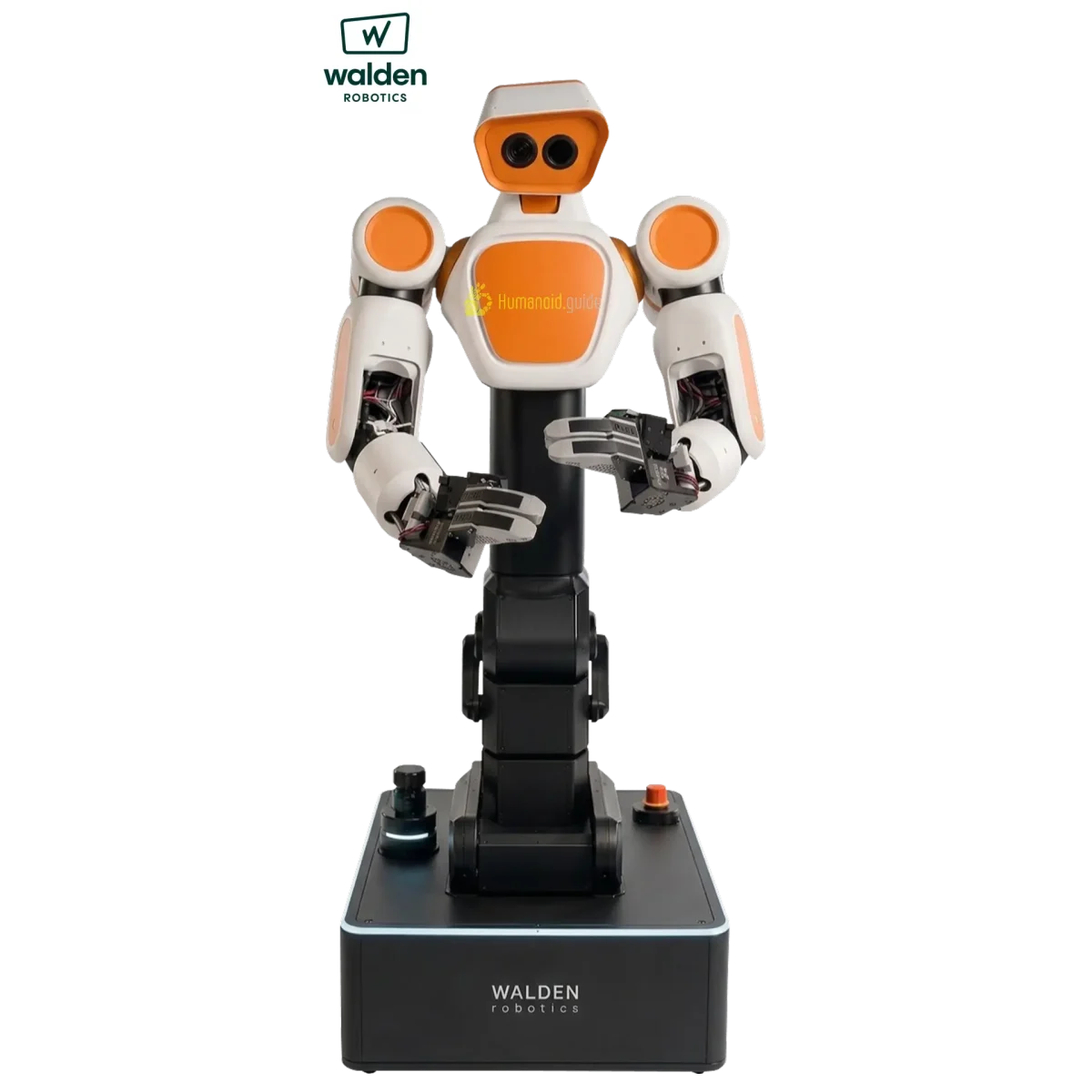
Walden Robotics builds wheeled, dual-arm humanoid robots that skip legs for stability and safety. Its robot already works real shifts in a Toyota factory, learning new tasks through proprietary AI models instead of pre-programming.
Skill Score
 3
3

Specifications and details:
| Availability | Early production / limited release |
|---|---|
| Nationality | US |
| Website | https://www.waldenrobotics.com/ |
| Degrees of freedom, overall | 24 |
| Degrees of freedom, hands | 12 |
| Height [cm] | 165 |
| Max speed (km/h) | 5 |
| Strength [kg] | 15 |
| Weight [kg] | 90 |
| Runtime pr charge (hours) | 4 |
| Safe with humans | Yes |
| CPU/GPU | N/A |
| Ingress protection | N/A |
| Camera resolution | N/A |
| Connectivity | N/A |
| Operating system | N/A |
| LLM integration | Yes, powered by proprietary "Large Behavior Models" (LBMs) |
| Latency glass to action | N/A |
| Motor tech | N/A |
| Gear tech | N/A |
| Main structural material | N/A |
| Number of fingers | 3 per hand |
| Main market | logistics, Manufacturing |
| Verified | Not verified |
| Shipping Size | N/A |
| Manufacturer | Walden Robotics |
Description
Walden Robotics builds humanoid robots for factories and warehouses. The company launched from stealth with $300 million in funding at a valuation of $1.1 billion. Toyota and Deviation Capital led the round, and NVIDIA, Boeing, and Samsung Ventures joined in. Walden is a spinout of Toyota Research Institute, and cofounder and CEO Russ Tedrake is an MIT professor. The company sits in Cambridge, Massachusetts, and it started working with real customers within weeks of its launch. In fact, Walden already has robots working in a Toyota plant in North America, powered by its own AI models.
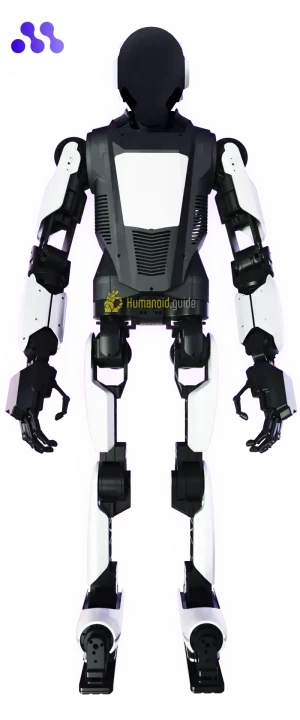
Walden’s robot skips legs entirely and rolls on a wheeled base instead. This choice keeps the design simple and remarkably stable. Because the base sits low and carries most of the batteries, the robot rarely tips over — a large wheeled base lets Walden pack the base full of batteries, since more weight near the floor keeps the robot stable and also solves the problem of running out of power mid-shift. The look is easy to recognize: white and orange panels, plus a slightly asymmetric head that people seem to like. Its hands use simple two-finger grippers rather than complex five-fingered designs. Simplicity pays off on the factory floor, since Tedrake says these grippers hold up to the daily wear of real factory shifts better than more dexterous hands would.
New! 2026 Humanoid
Robot Market Report
198 pages of exclusive insight from global robotics experts — uncover funding trends, technology challenges, leading manufacturers, supply chain shifts, and surveys and forecasts on future humanoid applications.

now Google DeepMind
Walden robots already work real shifts inside a Toyota plant in North America. They handle machine tending, tool setting, parts kitting, and assembly tasks alongside human coworkers. Walden moved from its first pilot to genuine production work in under two months. The company doesn’t sell its robots outright; instead, it charges customers fees to use the robots rather than selling the hardware, calling it a robots-as-a-service approach because the technology and hardware are changing fast. Meanwhile, human workers can hand off repetitive tasks and focus on skilled, judgment-heavy work instead.
I’m Olivia, Humanoid Analyst at Humanoid.Guide
My mission, together with the team, is to help your organization understand the landscape, compare solutions, and move toward successful robot deployments.
A custom class of models called Large Behavior Models powers every Walden robot. These models let the robot learn new skills quickly and improve them through real practice on the job. The approach builds on a decade of prior research, including work on diffusion policy, the Universal Manipulation Interface, and the open-source Drake simulator. As a result, Walden can teach one platform many different tasks instead of building a new robot for every job. The company targets automotive, aerospace, semiconductors, electronics, logistics, and life sciences customers first. Still, Tedrake insists the mission goes beyond profit: Walden aims to expand what people can achieve, not replace them.
Download the Humanoid Robot Market Report here
Website: www.waldenrobotics.com