Welcome, NORI L3!
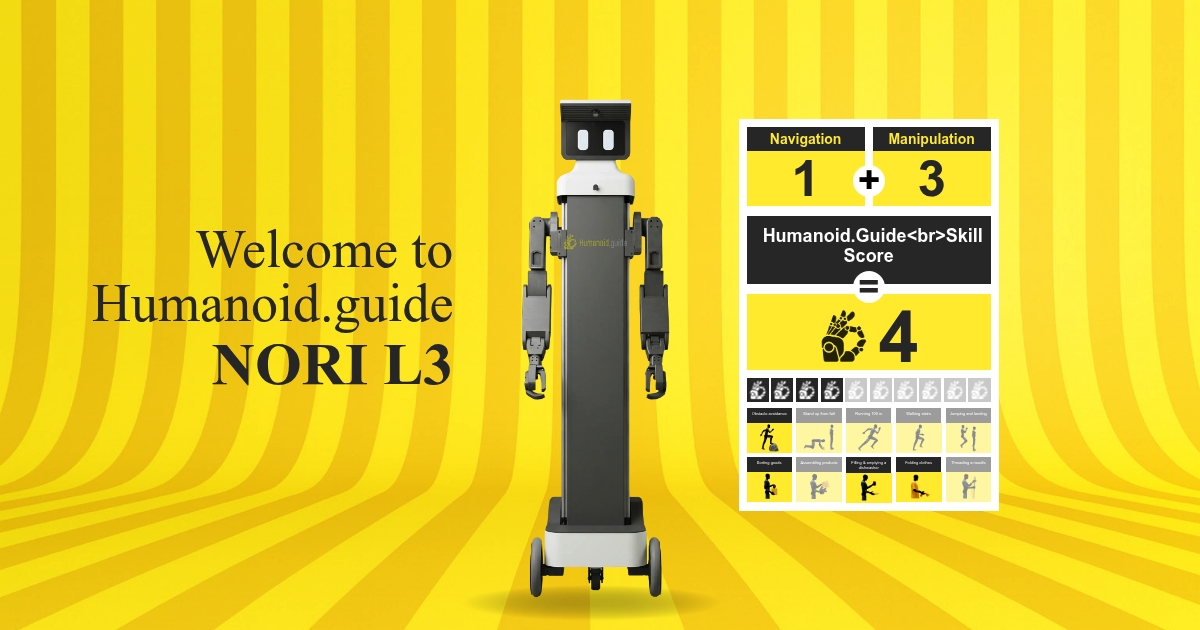
NORI L3 is a compact wheeled humanoid robot built by Nori Robotics for research, education, and home service experimentation. It combines a mobile base with two robotic arms, giving developers a platform that can move through indoor spaces and interact with objects instead of serving only as a stationary manipulator. The robot stands 145 cm tall, weighs 40 kg, reaches a top speed of 5.4 km per hour, and offers 20 degrees of freedom overall, including 16 in the hands. Its overall skill score of 4 places it in the developing tier, with a navigation rating of 1 and a manipulation rating of 3, which points to stronger arm and hand utility than autonomous mobility depth. The hardware stack includes electric servo motors, harmonic and planetary reducers, four 720p RGB cameras, Bluetooth, wireless networking, an AI computer, and a Linux based software platform called NORI Lab. Voice interaction, LLM integration, and a human safe design make it suitable for embodied AI testing in everyday environments.
The strongest story around NORI L3 is practical manipulation paired with indoor movement. It supports obstacle avoidance, which helps it operate around furniture, people, and common clutter found in labs, classrooms, and homes. Its manipulation profile is broad enough for sorting goods and handling structured domestic routines such as filling and emptying a dishwasher. More delicate tasks are also part of its capability set, including folding clothes and threading a needle, showing that the platform is not limited to simple pick and place behavior. These examples make it useful for teams working on perception driven control, grasp planning, multimodal instruction following, and voice guided household assistance. For education, it offers a concrete way to study how language, vision, and robotic action can work together in one embodied system.
NORI L3 is already in production, which gives it relevance beyond a concept demonstration and makes it a realistic option for universities, startups, and applied robotics groups that need hardware they can begin developing on now. The robot comes from China and is positioned as an affordable entry point into humanoid style research, especially for teams that want dual arm interaction without the cost and complexity of larger bipedal systems. Its broader significance lies in accessibility: by combining mobile operation, usable manipulation, onboard sensing, and support for modern AI software, it lowers the barrier to experimenting with embodied intelligence. That matters for the market because many developers need a platform for iterative software progress long before they require the highest tier of locomotion.