Machina 2026
Machina 2026 packed the world's top humanoid companies into Station F in Paris: Boston Dynamics, Apptronik, Google DeepMind, Agility, Schaeffler, LimX, 1X and more, back to back in 20-minute keynotes. We were in the room. These are our notes.
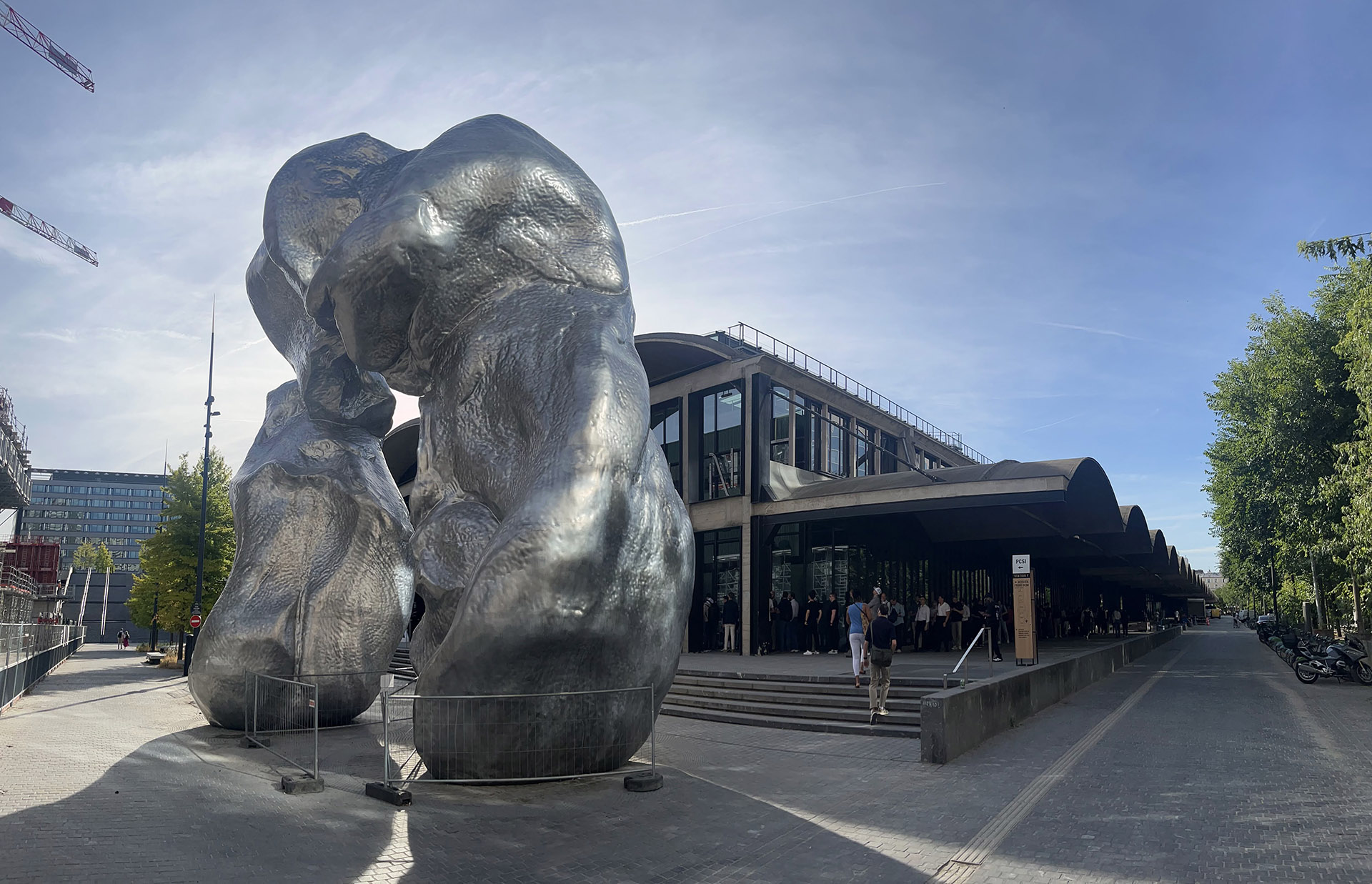
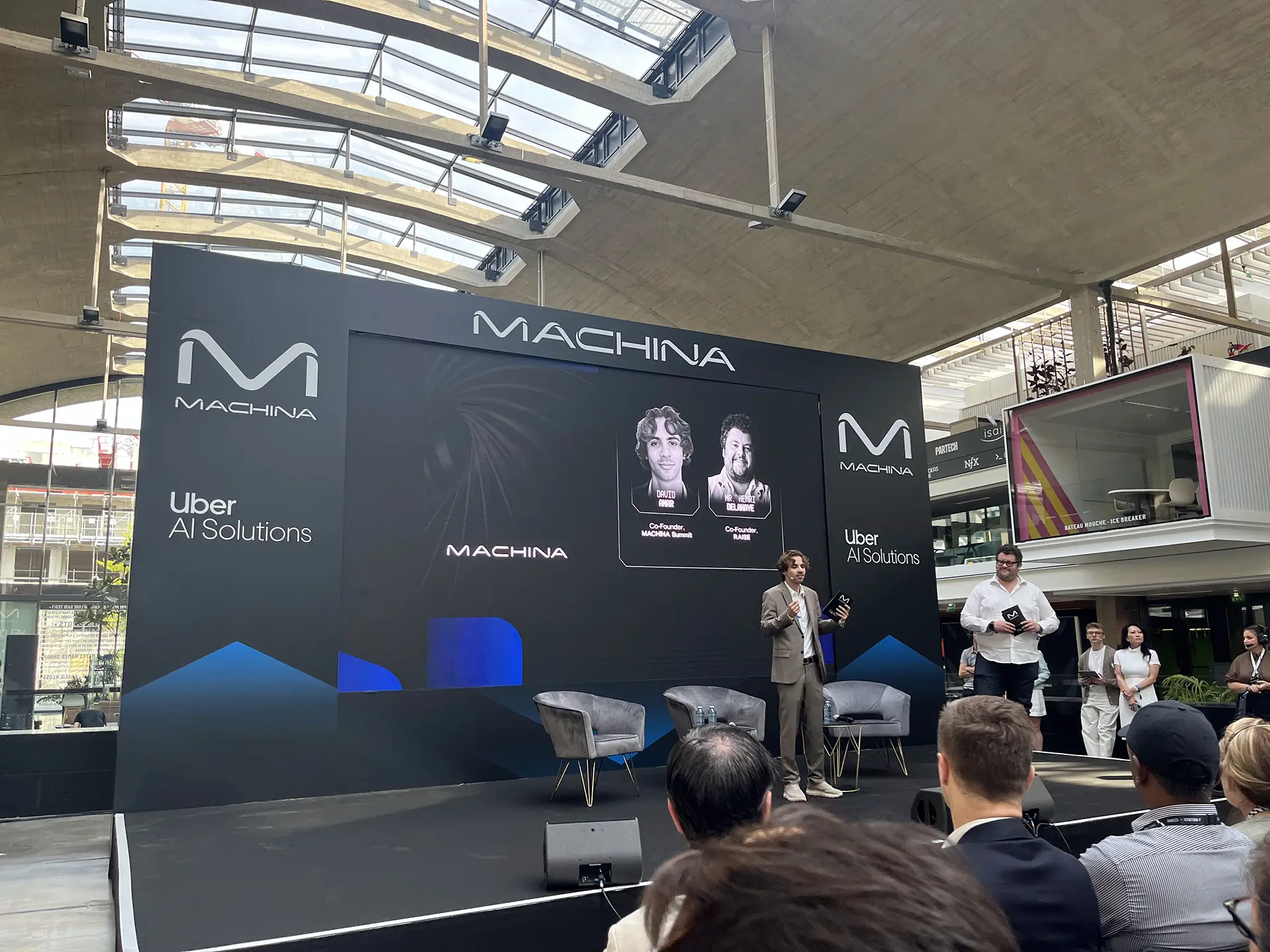
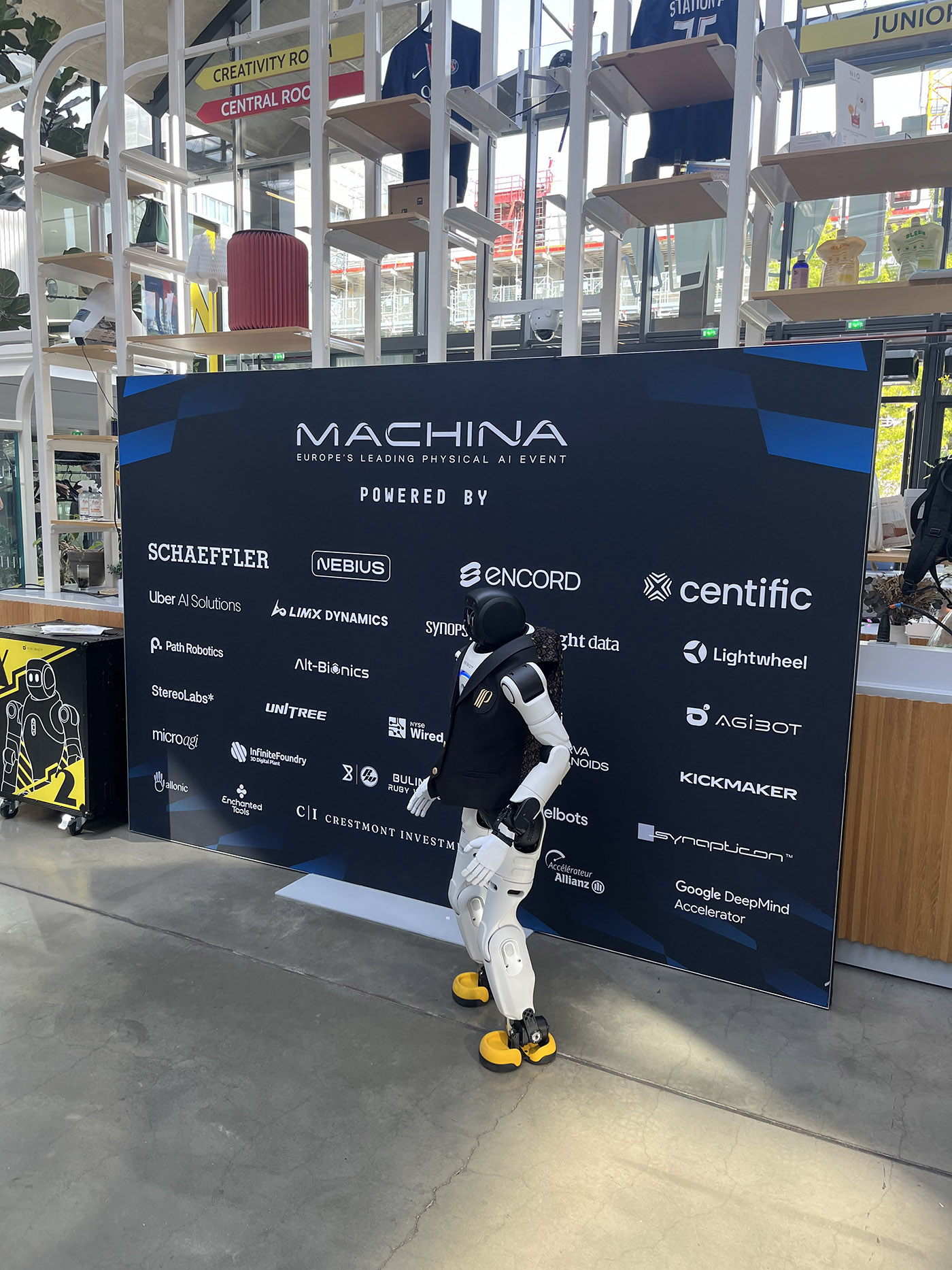
Machina 2026 was very well visited, highly professional and well organized, with top companies from all over the world – including the US and China. The venue was excellent: Station F, the national startup hub of France, highly modern and sponsored by OpenAI, Google, NVIDIA and others. The agenda was packed with 20-minute keynotes, back to back, no breaks – and almost all of them were high quality.
Machina 2026 · a quick look around Station F, filmed by humanoid.guide
The Warm-Up · Jim Fan in Three Minutes
The week started at Nebius Robotour Paris – a side event at Les Maquereaux on the Right Bank, hosted by Nebius, the AI-cloud company training a growing share of the world's robot foundation models, and co-hosted by Lukas Ziegler together with the RAISE Summit and MACHINA Summit teams. No panels, no presentations – just an open bar, hardware demos and a full room (event page). Then Jim Fan, Director of AI & Distinguished Scientist at NVIDIA, took the floor anyway. Three numbers and three strategies, in three minutes. He opened bluntly: "The time for robotics is now – and we're still early in the game."
-
–1.5% · the zero-trillion-dollar businessThe world is aging and there are not enough humans for the jobs required. Fan puts the loss from vacant jobs at 1.5% of GDP – more than $1 trillion. "We are in a zero-trillion-dollar business: zero today, one trillion ahead."
-
$40K · a humanoid at Walmart pricesA Unitree G1 is now listed on Walmart for $40K – roughly the price of a car, against the ~$2 million Honda's ASIMO cost twenty years ago. That is "about the highest price humanoids will ever have". From here it only falls, toward the cost of the raw materials.
-
10 million · an ecosystem formsNVIDIA's open-source GR00T models and physical-AI datasets have passed 10 million downloads. The whole community is building physical AI together.
His three strategies: models – the next paradigm is the world action model, physical AI that produces pixels, learns physics from video and predicts the next frame. Data – egocentric human data ("the new FSD": full-self-driving-style collection at fleet scale) plus ever faster, ever more realistic simulation. Learning – agentic robotics: "The LLM folks have had all the fun – so we're going to take some of their toys."
From the Machina stage, Fan went deeper with what he calls the Great Parallel: 2016, the first DGX and Jensen with Elon; 2020, GPT-3; 2022, InstructGPT; 2024, o1 surpassing imitation learning; 2026, AutoResearch. The LLM endgame is here – "they have a party. Robotics should have some fun too." His new bet is the World Action Model: instead of a traditional VLA taking a frame and predicting an action, the robot dreams – it generates video a few seconds into the future. Fan calls it the GPT-2 moment for robotics, with Cosmos simulating buoyancy, reflection and collision.
On data: the golden era of teleoperation (2022–2025) is bounded by 24 hours per day – in practice about 3. NVIDIA is going all in on egocentric data with EgoScale: 99.99% human videos, 20,000 hours, no robot data in pre-training. Add 50 hours of glove data and 4 hours of teleop, and EgoScale can sort cards or manipulate syringes. The endgame is fully autonomous robot research – and the physical Turing test: you cannot tell whether a human or a robot did the task.
Boston Dynamics
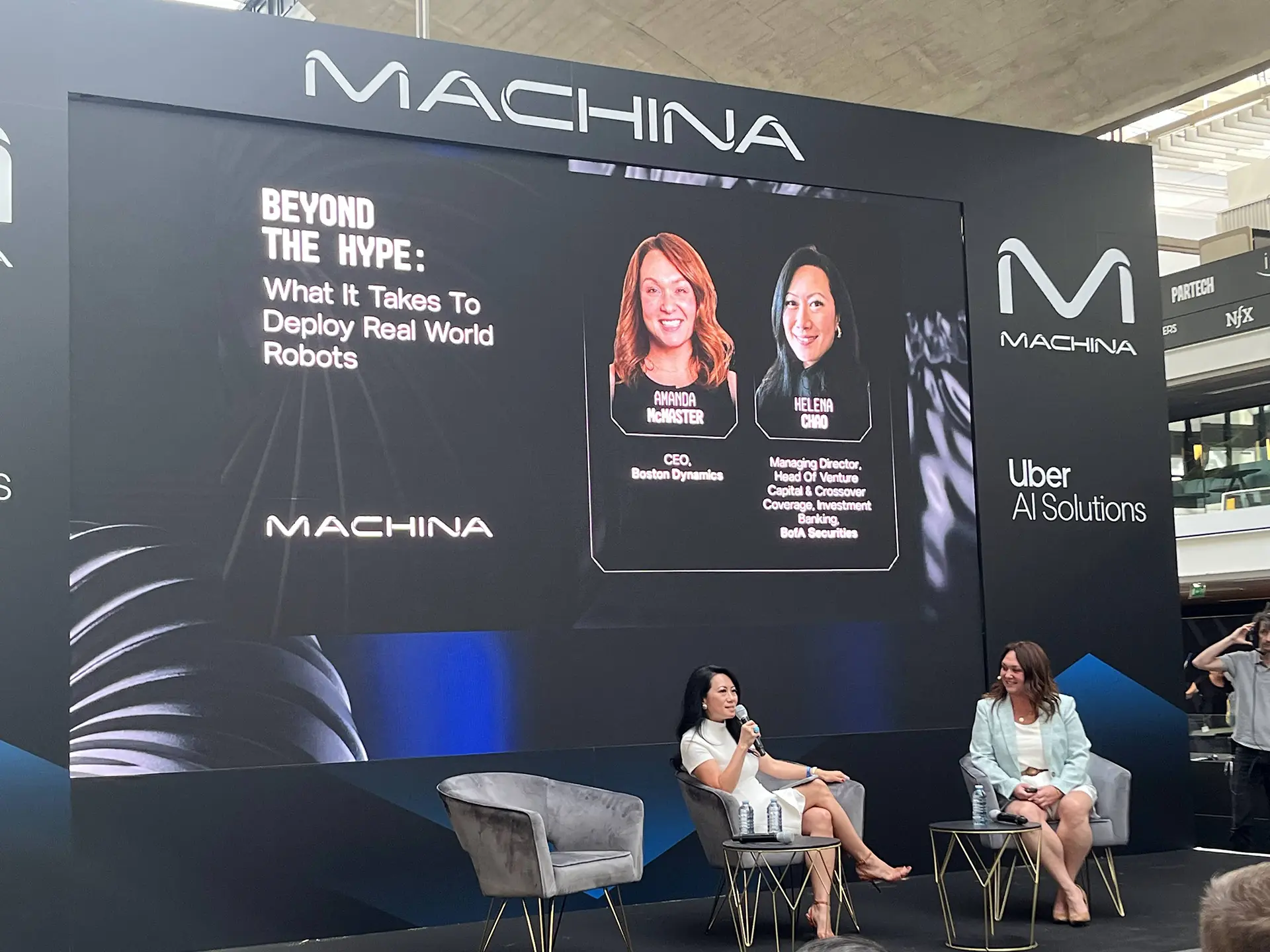
Interim CEO and CFO, Boston Dynamics · in conversation with Helena Chao, Managing Director and Head of Ventures, Bank of America Securities
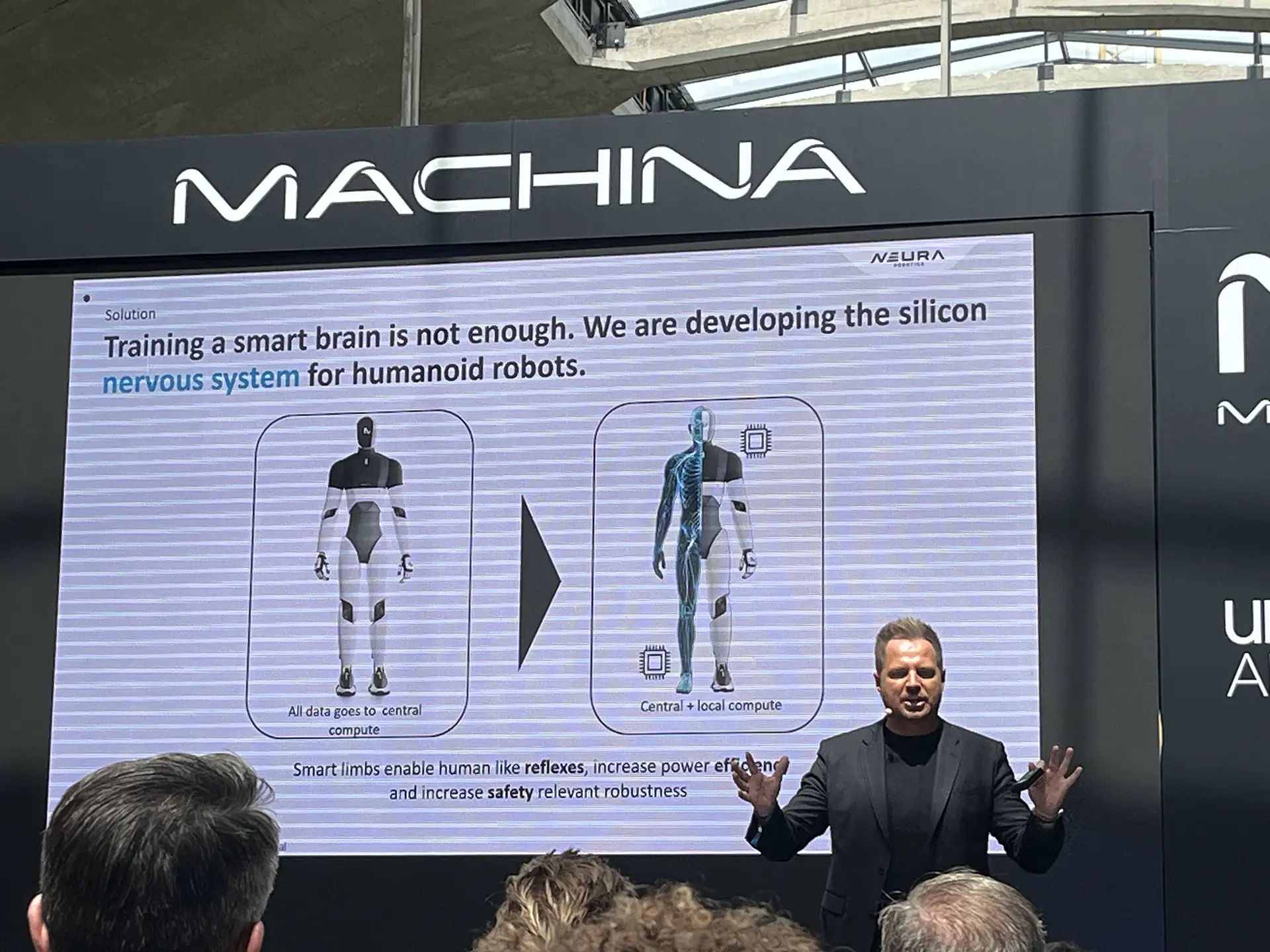
McMaster's message was scale. Create a scalable robot: on Atlas, arms and legs are interchangeable, and with Hyundai behind large-scale deployment, Boston Dynamics has cut 108 actuator types down to 2 in Atlas D1. She tests every project against four pillars: Does it work? Is it useful? What is the use of AI? Does it scale?
The Google DeepMind partnership covers physical skills and semantic intelligence, and a "job harness" – natural user interface, logical and spatial reasoning, user and factory fine-tuning – with a clear division of labour. When does a humanoid pay for itself? A two-year ROI or less is possible. Her advice to factories planning around humanoids: start with repeatable tasks and make it safe for humans to work alongside robots. Spot remains the primary product, and Boston Dynamics will establish skills development labs in 2027. Her milestone for physical AI one year out: do we have robots in the world – are they deployed?
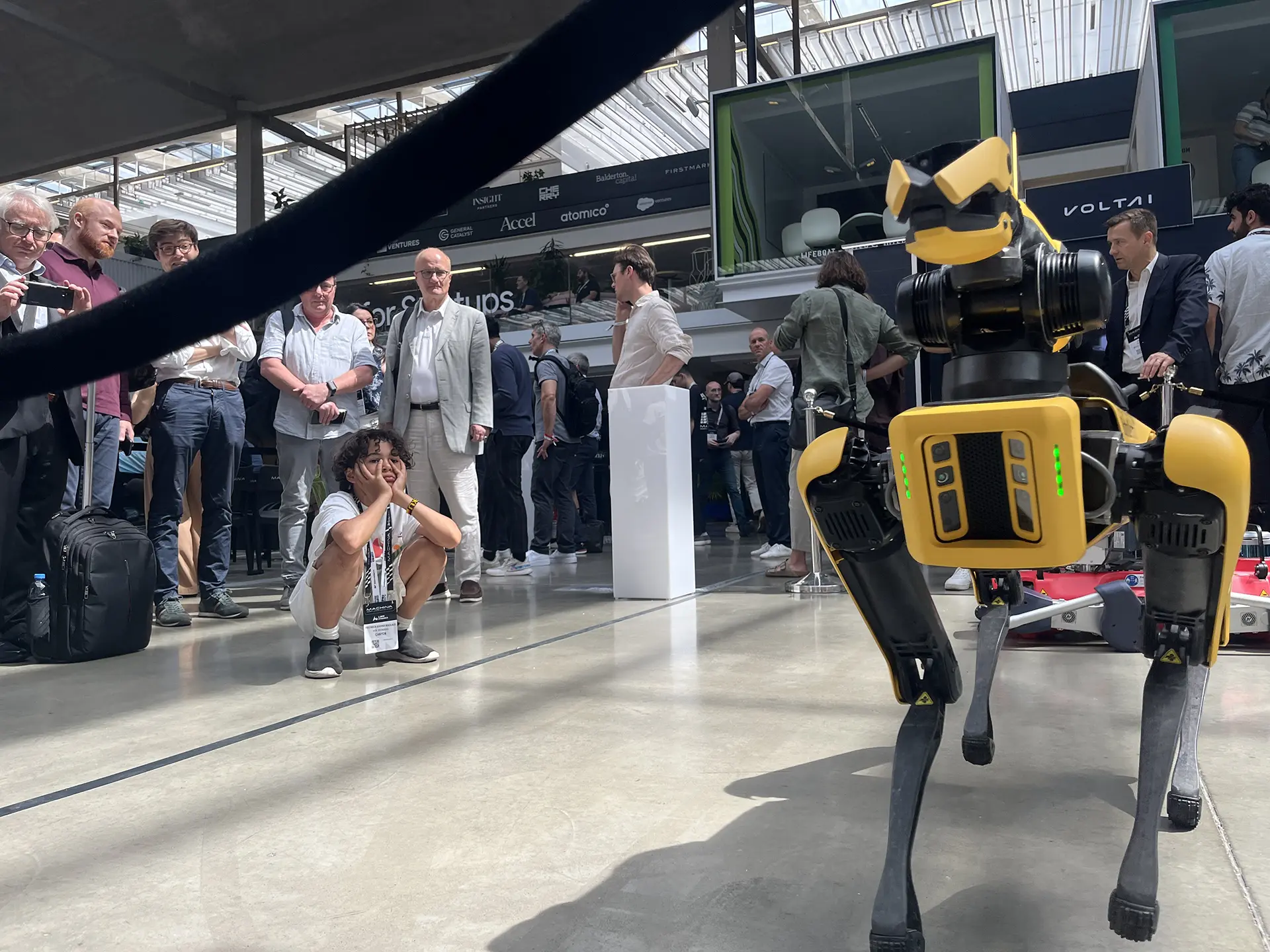
McMaster introduced Spot on stage herself: AI visual inspection built with Google DeepMind, feeding into Orbit AI. It lets humans engage with the robot directly – "inspect this area, tell me if there are any puddles."
Watch the conversation · Amanda McMaster (Boston Dynamics) with Helena Chao (BofA Securities) on the Machina stage, filmed by humanoid.guide
Standardization is how humanoids get cheap: Boston Dynamics went from 108 actuator types to just 2 in Atlas D1 – the same playbook carmakers used to industrialize.
Apptronik
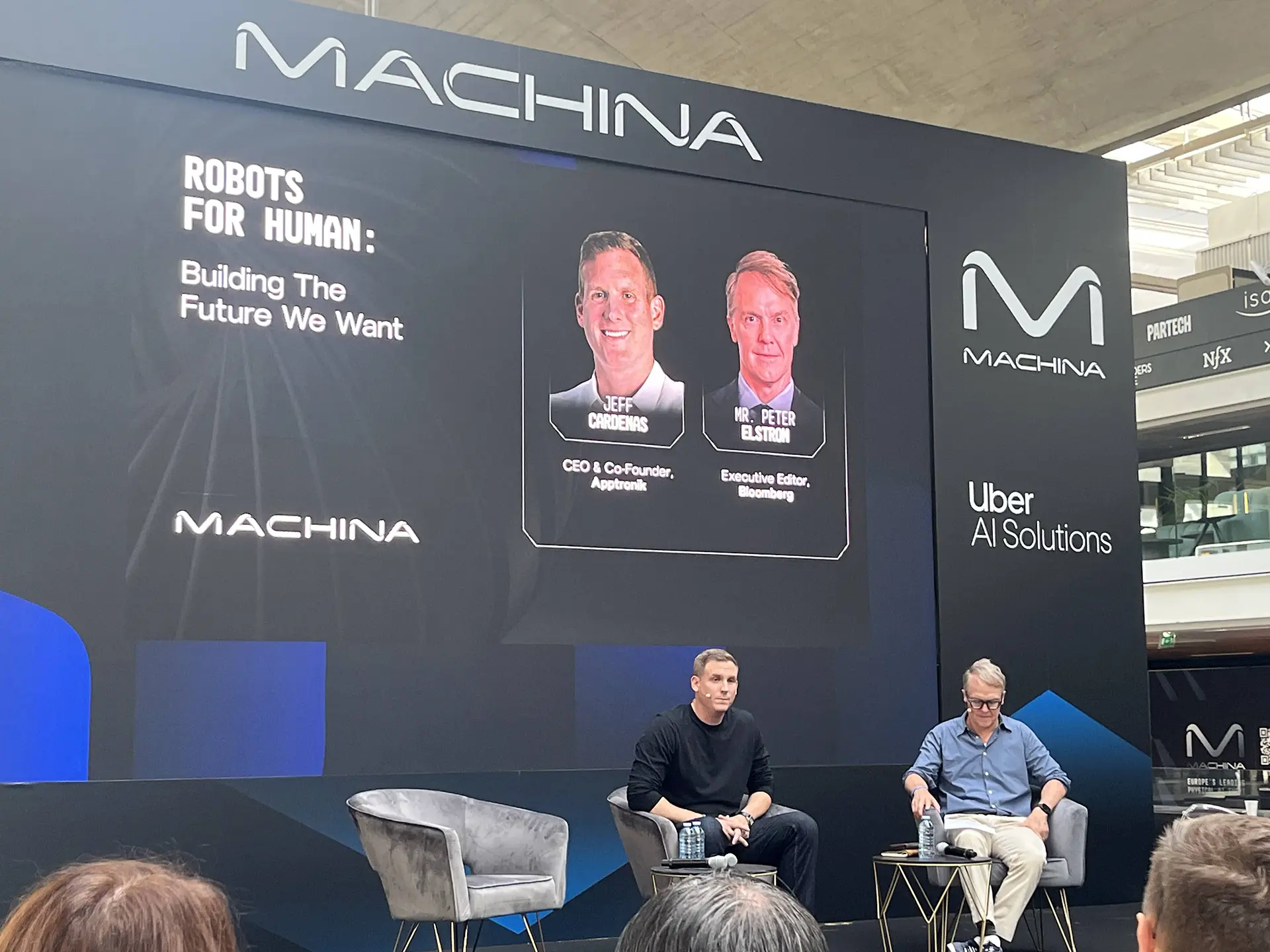
CEO, Apptronik · in conversation with Peter Elstrom, Executive Editor, Bloomberg
Apptronik – maker of the Apollo humanoid – started in Texas in 2016, spun out of the university in Austin. Cardenas splits humanoid deployment into three stages: technical feasibility, commercial viability, and commercial scaling – and people confuse the two latter. Today robots are "back of house" because of safety; soon they will be "front of house". The home is the last place we will see robots: the most unstructured environment there is, with stairs, pets, kids and hurdles – and liability to match. The more controlled the environment, the easier it is for the robot. Safety is the gate to scale.
Robot Park in Texas is his optimistic future: 90,000 square feet of large-scale data collection. It looks like a data factory – basically a warehouse. Retrofitability was the first hurdle; now the question is how to make the robot versatile and able to learn from humans. "For a long time we had a ceiling for development. That ceiling has been removed." The Google DeepMind partnership is two years old now, and synthetic data is scalable – it holds a lot of promise. "The beauty of robotics is showing without telling."
Ten years out, Cardenas expects billions of robots, in every facet of our lives – and he wants the US to have a robot industry to match. The US invented the first industrial robot in 1961; then the industry disappeared in the 80s. He calls for a US national robotics strategy, in line with Jeff Burnstein's testimony before Congress in April 2026. China had its strategy ready in 2021, backed by a $138 billion national fund. "What is our answer to that?"
Schaeffler
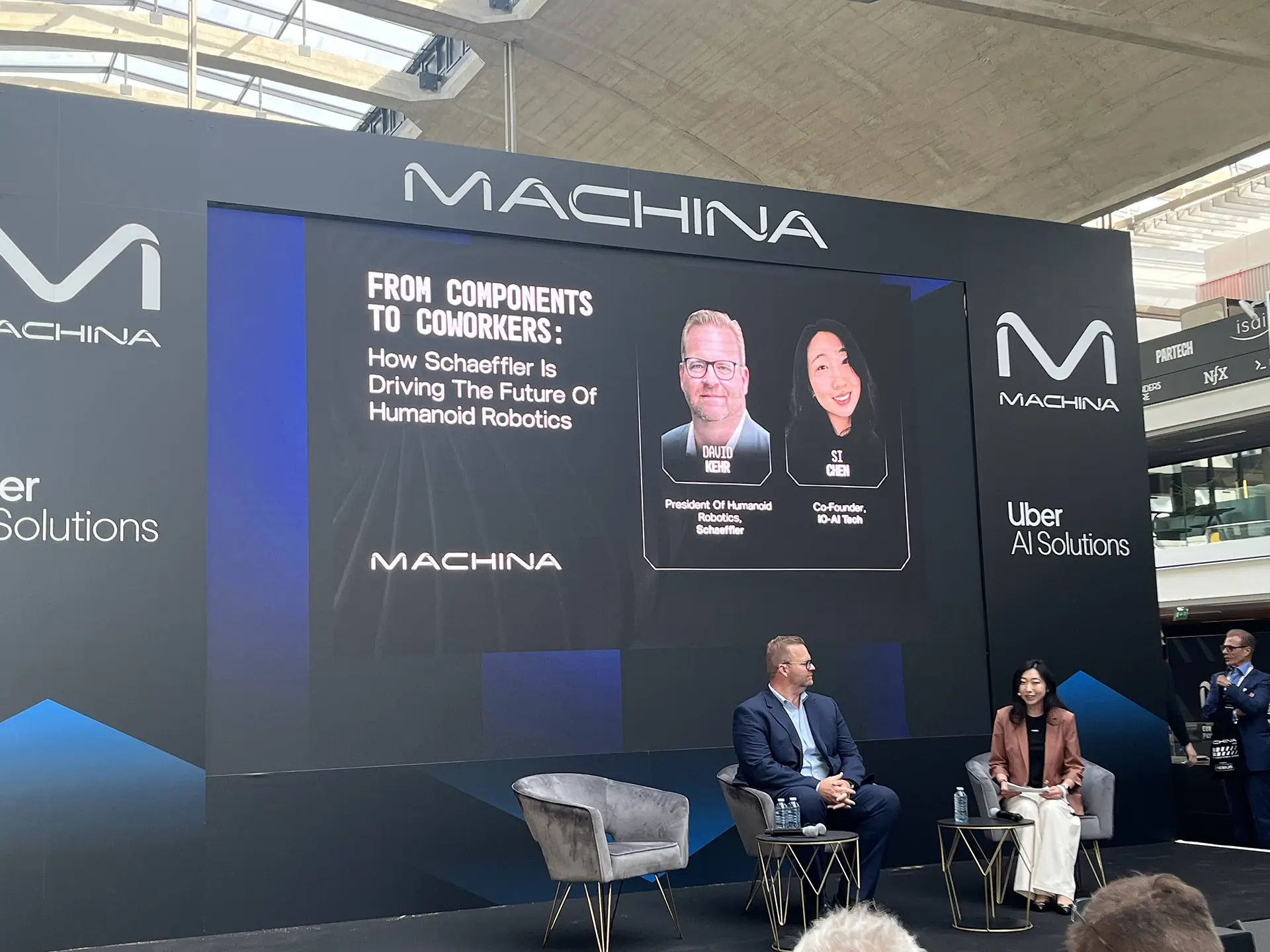
President of Humanoid Robotics, Schaeffler · in conversation with Si Chen, Co-founder, IO-AI Tech
Schaeffler brings 18 years of experience. They have the competencies – but they also need speed, and second, scale. Kehr's group is separated from the rest of the business and can operate autonomously, and their CEO is bullish on physical AI. They identified six use cases in their own factories, then found the right partners. "There is no better way to learn than to just get started."
Two sharp observations: off-the-shelf actuators are over-engineered – Schaeffler dissected them in order to ask suppliers to redesign their actuators. And on humanoid form factors they are agnostic: sometimes two arms, sometimes two legs, sometimes four. The target: 100 factories, some of them dark or brownfield.
Agility Robotics
Co-founder and Chief Robot Officer, Agility Robotics
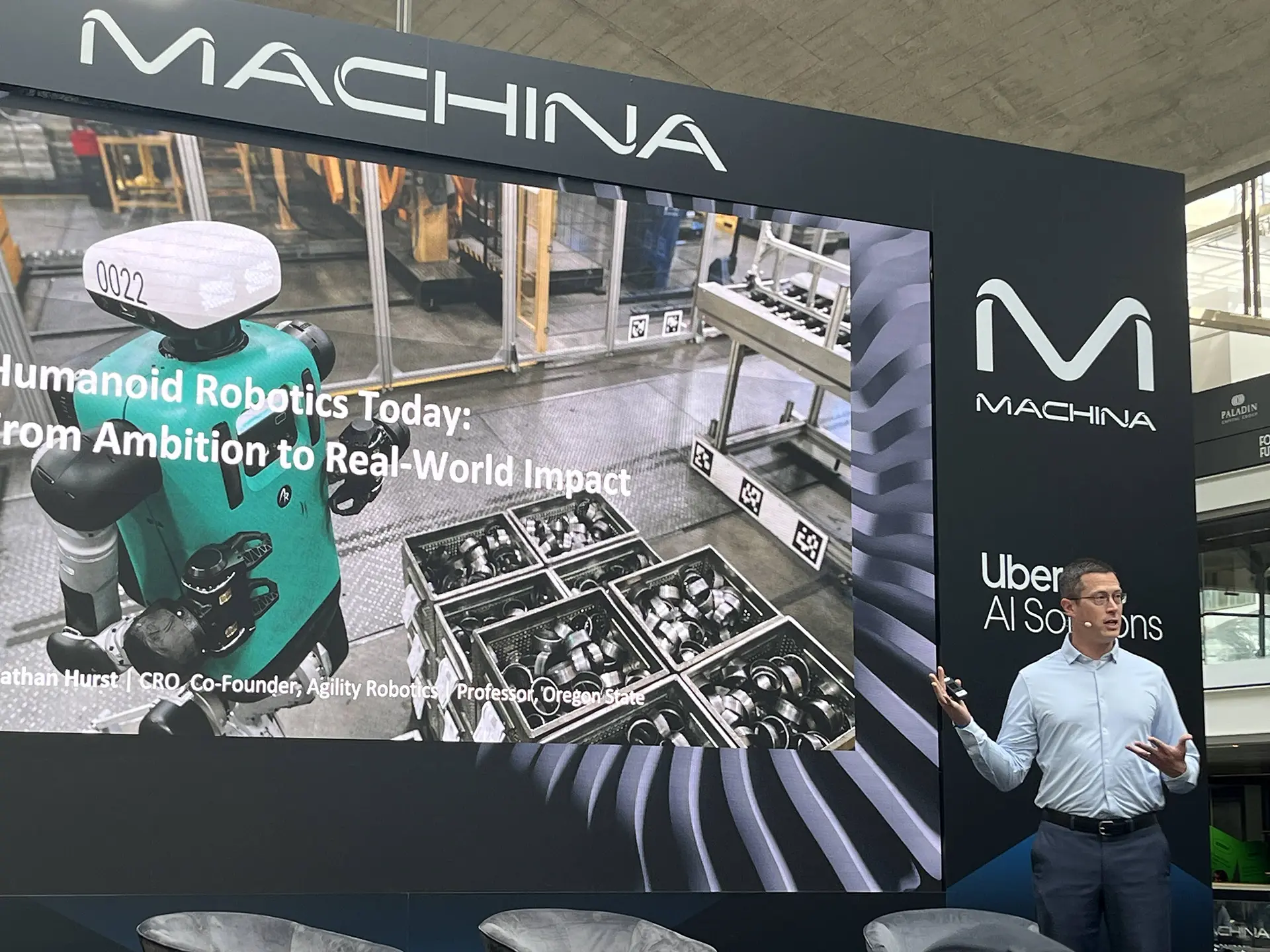
Hurst laddered up through technology history – from blacksmiths to laptops – to answer "why humanoids?": we are building human-centric robots. There is no silver bullet in how to create the AI software stack. Agility's Digit has been picking up bins for two years, at Amazon and Schaeffler – behind a physical barrier for human safety. It limits the robot's utility, but it has to be like this: a robot will fall, and judgement errors are a problem – hot coffee, how to touch a person.
The news: late 2026, Agility will release a machine that can detect people around it and adjust its behaviour – slow down or even power off – to exit the safety cage. His analogy is autonomous vehicles: safety drivers, fewer degrees of freedom, and roads far more structured than homes. Demonstrate the statistics of complex systems, and start with logistics and warehousing.
Path Robotics
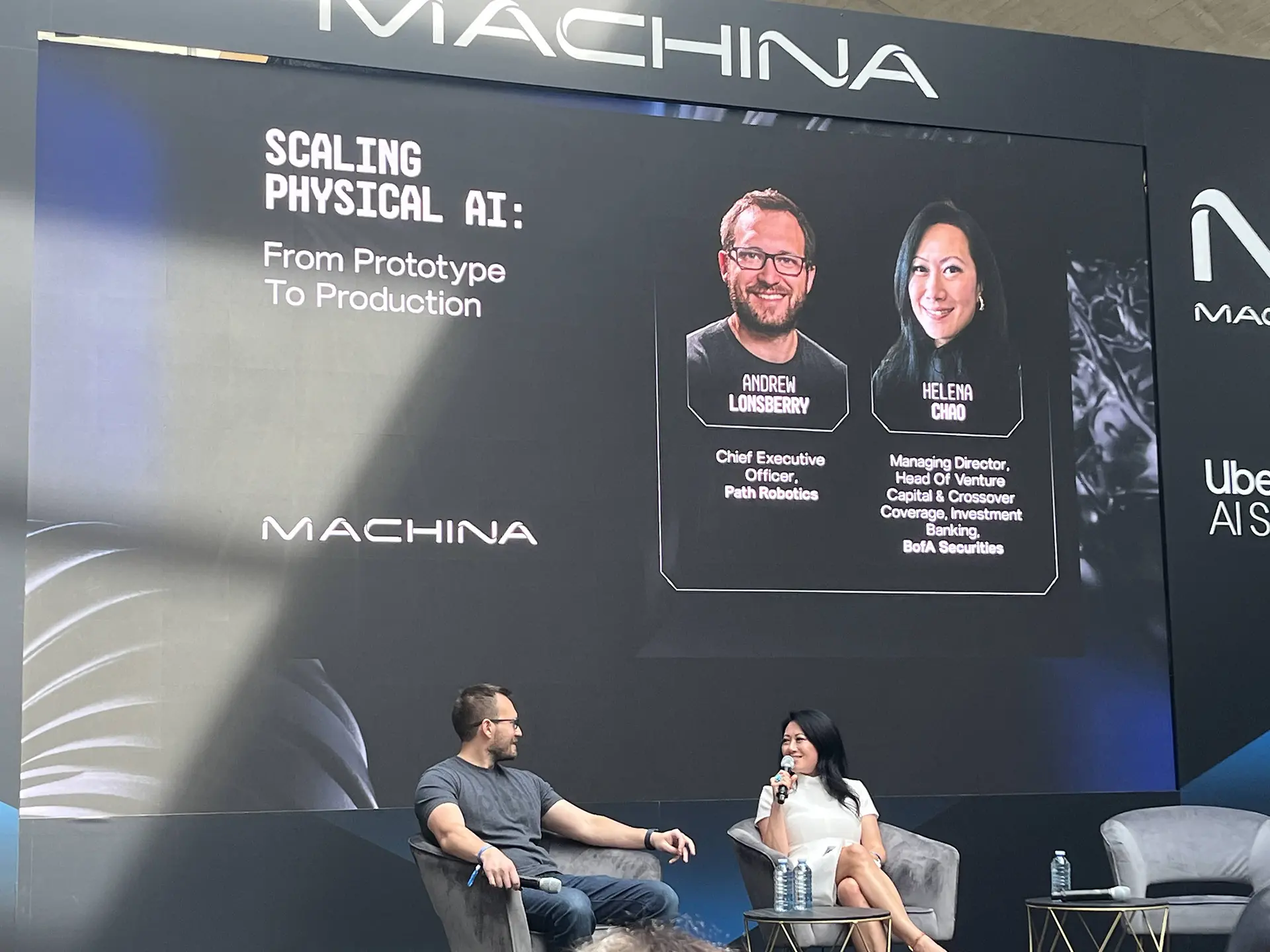
CEO, Path Robotics · in conversation with Helena Chao
Ten years ago the DARPA challenge went badly; Path was founded in 2018, and access to compute is now accelerating the development. His core concept is the data flywheel: to build a foundation model you need a data pipeline, and that means robots in the field collecting data. "The next 3–5 years will be mind-bending."
Having happy customers is difficult in robotics – robots get delivered to Fortune 100 companies that never deploy them. Can they deliver value? Path's answer is to start with the customer pain point, in verticals with extreme demands: energy, AI and defense. One use case from Canada: welding kits for data centres took 150 man-hours, and the customer needed to 10x its workforce. With Path Robotics, that came down to 9 hours. Year 1 is painful; year 3 is happy customers – and all of Path's customers are coming back, planning to double their revenue.
The vast majority of data will come from customers: "If you have your own data farm, you will not succeed in getting enough data – or it will be too expensive." In the end, robots will be a service business. And notably: their customers have not laid off a single worker – it is all about revenue, with floor bonuses for workers meeting the quota. What the industry underestimates is the operational layer: deploying at scale and turning on continuous learning. "This entire room is betting on continuous learning." The big bet is on post-training.
New! 2026 Humanoid
Robot Market Report
198 pages of exclusive insight from global robotics experts — uncover funding trends, technology challenges, leading manufacturers, supply chain shifts, and surveys and forecasts on future humanoid applications.

now Google DeepMind
Google DeepMind
VP and Head of Robotics, Google DeepMind · keynote: "From Language to Motion: How Gemini Powers the Next Generation of Robots"
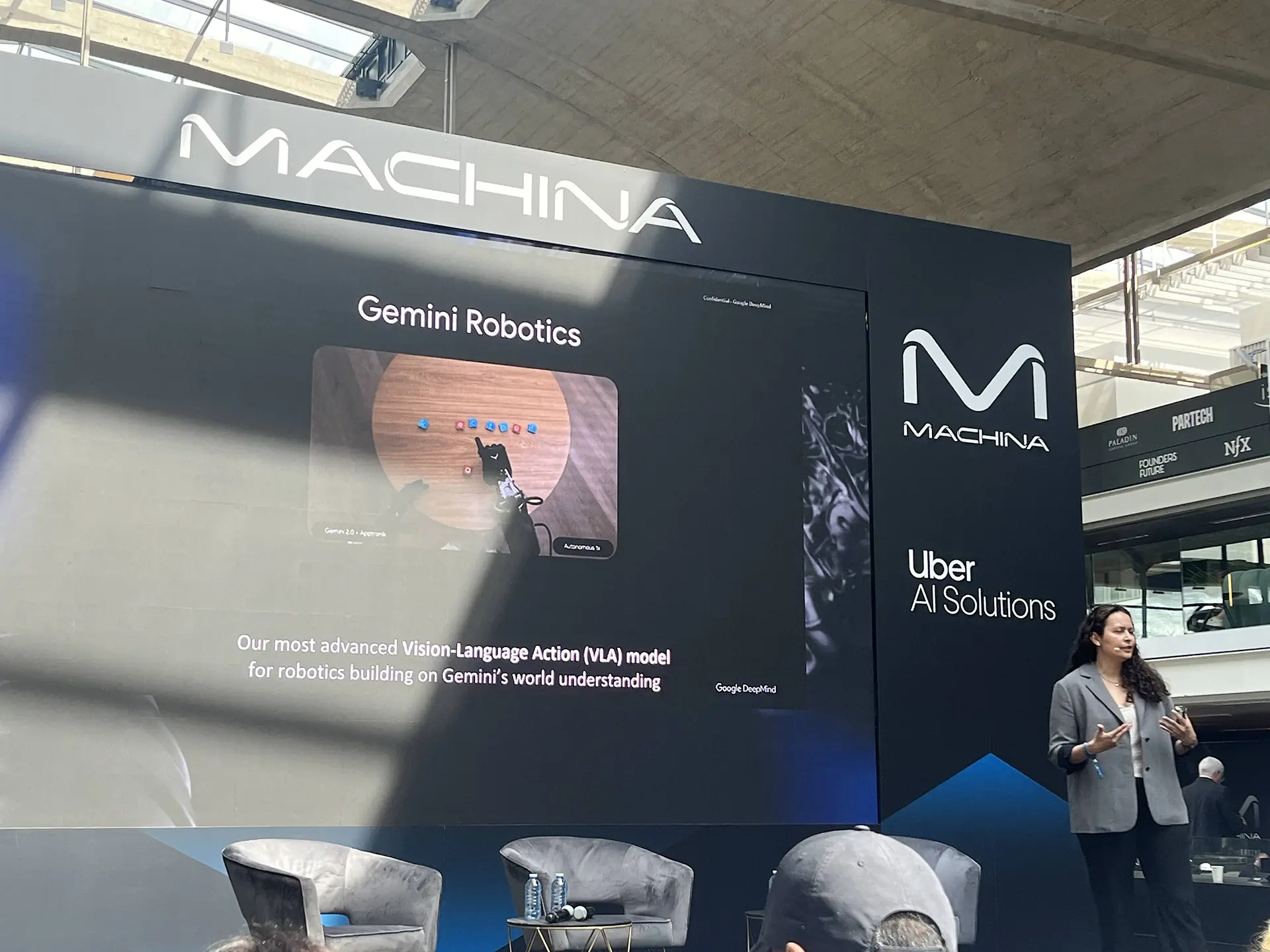
DeepMind is the core AI for robots right now – Boston Dynamics, Apptronik and others depend on them. Parada, newly promoted, laid out the arc: robots used to be programmed, which made them difficult to deploy – it took months to learn a new task. Now it is Gemini for the physical world, with a promise of intelligent general-purpose robots that are general, intuitive, safe and drop-in. The north star: solve AGI in the physical world.
In 2022, VLMs and LLMs entered robots – transformers understanding the environment semantically. The VLA – enabling natural-language and environment understanding – is now the industry default, and Gemini Robotics is Google's most advanced VLA, able to produce trajectories. Generalisation is hard, but they made a robot slam-dunk a basketball without training, across platforms like ALOHA, Franka and Apollo. The new GR 1.5 model powers physical agents: demos included a robot sorting waste based on the user's position, resetting a scene after changes (the robot has to understand what "reset" means), and pointing at, identifying and counting objects – helpful for logistics.
Instrument reading is where it meets Spot's inspections: agentic vision, where the model decides to zoom in, detects key points and delivers a final answer – 93% on the test set within just 3–6 months. The data pyramid runs on simulation with MuJoCo and world models, and it is now impossible to spot the generated video. Partners: Apptronik, Boston Dynamics, Agile Robots – plus a Trusted Tester Program (Enchanted Tools among them) and an EU Accelerator that just started for 2026.
Neura Robotics
CEO, Neura Robotics
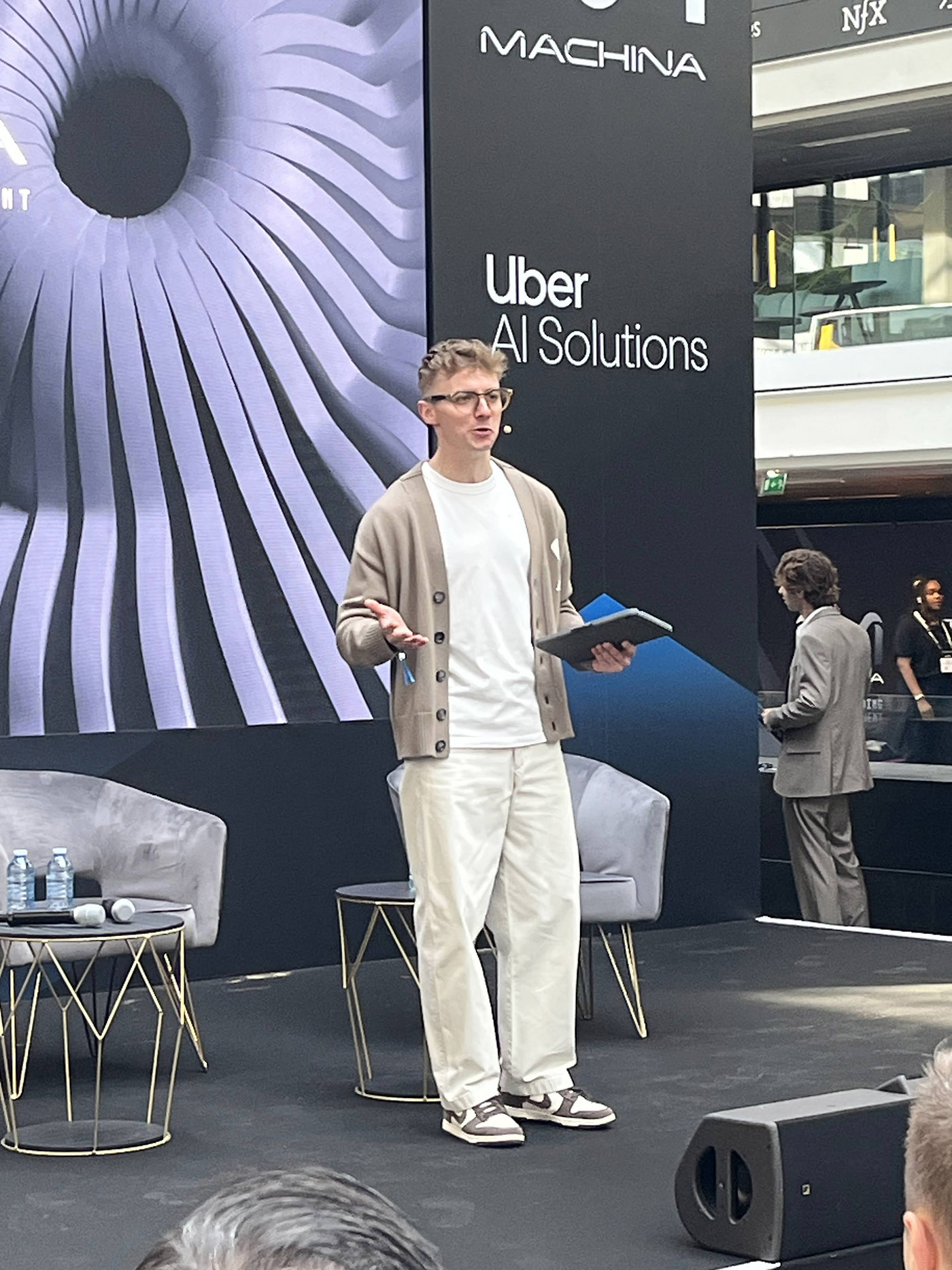
Reger's framing sticks: a human takes three hours to learn a factory job. A robot needs 10,000 hours – but after that, deployment takes 3 hours. How do you learn to swim? Someone telling you, showing you, watching videos, imagining? No. Neura uses a perception language model – a new proprietary standard – with central plus local compute. Neura gyms across the globe build each robot a "brain account", and the Neuraverse connects the internet of things with the robot. It controls everything.
The Legend
Founder, Boston Dynamics · in conversation with Marc Theermann, CEO, Boston Dynamics
Boston Dynamics always tried to be honest about successes and failures: figure out what the hardest problems are and work on them – some companies are too optimistic. "It was fun to crash robots. Put them on fire." Being acquired by Google brought a marketing department and commercial steps – more focus on liability engineering, marketing and customer success. Less time spent breaking glass.
He started the RAI Institute with zero revenue to work on the unsolved problems: real dexterity at par with humans does not exist, subway travel is currently impossible, semantic navigation is difficult. Any human can train inside a factory for 15 minutes and learn the task – "watch, understand, do" is a four-year-old program inside RAI. In twenty years there will be a lot more robots doing a lot more things. It took 12 years from the Tesla Roadster to the Model S; Raibert thinks robots need 10 more years. They are a success in warehouses – but in homes, cost and safety are fighting each other, and Alexa is the only current home tech. On when humanoids reach our homes, he made no guesses. Perhaps that comes later than we think.
OpenAI & Hugging Face
Head of EMEA startups, OpenAI · Chief Science Officer, Hugging Face · "Physical AI from code to action: where foundation models meet robotics"
An interesting European angle: at ETH Zurich they both build robots and train LLMs and VLMs – the combination of both. In the US you get hardware companies or software companies, not a mix. Europe is building communities: at ETH, the companies and teams split the problems between them and created a student robotics association. OpenAI's pipeline is research, products, deployment – broad research first – and the company claims to be at the forefront of robotics research, with the 2019 Rubik's Cube challenge as its calling card. OpenAI positions itself as the partner for new companies once they are in service.
On form factors, Wolf is sceptical of humanoids – "they are scary" – and likes the weird form factors. Modiani's advice to startups: use Codex. Robotics teams are the most savvy users of agentic AI.
Uber AI Solutions
GM, Uber AI Solutions · in conversation with Sandor Felber, CEO, Minerva Humanoids
Uber was born in Paris in 2008. The company internalised its data pipeline and now makes it available to customers, alongside Uber AV labs and autonomous partners – a new bet built on the Uber ecosystem apps: ID, payment, security, planning. The problem is data scarcity and edge cases: snow, braking, streets without names in China. Labelling and annotation are difficult, so data gets collected with sensors on backpacks and through delivery services. In China, the same people record the same scenario over and over before the video is sold.
The View from Shenzhen
CFO, LimX Dynamics · keynote: "Building General-Purpose Humanoid Robots: From Motion to Intelligence"
LimX started in 2022 with a question: what does the ecosystem for robotics require in the future? Two answers: a general-purpose humanoid, and a fully modular robot. Oli and Luna are general purpose; Tron is the world's first modular reconfigurable robot – put it on wheels, make it a centaur, or give it feet. The demo showed full-body motion control, catching a tennis ball in motion, and a 50 kg payload. Luna is feminine and moves without remote control – voice and visual interaction only. The system takes an agentic approach, and customers can use the open-source FluxVLA engine to train robots and collect data that feeds back into FluxVLA.
Liu's view of the future (he has argued China's robotics industry is "not crowded enough"): on data and models, real robots grow 100x in 2026, first-person video 1000x, with a rapid transition to world action models and real-robot manipulation RL. On hardware, China's supply-chain advantage remains and is hard to replace, with innovation moving in practical directions – underwater, reconfigurables, quadrupeds. On landing, expectations are high for moving from PoC to mass deployment with standardised, scenario-focused data and solutions. And China will go global, not only on hardware – the new China is global partnership. Good hardware enables 1+1>2: quadrupeds for inspection and logistics, bipedal humanoids for whole-body loco-manipulation. Models remain competitive, but user-oriented toolchains can be universally adopted for more efficient deployment.
Also on the Machina Stage
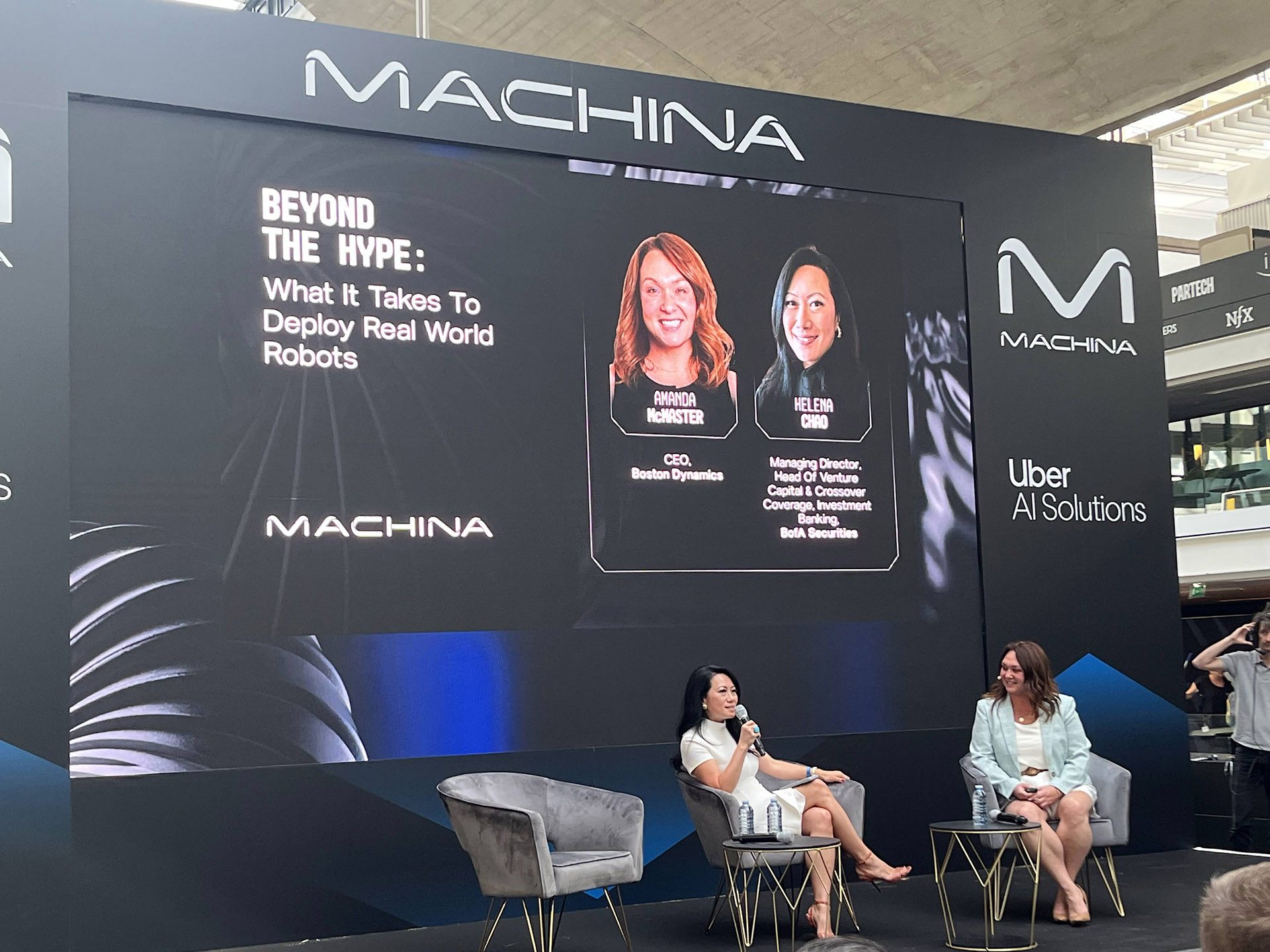
- 1X Technologies · Bernt Børnich: emphasised safety and data training – and made the biggest news of the show: 1X is setting up a data farm where developers can rent or use its robots to train them, instead of buying one. A remote training centre.
- Galbot · Yuli Zhao, Chief Strategy Officer: AstraBrain, driven by Astra Data – the biggest dataset, with 2 billion frames of human data to train models. Focus on wheels, and the first tennis-playing robot.
- Persona AI · Nicolaus Radford: keynote "Humanoids at Work – Building the Machines That Build the World". HARI – the humanoid adaption readiness index – says the home is the last place. Heavy industrial focus: welding on ships, 1,000 workers, a partnership with a US state – and a partnership with Under Armour on padding, shoes and softgoods. The company is 18 months old. Impressive.
- Liquid AI · Ramin Hasani: builds its own foundation models – cheaper and better.
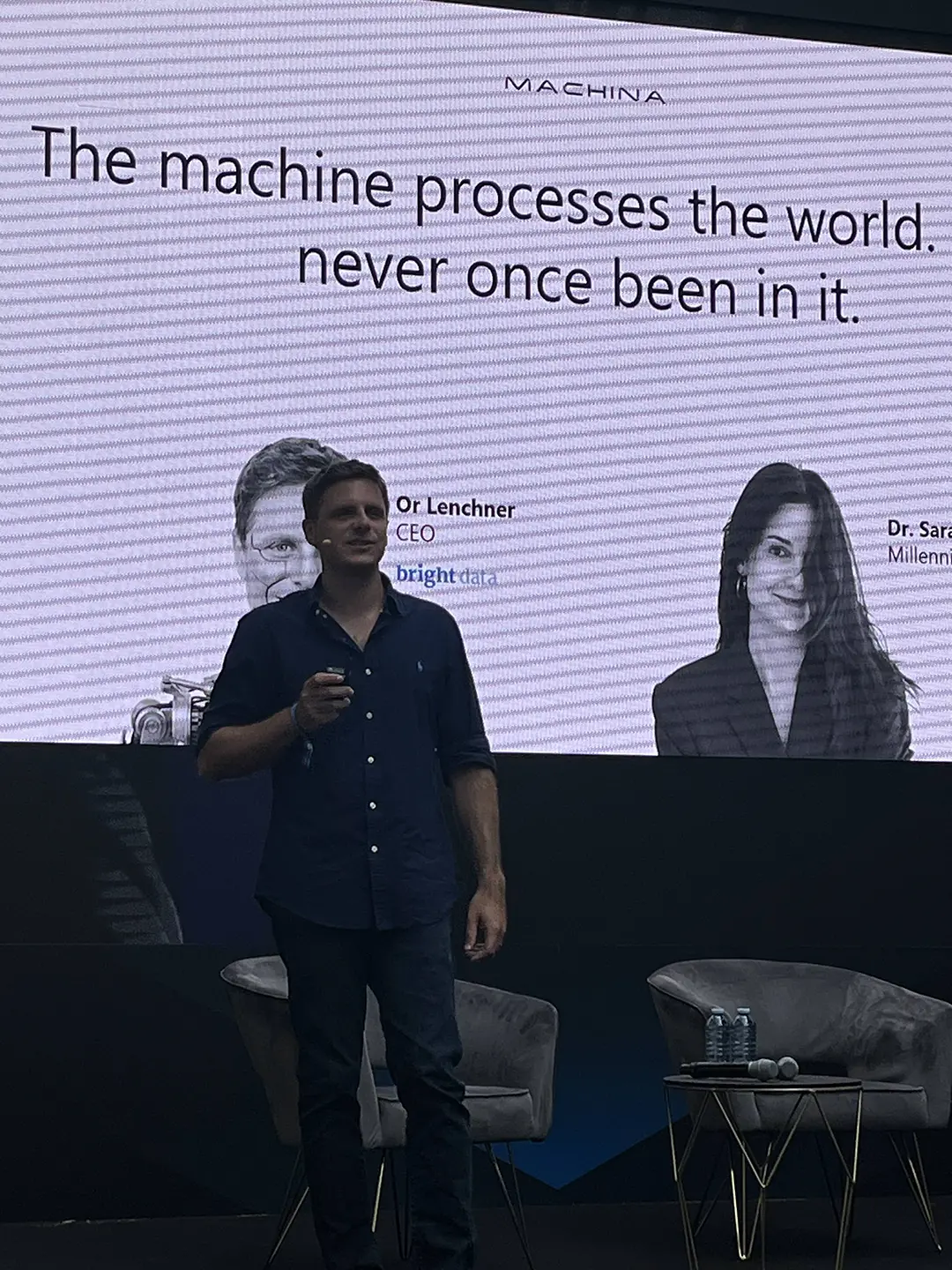
- Bright Data · Or Lenchner: the philosophical interlude, opening with a near-death surfing experience in Australia. What does it mean to be human, and will AI be able to replicate it? Humans and humanoids experience differently – we are afraid of the unknown. AI "understands", "knows" or "believes" something when it is pattern-matching on tokens; it gets confused and produces incoherent outputs; it does, refuses, likes – and apologizes without remorse.
Voices from the Floor
Between the keynotes we kept the camera running. Here are quick interviews and moments picked up on the floor at Station F – shot vertical, as they happened.
Interview from the floor · Machina 2026
Interview from the floor · Machina 2026
Interview from the floor · Machina 2026
Interview from the floor · Machina 2026
Interview from the floor · Machina 2026
Interview from the floor · Machina 2026
Interview from the floor · Machina 2026
All clips filmed by humanoid.guide at Machina 2026, Station F, Paris.
Key Findings from Machina 2026
The best keynotes were the ones you have just read. Across two days, a few threads kept coming back. Safety is the gate to scale – Cardenas said it, Hurst built his roadmap around it, and Børnich emphasised it. Google DeepMind is the AI backbone that Boston Dynamics, Apptronik and others depend on. The data race has moved to humans: egocentric video at NVIDIA, 2 billion human frames at Galbot, customer-generated data at Path, and 1X's data farm – the biggest news of the show.
And one telling silence: the founder of Boston Dynamics refused to answer when he thought humanoids would be present in homes. Perhaps this will come later than we think.
Machina 2026 delivered. We should join next year as well.
"Robotics right now is like LLMs in 2020. The upside is colossal. Stop laughing – start building."
Jim Fan's challenge stood for the whole week. We'll keep tracking who takes him up on it.
New! 2026 Humanoid
Robot Market Report
198 pages of exclusive insight from global robotics experts — uncover funding trends, technology challenges, leading manufacturers, supply chain shifts, and surveys and forecasts on future humanoid applications.
now Google DeepMind