Welcome, Eno!
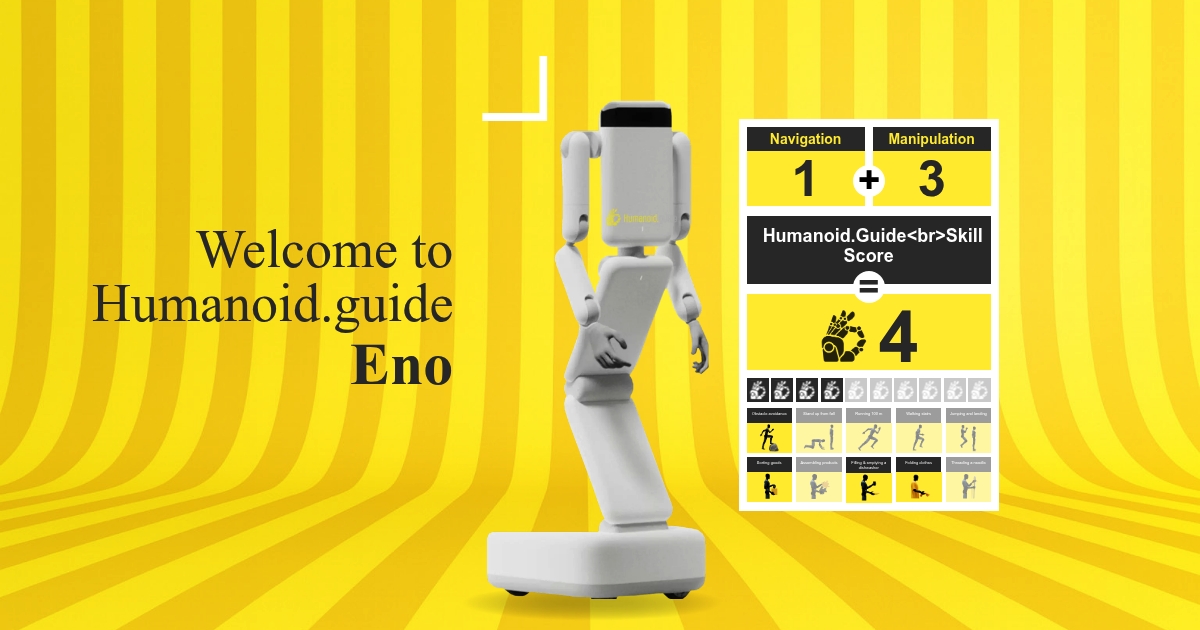
Eno is a general purpose humanoid focused on practical work rather than humanlike walking. It uses a wheeled mobile base, an adjustable upper body, and dexterous two handed manipulation to operate in structured environments such as factories, laboratories, hospitals, logistics sites, and commercial settings. Standing 170 centimeters tall and weighing 120 kilograms, it combines mobility with a payload strength of 12 kilograms and a runtime of up to 8 hours per charge. Its top speed reaches 6 kilometers per hour, and its electric servo actuators support controlled motion for handling tools and objects. Safety around people is a core part of the design, and the system is intended to work in shared spaces. The robot uses ten fingers across two hands and is built from aluminum alloys, composites, and engineering plastics. Its overall Humanoid Guide skill score of 4 places it in a developing stage, with navigation rated 1 out of 5 and manipulation rated 3 out of 5, highlighting stronger progress in handling tasks than in mobile autonomy.
A key strength of Eno is its manipulation centered design. Human scale hands let it use existing tools, fixtures, and appliances without requiring workplaces to be rebuilt around the robot. Its current capability set includes obstacle avoidance during movement and task execution, which supports safe operation in busy indoor environments. On the task side, it is positioned for practical service and logistics work such as sorting goods, plus domestic style routines including filling and emptying a dishwasher and folding clothes. Those examples point to a robot aimed at useful repeatable workflows where hand use matters as much as movement. Combined with its adjustable body and wheeled base, Eno is tailored for stations, carts, benches, shelves, and rooms where stability, reach, and dexterity can matter more than legged locomotion.
Eno is currently a prototype from Genesis AI in the United States, and it is tied closely to the company’s proprietary robotics platform and its GENE foundation model. That integration gives the robot a unified hardware and software stack with cloud connectivity, Ethernet, Wi Fi, and large language model support for planning and multi step task execution. Genesis AI has positioned Eno as an early platform for targeted customer deployments in manufacturing, logistics, and laboratory settings by the end of 2026, with broader sector expansion expected afterward. Its significance lies in offering a different path for humanoid development, one that prioritizes useful hand centered work, reliability, and compatibility with existing human environments. For organizations exploring automation, Eno represents a purposeful blend of mobility, dexterity, and adaptable robot intelligence.