Figure AI humanoid robot nearly matches intern in sorting test
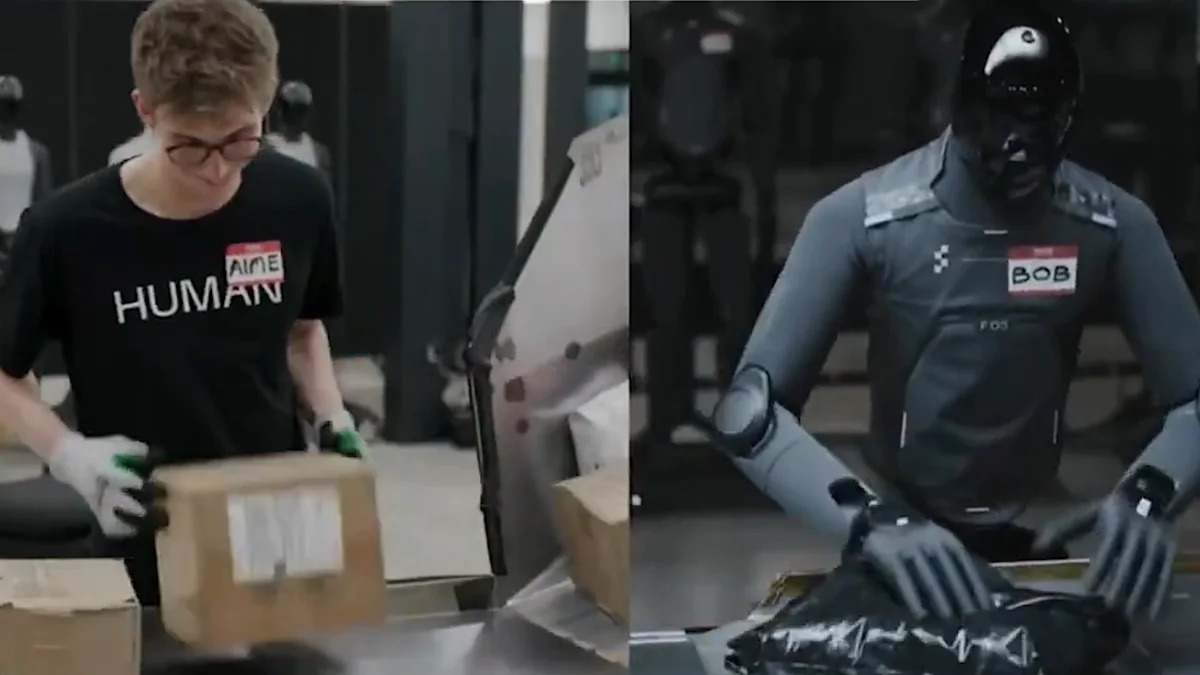
A Figure AI humanoid robot came within fewer than 200 packages of beating a human in a 10-hour parcel-sorting challenge, offering a concrete benchmark for warehouse-style humanoid work. Figure AI said its F.03 system sorted 12,732 packages, while intern Aime sorted 12,924 in a test centered on barcode scanning, parcel identification, and conveyor placement.
The result matters because it moves the discussion around humanoid labor away from short demo clips and toward sustained throughput on a repetitive industrial task. On the published figures, the human averaged 2.79 seconds per package, while the robot averaged 2.83 seconds, a gap of just 0.04 seconds per parcel.
Figure AI humanoid robot tested on parcel sorting
As tech.yahoo.com reports, the challenge was built around a familiar logistics workflow rather than a novelty demonstration. The job sequence was simple and measurable: scan a barcode, identify the parcel, and place it onto a conveyor belt, which makes the output easy to compare over a long shift.
The article also said Aime worked the full shift with a lunch break, while the robots rotated in and out about every hour. That meant the machine side could keep running continuously across the full 10-hour test, a notable detail because long-duration operation is often as important as peak speed in warehouse automation.
Figure AI identified the robot system as F.03. The source does not provide technical specifications for the platform in this test, but the published result still gives operators a narrow and relevant data point: a humanoid system remained close to human pace on a physically repetitive sorting workflow over an extended period.
What the sorting result actually showed
The headline result is that the human still won, but only narrowly. Aime finished ahead by just under 200 packages, and the per-package timing suggests the gap was measured in consistency and endurance over thousands of repetitions rather than in any large difference in raw cycle speed.
Figure AI CEO Brett Adcock framed the outcome aggressively on X, writing, “This is the last time a human will ever win.” That statement should be read as company prediction rather than established fact, but it does reflect how Figure wants the test understood: not as a robot victory, but as evidence that a humanoid system is approaching human productivity on a constrained warehouse task.
At the same time, the published numbers leave several operational questions unanswered. The source focuses on throughput, not on error rates, intervention frequency, or how parcel variability may have affected either side, all of which would matter in a commercial deployment decision.
Why parcel sorting is a meaningful humanoid benchmark
Parcel sorting is one of the clearest warehouse use cases for humanoids because it combines repetitive upper-body motion, object recognition, and sustained pace. The source notes that this kind of work can be physically demanding over long stretches, which is one reason logistics operators continue to evaluate robotic systems for scanning and sorting roles.
That does not mean the economics or deployment model are settled. A controlled contest can show capability progress, but warehouse adoption depends on broader factors such as uptime, integration with conveyors and scanning systems, safe handoff between people and machines, and the cost of maintaining productivity over many shifts.
The article also points to Figure AI’s continued software development, noting that the company introduced its proprietary AI system, Helix, in 2025 for robot integration. That suggests the company views progress in this area as a combined robotics and software problem, not simply a matter of faster hardware cycles.
For the humanoid sector, the significance of this test is less about a promotional “man versus machine” framing and more about the narrowing performance gap on a specific industrial task. What remains unclear is whether Figure AI can translate this near-parity result into repeatable warehouse operations at scale, where consistency, fault handling, and total system cost matter as much as seconds per parcel.
Source: tech.yahoo.com