Shenzhen opens pilot humanoid robot production line
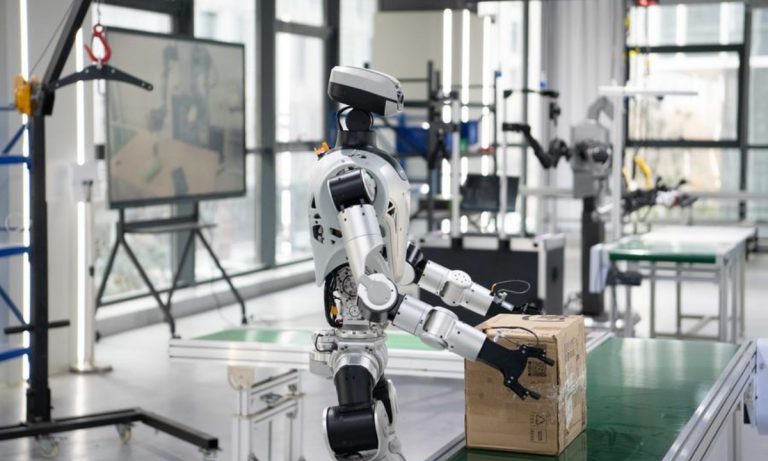
Shenzhen has launched its first pilot production line for humanoid robots, marking a transition point from prototype development toward scalable manufacturing. The facility, located in the city’s Longhua district, began operations on April 12 and is designed to support early stage production and process validation.
2026 Humanoid Robot Market Report
160 pages of exclusive insight from global robotics experts – uncover funding trends, technology challenges, leading manufacturers, supply chain shifts, and surveys and forecasts on future humanoid applications.

Featuring insights from
Aaron Saunders, Former CTO of
Boston Dynamics,
now Google DeepMind

2026 Humanoid Robot Market Report
160 pages of exclusive insight from global robotics experts – uncover funding trends, technology challenges, leading manufacturers, supply chain shifts, and surveys and forecasts on future humanoid applications.
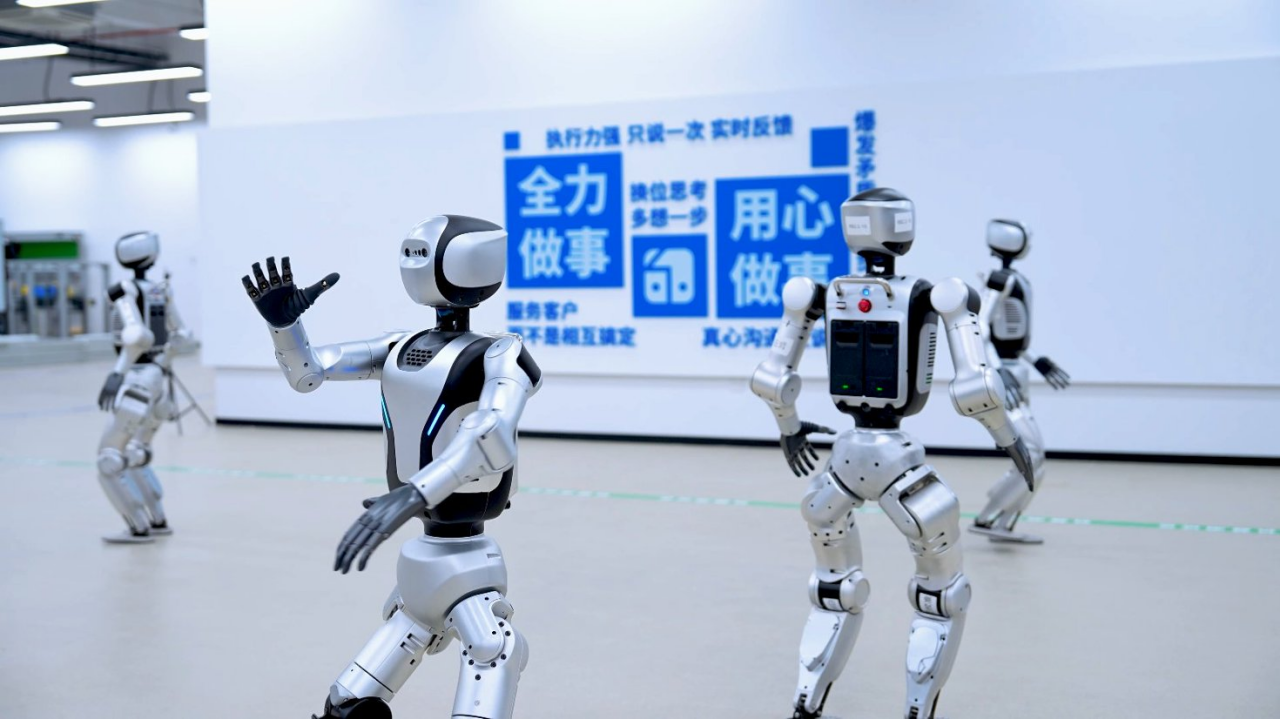
The line is currently configured to assemble Leju Robotics’ Roban 2 research and education humanoid robot. According to the company, each unit can be assembled in approximately two hours, with annual output expected to reach between 500 and 1,000 units during the pilot phase.
Following certification, production is expected to scale at a separate facility in Foshan. That site, co-developed by Leju Robotics and a high end intelligent equipment manufacturer, is described as China’s first automated humanoid robot production line with an annual capacity exceeding 10,000 units. At full operation, it is designed to produce one robot every 30 minutes.
The pilot line incorporates 24 precision assembly processes. Each robot undergoes 77 inspections and 41 scenario based tests prior to shipment, simulating real world operating conditions. These validation steps are intended to address one of the central bottlenecks in humanoid robotics: ensuring consistency and reliability when moving from lab scale builds to repeatable manufacturing.
Industry participants have identified high costs, variable quality, and unstable production processes as key barriers to commercialization. Pilot lines such as the one in Shenzhen are used to standardize workflows, refine supply chains, and establish repeatable quality control procedures before committing to higher volume output.
Leju Robotics indicated that its broader platform has achieved a localization rate of more than 95 percent across its humanoid system, reflecting the maturation of regional supply chains. The Guangdong Hong Kong Macao Greater Bay Area is increasingly positioned as a manufacturing base for humanoid robots, supported by regional policy initiatives and industrial infrastructure.
China’s 15th Five Year Plan for 2026 to 2030 identifies embodied intelligence as a priority sector and calls for expanded concept validation and pilot verification platforms. Local governments, including Shenzhen and Guangdong province, have introduced policies aimed at accelerating pilot production and the development of smart factories.
Market forecasts suggest that 2026 will be a pivotal year for commercialization. TrendForce estimates that global humanoid robotics will enter a critical growth phase in the second half of the year, with China’s production projected to increase significantly compared with 2025.
The Shenzhen pilot line reflects a broader shift across the industry, where attention is moving from demonstration capabilities toward manufacturability, cost control, and supply chain integration. For operators and system integrators, the emergence of standardized production processes may prove as important as advances in locomotion or manipulation in determining near term adoption.
Source: chinadailyasia.com