Humanoid AI puts HMND 01 humanoid on wheels for industry
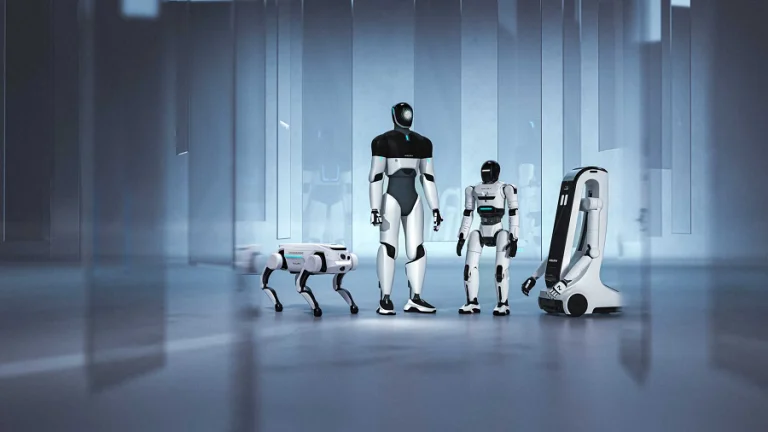
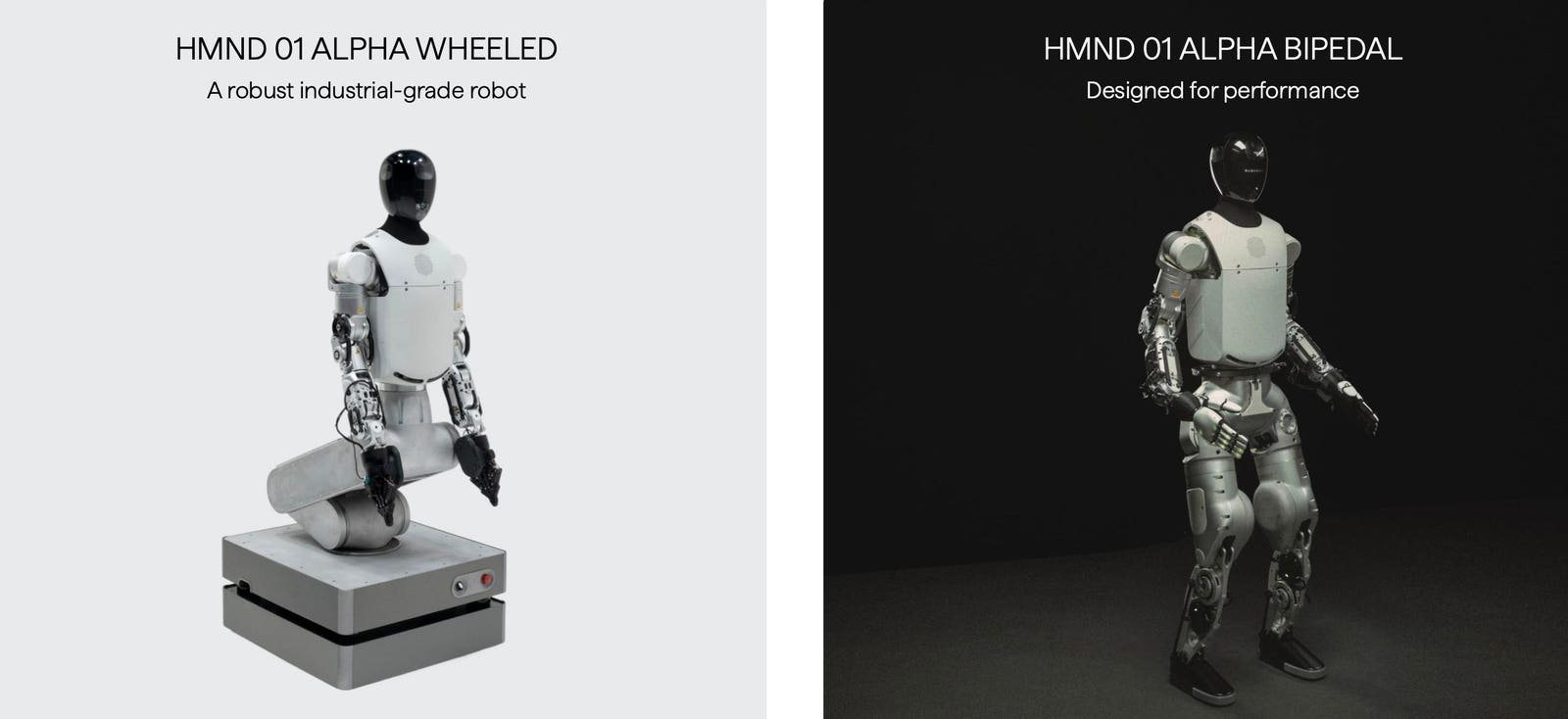
Humanoid AI is concentrating roughly 90% of its engineering effort on the wheeled HMND 01 humanoid, even though the UK company has also built a bipedal prototype, according to Forbes, which visited the company’s London headquarters and interviewed chief product officer Sotirios Stasinopoulos.
The choice is a pragmatic one. Humanoid AI is aiming first at industrial work, where energy use, stability, reach, payload and certification can decide whether a robot gets beyond trials. Stasinopoulos told Forbes that “more than 85 or 90% of the use cases can be covered by a wheel based platform.”
The current Alpha version of HMND 01 can lift 15 kilograms, or 33 pounds. The next version is expected to handle 20 kilograms, or 45 pounds. Stasinopoulos also described the robot’s hands as working from zero up to 1.5 meters fully extended and 1.5 meters away from the robot.
Key facts
- Company: Humanoid AI, founded in 2024
- Team size: 130 people
- Main platform: Wheeled HMND 01 humanoid
- Engineering focus: Roughly 90% on the wheeled platform
- Current lift rating: 15 kilograms, or 33 pounds
- Next lift target: 20 kilograms, or 45 pounds
- Certification target: Fully certified product by late 2027
Certification is driving the form factor
For industrial buyers in Europe, CE certification is not a cosmetic detail. Humanoid AI’s argument is that a wheeled humanoid can fit within existing certification routes more cleanly than a bipedal machine.
Stasinopoulos said there is no ISO standard yet that covers bipedal technology for industrial frameworks, since a legged robot can fall. He told Forbes that certification for bipedal systems is still immature and suggested relevant standards may arrive “maybe late next year or early ’28.”
The wheeled HMND 01 can instead draw from autonomous mobile robot standards and collaborative robot industrial frameworks. Humanoid AI is targeting a fully certified product by late 2027.
The biped has not been abandoned, but it has a different brief. Stasinopoulos said Humanoid AI is retargeting it toward service and household applications as a mid to long term strategy. He also said bipedal technology is not yet robust enough for the 20 hours a day industrial duty cycle the company is designing around.
Four software layers, from fleet tasks to motion
Humanoid AI describes its robot intelligence stack in four layers, numbered from System 3 down to System 0. At the top, System 3 acts as an agentic fleet coordinator, taking tasks from a customer’s warehouse management or ERP system and distributing them based on robot location, battery status and available end effectors.
System 2 is a reasoning layer built on vision language models such as Google’s Gemini. Its role is to break a requested job into a deterministic workflow that can be checked before execution. System 1 is Humanoid AI’s proprietary vision language action model for discrete actions such as picking an item from a shelf. System 0 is the whole body controller that turns those instructions into physical motion.
The architecture reflects a fleet first view of humanoid deployment. Stasinopoulos told Forbes that the company is not trying to place single robots into single task applications, arguing that fixed automation is often a better fit when only one job is needed. The target is a flexible set of robots that can stock shelves, feed machines and reorganize inventory across a workday.
Humanoid AI also claims its robots are now performing some core tasks at roughly 80% of human speed and success rate, up from about 60%. The company expects to reach and eventually exceed human performance on some tasks, according to the Forbes report, but that claim depends on reinforcement learning rather than only imitation from human demonstrations.
Partnerships compensate for a smaller war chest
Humanoid AI has raised $74 million so far, according to the source. Forbes contrasts that with German rival Neura Robotics, which it says has raised more than $1 billion, and with US competitors such as Figure and Apptronik, which have much larger capital bases.
The UK company has signed deployment deals with Schaeffler, Bosch and Siemens. Its actuator strategy is tied closely to Schaeffler, with actuators co designed by the two companies, while compute runs on Nvidia. Forbes also reports that Schaeffler has signed up for at least 1,000 of Humanoid AI’s robots, and that Humanoid AI has access to enough production capacity to build 100,000 humanoids by 2031 through its European partnerships.
Stasinopoulos framed the supply chain as a strategic issue, saying Humanoid AI plans to manufacture in Europe for European customers and pursue a “China plus one” approach for supply chain resilience. Forbes also reported that more funding appears likely, although Stasinopoulos did not comment specifically on a new round.
Source: forbes.com