Can a Norwegian Robot Really Replace China’s Humanoid Juggernaut?
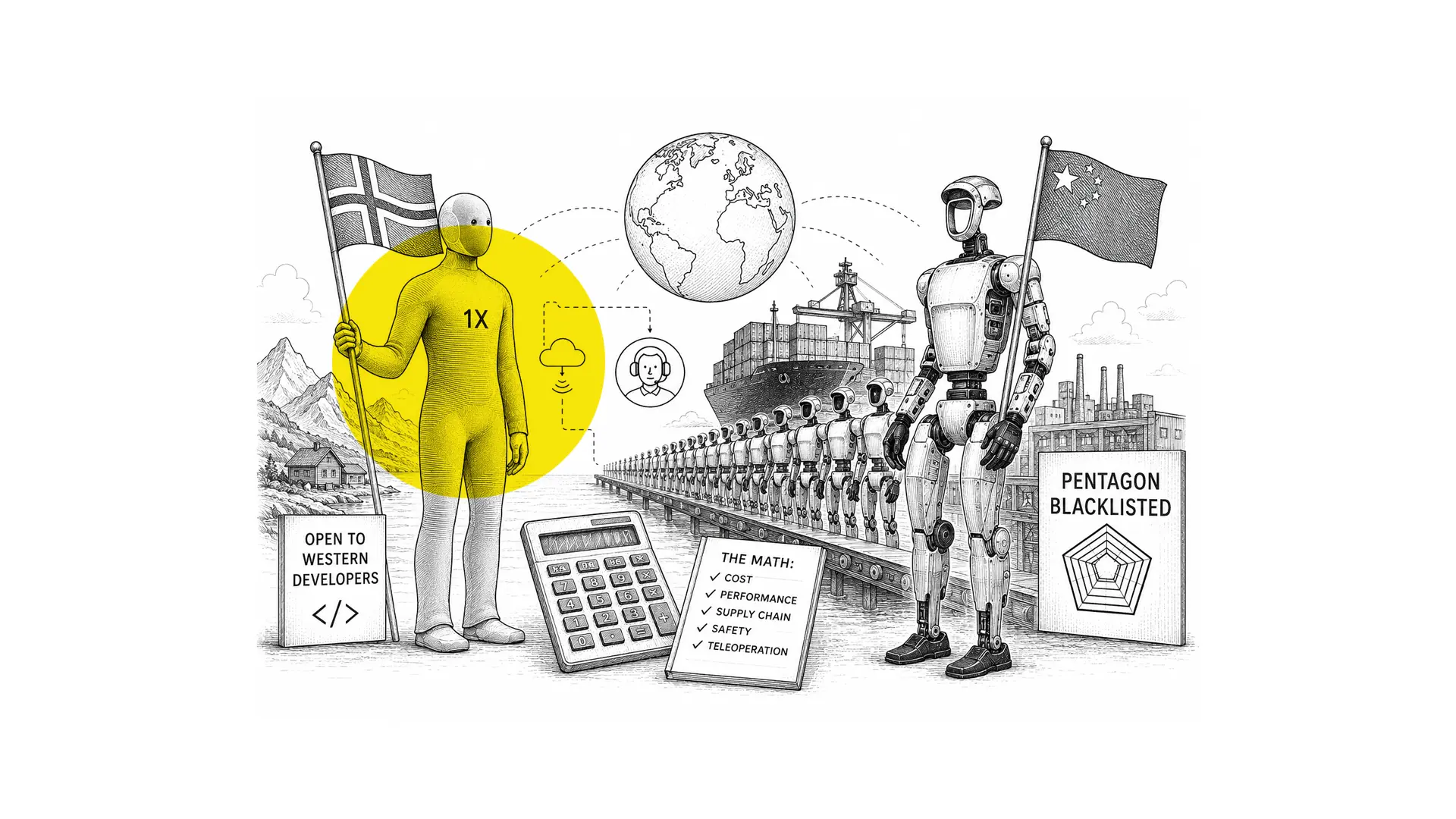
1X opened NEO to Western developers the same week the Pentagon blacklisted Unitree. We did the math on whether a relocated – and partly teleoperated – home robot can stand in for the company that out-shipped Tesla.
The timing was not subtle.
On June 8, 2026, the Pentagon added Unitree – China’s best-known humanoid maker – to its list of Chinese military companies, alongside Alibaba, BYD and Baidu. The designation triggers a ban on U.S. defense contracts that takes effect June 30. Days later, 1X founder and CEO Bernt Børnich announced the company would accelerate plans to put its NEO humanoid in the hands of developers, arguing that the West having a proper humanoid platform was “too important… to gate-keep.” He posted it as a direct reply to the very congressional committee sounding the alarm on Unitree.
In other words: as Washington moved to wall off China’s robot champion, a Western rival raised its hand and said, we’ll be your platform.
It’s a genuinely big moment for the humanoid market. It’s also worth asking the unglamorous question underneath the patriotism – can 1X actually deliver?
The opening is real
This isn’t only flag-waving. Unitree’s most reliable customers have long been universities and research labs – exactly the developer base now staring down procurement friction, export-control exposure and institutional risk-aversion in the West. A non-Chinese, non-PLA-linked humanoid platform suddenly has a real gap to walk into.
Zoom out and the shape is familiar: the humanoid market is starting to bifurcate into a Western stack and a Chinese stack, the way semiconductors, telecom and EV batteries did before it. Børnich’s developer pivot is a bid to become the default platform on the Western side of that line before anyone else claims it. Whoever owns the developer ecosystem tends to own the decade – that was the lesson of iOS and Android, and it’s the bet here.
About that “Norwegian” robot
A caveat the patriotic framing tends to skip: how Norwegian is 1X, really?
The roots are genuine. The company was founded in 2014 as Halodi Robotics by Norwegian engineer Bernt Børnich, and it still runs a manufacturing facility in Moss and R&D in Norway. But in mid-2025 it consolidated its Norwegian and Sunnyvale teams into a new headquarters in Palo Alto, and NEO is now built at a factory in Hayward, California. The honest label is Norwegian-founded, American-made.
And that American manufacturing isn’t an inconvenient detail – it’s the whole pitch. 1X’s stated answer to China’s production advantage is domestic vertical integration: build the actuators and core components in-house, manufacture on U.S. soil, iterate fast on real-world feedback, and avoid the offshore supply-chain exposure that a military-designation regime now punishes. Norwegian blood, American-made answer. For a story about Western technological independence, the relocation is the point – not a footnote.
The juggernaut is not waiting
Here’s the sobering half of the ledger. Unitree shipped more than 5,500 humanoid robots in 2025 – out-shipping Tesla on that metric for the year. Its machines dance at the CCTV Spring Festival Gala in front of hundreds of millions of viewers, and the company is in the middle of a roughly $610 million IPO on the Shanghai Stock Exchange, with nearly half the proceeds earmarked for AI model training over the next three years. On top of that sit the state subsidies, tax breaks and military-civil-fusion funding pipelines that Western rivals simply cannot match.
So the “juggernaut” framing is earned. This is a company with volume, capital, brand recognition and a state behind it.
The uncomfortable part
Now the part the launch-day enthusiasm glosses over: NEO is not yet a fully autonomous robot.
By 1X’s own framing, NEO runs somewhere around 60–70% autonomous at launch, with human “Expert Mode” operators stepping in remotely – via VR headsets, seeing through the robot’s onboard cameras – to finish tasks the AI can’t yet handle on its own. When a Wall Street Journal reviewer tested a unit, it took roughly two minutes to fold a shirt and over a minute to fetch a water bottle from a fridge ten feet away, much of it teleoperated rather than autonomous.
The West’s “answer” to a company shipping thousands of humanoids is, for now, a robot that is partly a person in a headset in another building.
That’s not a gotcha – every humanoid company is climbing the same autonomy curve, and 1X is unusually transparent about where it sits. But it reframes the question. The contest isn’t “Western champion vs. Chinese champion” today. It’s “can the Western champion close its autonomy gap before the Chinese one’s volume, subsidies and fresh IPO capital compound into an unassailable lead?”
Two ironies the framing skips
Privacy cuts both ways
A core national-security objection to Unitree is its “CloudSail” remote-access feature – the idea that a machine in a sensitive U.S. facility could phone home. But NEO’s Expert Mode by design puts remote human operators behind the cameras of a robot standing in your living room. Different threat models, very different intentions – but the same underlying unease: someone remote is in the loop.
The supply chain isn’t decoupled yet
1X’s own cost-reduction roadmap counts on sourcing competitively priced components, including from Asia. Full decoupling from the Chinese supply base is a direction of travel, not a finished fact – for 1X or for anyone else in this race.
So – can it?
The honest answer is: not yet, and that’s exactly what the developer move is for.
Opening NEO to developers is how 1X borrows the world’s roboticists to close the autonomy gap faster than it could alone – while its OpenAI backing and a growing home-data flywheel give it advantages no spec sheet captures. Whether “the West’s humanoid platform” becomes a real thing or stays a well-timed tweet comes down to execution speed against a state-backed competitor that is not slowing down.
Eighteen months. That’s the window in which we find out whether a Norwegian-born, California-built robot can actually hold the line – or whether the juggernaut just keeps shipping.