Humanoid Schaeffler deployment brings humanoids to German factories
Humanoid Schaeffler deployment plans call for thousands of humanoid robots to be introduced into Schaeffler manufacturing plants, with the first systems scheduled to go live before the end of this year at two sites in Germany. The deal matters because the companies said it could become one of the largest humanoid rollouts yet in an industrial setting, moving the category beyond isolated pilots and into a staged factory program.
Humanoid Schaeffler deployment starts in Germany
According to AI Business, the initial deployment phase is set to run from December 2026 to June 2027 at two Schaeffler facilities in Germany. The sites named in the report are Herzogenaurach and Schweinfurt, both of which will be used to test how the humanoid systems perform in live industrial workflows.
New! 2026 Humanoid
Robot Market Report
198 pages of exclusive insight from global robotics experts — uncover funding trends, technology challenges, leading manufacturers, supply chain shifts, and surveys and forecasts on future humanoid applications.

now Google DeepMind
The companies did not disclose financial terms or the exact number of robots covered by the agreement. Even so, the use of the word thousands is notable in a market where many announcements still center on prototypes, proofs of concept, or small pilot batches rather than multi-year deployment plans.
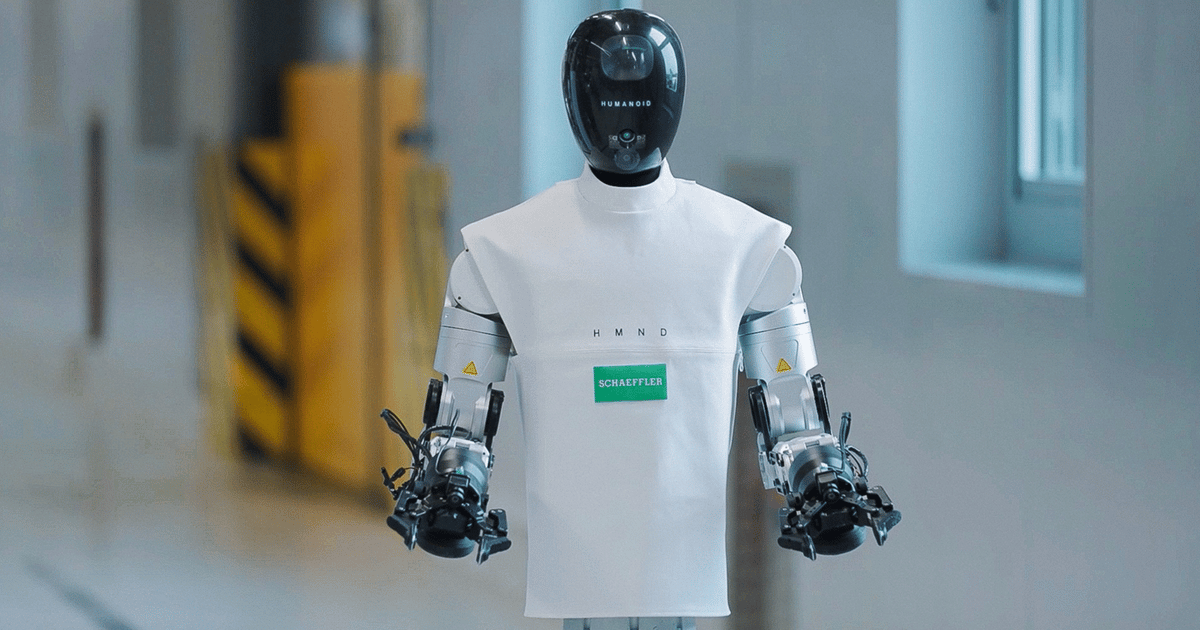
For Schaeffler, the agreement is also a practical test of whether a humanoid format can fit existing factory environments without major layout changes. For Humanoid, it is a chance to show that a system designed to work alongside people can meet manufacturing requirements at multiple sites instead of in a tightly controlled demo cell.
Initial use cases focus on material handling
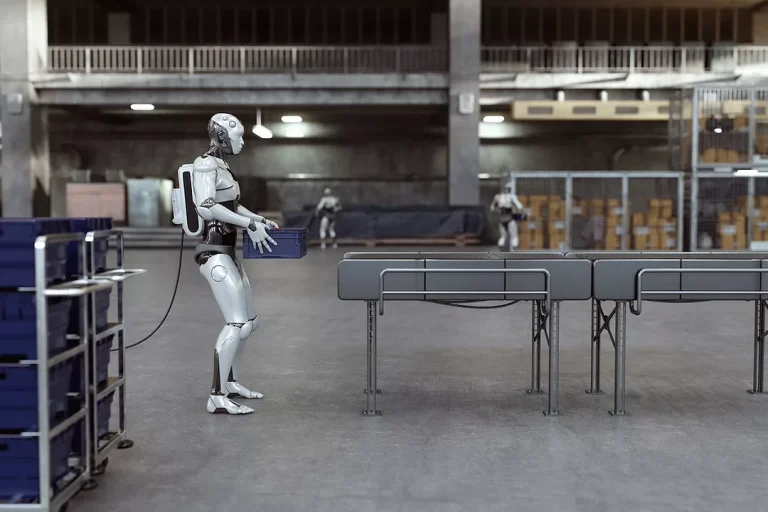
The first phase in Herzogenaurach will focus on box-handling applications in a live production environment. That choice reflects a common starting point for factory humanoid programs, where the near-term target is repetitive internal logistics work rather than fine assembly.
In parallel, Schaeffler’s Schweinfurt facility will host a three-month integration and demonstration project. That will be followed by a three-month real-world validation period, giving the partners a structured sequence for moving from setup and demonstration to performance testing under ordinary operating conditions.
Humanoid said in a company release that its technology is intended to help Schaeffler meet requirements around system architecture, safety, IT infrastructure, and security-by-design principles. Those details matter because industrial deployments are often constrained less by raw robot capability than by plant integration, network security, and the ability to operate within existing safety frameworks.
Beyond the first stages, the companies said they plan to assess performance with the aim of expanding deployment across the value chain. The longer-term target includes more dexterous work such as assembly and packaging, though the source does not specify when those tasks might move from evaluation into production use.
Supply agreement deepens the industrial relationship
The partnership is not limited to robot deployment. It also includes a five-year supply agreement under which Schaeffler will become Humanoid’s preferred supplier of actuators through 2031, linking the two companies on both the application side and the component side.
That structure is important for a humanoid program because actuators sit at the center of mobility, manipulation, and durability. A preferred supplier arrangement suggests that the companies are not treating the factory rollout as a short-lived pilot, but as a program that could shape both deployment planning and hardware sourcing over several years.
The latest deal builds on earlier cooperation between the two groups. AI Business reported that they formed a strategic alliance in January and completed a proof of concept in April, when a Humanoid robot carried out bin-picking tasks at Schaeffler’s facility in Erlangen, Germany.
Humanoid has also been building a separate factory record in Germany. Last month, the company partnered with Siemens to deploy its HMND 01 Alpha robot at Siemens’ electronics factory in Erlangen, where it performed autonomous logistics tasks including picking and placing containers alongside human workers.
Taken together, those projects indicate that Germany is becoming an early proving ground for industrial humanoids in real production environments. What remains unresolved is how quickly vendors can move from box handling and internal logistics to higher-dexterity work, and whether performance, safety, and uptime will support the much larger rollouts now being announced.
Source: aibusiness.com