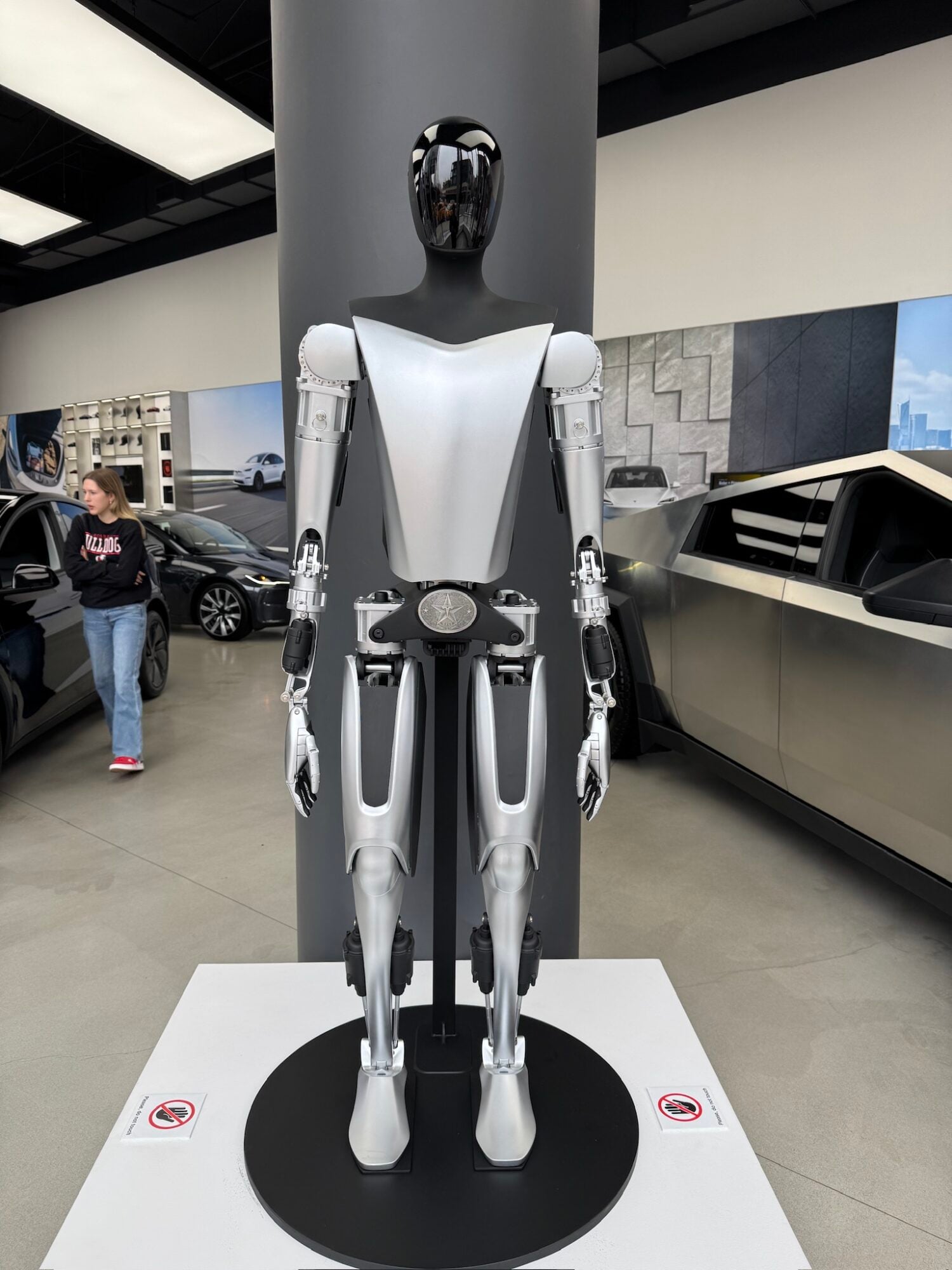
US Lawmakers Target Humanoid Robot Supply Chains
A new investigation has brought renewed scrutiny to the supply chains behind leading humanoid robots, highlighting a deep reliance on Chinese manufactured components and prompting early legislative action in the United States.
2026 Humanoid Robot Market Report
160 pages of exclusive insight from global robotics experts – uncover funding trends, technology challenges, leading manufacturers, supply chain shifts, and surveys and forecasts on future humanoid applications.

Featuring insights from
Aaron Saunders, Former CTO of
Boston Dynamics,
now Google DeepMind

2026 Humanoid Robot Market Report
160 pages of exclusive insight from global robotics experts – uncover funding trends, technology challenges, leading manufacturers, supply chain shifts, and surveys and forecasts on future humanoid applications.
According to reporting by The Wall Street Journal, several prominent humanoid platforms, including Tesla’s Optimus and systems developed by Figure AI, depend on Chinese suppliers for critical motion and sensing hardware. These components include motors, joints, sensors, and speed reducers that underpin core locomotion and manipulation capabilities.
The findings point to a structural division in the humanoid robotics stack. US companies continue to lead in artificial intelligence software and compute infrastructure, while China maintains a dominant position in the physical components required to build robot bodies. This includes precision actuators, rare earth based magnets, and other motion control elements that account for a substantial share of total system cost.
Industry estimates cited in the report suggest that motion related components alone represent more than half of a humanoid robot’s build cost. Access to Chinese manufacturing scale and supply chains can significantly reduce overall system costs, creating a strong incentive for US developers to source internationally even as geopolitical tensions rise.
The supply chain exposure is already influencing policy. In recent months, multiple US legislative proposals have targeted robotics systems linked to foreign adversaries. These include the American Security Robotics Act introduced in March, as well as earlier bills focused specifically on humanoid systems and broader robotics oversight.
The proposed measures would restrict federal agencies from procuring or operating humanoid robots and other ground based robotic systems tied to certain foreign entities. The structure of these proposals mirrors earlier actions taken in the drone sector, where restrictions on Chinese manufacturers reshaped procurement but also exposed gaps in domestic manufacturing capacity.
Data cited in the report underscores the scale imbalance. Chinese firms released significantly more humanoid models than US competitors in the past year, and shipments from companies such as Unitree far exceed those of American developers. At the same time, US firms remain in early commercial deployment phases, with relatively limited unit volumes.
The reliance on Chinese inputs is not limited to finished components. Upstream dependencies, including rare earth materials and processing capacity, further complicate efforts to establish a fully domestic supply chain. Even robots assembled in the United States may rely on globally sourced subcomponents at multiple tiers.
For humanoid robotics developers, the situation introduces both operational and strategic risk. Export controls, tariffs, or retaliatory measures could disrupt access to essential parts, particularly as companies begin to scale production from pilot deployments to larger fleets.
The debate now centers on sequencing. Policymakers are moving quickly to address perceived security risks, while industry stakeholders point to the longer timelines required to build competitive domestic manufacturing for precision robotics components.
The outcome of this tension will shape the near term trajectory of humanoid robotics in the United States. Constraints on component sourcing could affect cost structures, deployment timelines, and system design choices, particularly for companies targeting high volume production in industrial and logistics environments.
Source: dronexl.co