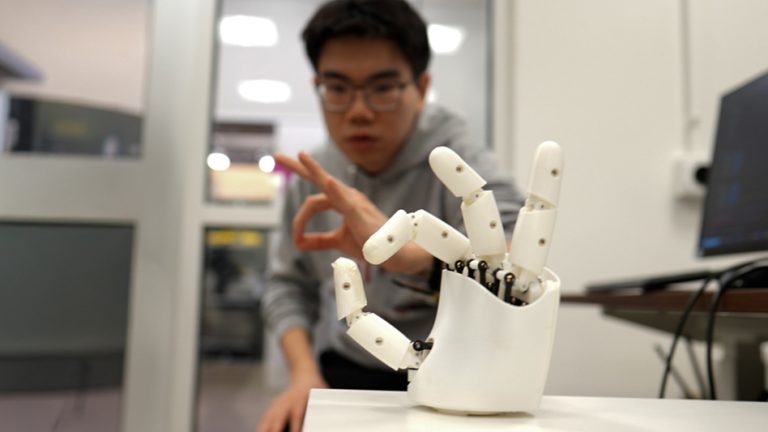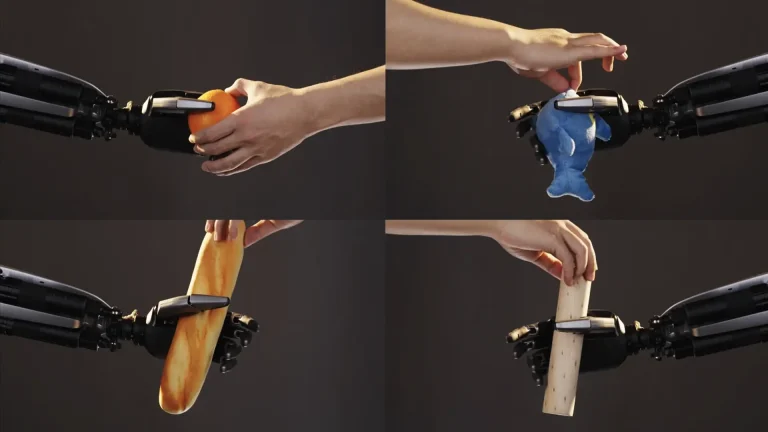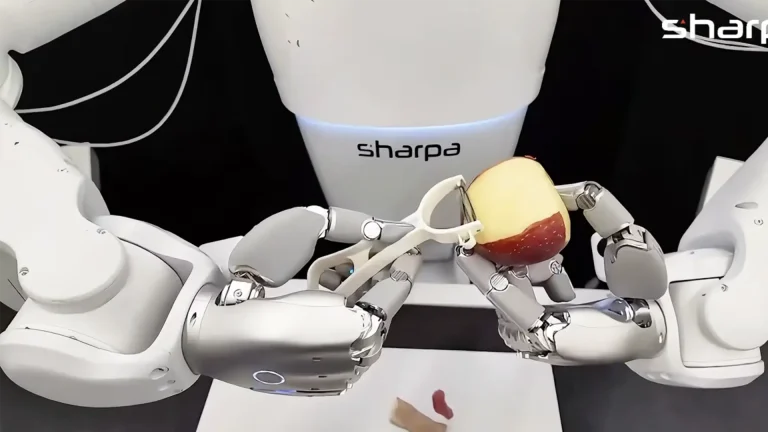

The goal was simple: To find out what was possible
Boston Dynamics has long been the world leader in mobile robotics, but their latest announcement marks a historic shift. The transition of the Atlas robot from a research platform to a fully electric, commercial-grade humanoid is more than just a technical upgrade – it is the beginning of a new industrial revolution. Designed for the factory floor rather than the lab, the new Atlas is built to tackle the toughest automation challenges in manufacturing and logistics.
2026 Humanoid Robot Market Report
160 pages of exclusive insight from global robotics experts – uncover funding trends, technology challenges, leading manufacturers, supply chain shifts, and surveys and forecasts on future humanoid applications.

Featuring insights from
Aaron Saunders, Former CTO of
Boston Dynamics,
now Google DeepMind

2026 Humanoid Robot Market Report
160 pages of exclusive insight from global robotics experts – uncover funding trends, technology challenges, leading manufacturers, supply chain shifts, and surveys and forecasts on future humanoid applications.
Beyond the Lab: A Robot Built for Scale
For years, Atlas was the star of viral videos, showcasing backflips and parkour. However, the new electric Atlas is all business. This version is designed for reliability, serviceability, and mass production. By leveraging years of experience from deploying over 2,000 Spot and Stretch robots, Boston Dynamics has created a humanoid that isn’t just a prototype, but a rugged tool. Through a strategic partnership with Hyundai, these robots are already being prepared for large-scale deployment, with a dedicated factory capable of producing thousands of units per year to meet global demand.
Augmenting the Human Workforce
One of the most significant advantages of the new Atlas is its ability to operate in environments designed for people –without needing expensive retrofitting or safety cages. Standing 1.9 meters tall with a 2.3-meter reach, it can handle repeated 30 kg (66 lbs) lifts with ease. This doesn’t just increase efficiency; it protects human workers from ergonomic strain and hazardous conditions. With advanced onboard sensors and “fenceless” safety systems, Atlas can detect colleagues and vehicles in real-time, pausing and navigating safely in busy, shared workspaces.
Engineered for Continuous Operation
In a high-intensity industrial environment, downtime is the enemy of ROI. Atlas addresses this with a focus on 24/7 productivity. The robot features a four-hour battery life and, most impressively, the ability to autonomously swap its own batteries in less than three minutes. This ensures that the robot can keep working through multiple shifts. Furthermore, the hardware is built for the “long haul” with an IP67 rating (dust and water-resistant) and a modular design that allows onsite teams to replace a limb in under five minutes.
The Power of Orbit and AI Intelligence
Hardware is only half the story; the true power of Atlas lies in its “brain.” Managed through the Orbit™ platform, fleet operators can monitor metrics, assign tasks, and integrate the robots directly into existing Warehouse Management Systems (WMS) or Manufacturing Execution Systems (MES). Thanks to a partnership with Google DeepMind, Atlas is also gaining the ability to learn new tasks faster and understand the context of its environment. This means that once one robot learns a new sequencing task, that knowledge can be instantly deployed across the entire fleet.

Delivering Real ROI in the Factory of the Future
While humanoid robots have often been dismissed as “hype,” Boston Dynamics is focusing on measurable results. Most customers are expected to see a return on investment within the first two years. By combining the latest advancements in AI with a hardware platform built for the rigors of the factory floor, Atlas is moving beyond demonstration and into real-world value. Whether it’s part sequencing, machine tending, or heavy material handling, the path to the factory of the future is now walking on two legs.