Pentagon Engages Humanoid Robot Startups for Defense
The US Department of Defense is expanding its engagement with humanoid robotics startups, signaling a deeper interest in deploying bipedal systems for military logistics and reconnaissance roles.
2026 Humanoid Robot Market Report
160 pages of exclusive insight from global robotics experts – uncover funding trends, technology challenges, leading manufacturers, supply chain shifts, and surveys and forecasts on future humanoid applications.

Featuring insights from
Aaron Saunders, Former CTO of
Boston Dynamics,
now Google DeepMind

2026 Humanoid Robot Market Report
160 pages of exclusive insight from global robotics experts – uncover funding trends, technology challenges, leading manufacturers, supply chain shifts, and surveys and forecasts on future humanoid applications.
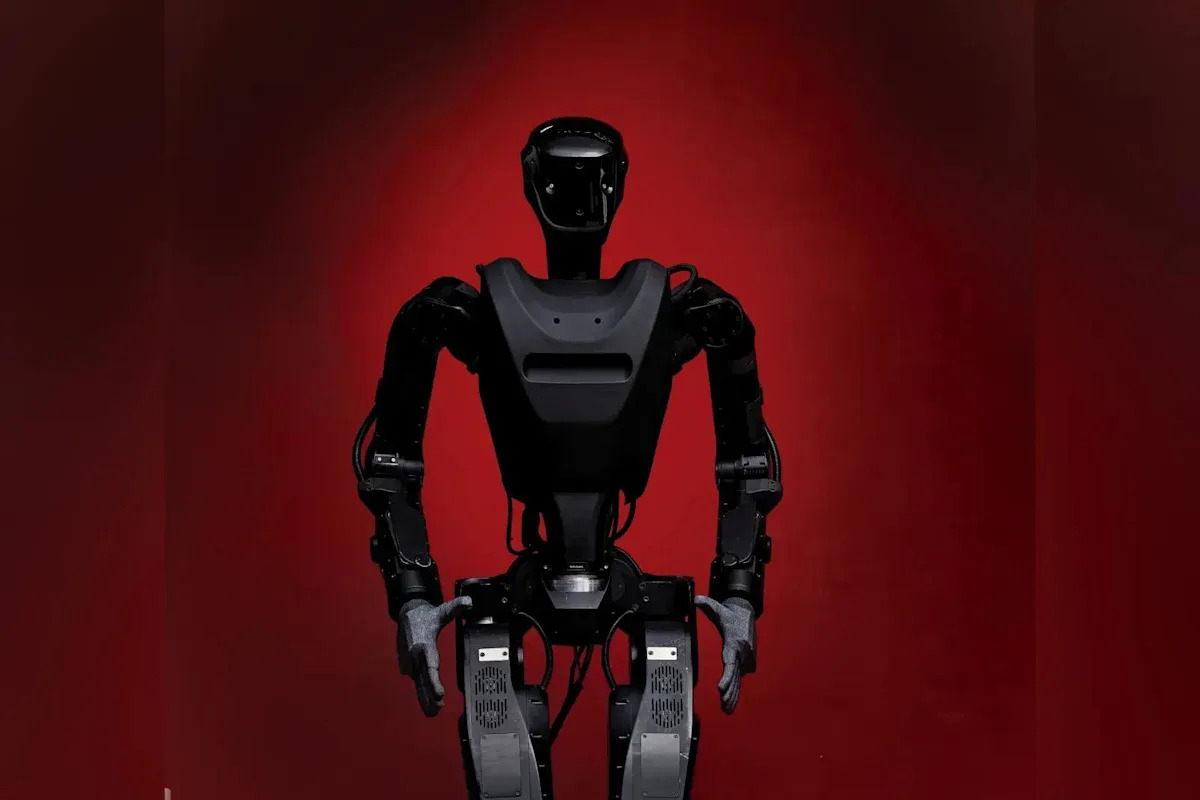
Foundation Future Industries, a two year old robotics company, has secured a $24 million contract with the Pentagon and has begun testing its humanoid robots in Ukraine. According to reporting, the company’s systems are capable of inspecting and transporting weapons, positioning them initially in support roles rather than direct combat.
The startup is training its robots to survey enemy territory and is planning a progression toward front line deployments in areas where civilians are not present. Founder Sankaet Pathak stated that the company aims to validate its technology this year and scale operations next year.
Foundation is part of a broader wave of defense oriented robotics startups seeking Pentagon partnerships. Scout AI emerged last year with a focus on military autonomy, and the US military is also testing quadruped robots for reconnaissance missions. Within this landscape, humanoid platforms offer a distinct value proposition: the ability to operate in environments designed for human mobility and manipulation.
The Pentagon’s interest in humanoid systems reflects a growing emphasis on adaptable, multi role robotic platforms. Unlike fixed industrial robots or single purpose unmanned systems, humanoids are being developed to handle varied tasks such as equipment handling, transport, inspection, and potentially more complex field operations.
While details about Foundation’s robot specifications have not been disclosed, the focus on weapons inspection and transport suggests manipulation capabilities robust enough for handling military hardware, as well as mobility suited to uneven or contested terrain. Early deployments in conflict adjacent environments provide real world validation that extends beyond laboratory testing.
The award also underscores a shift in defense procurement toward younger robotics companies. Foundation’s contract comes despite the founder’s previous startup filing for bankruptcy in 2024, highlighting the Pentagon’s willingness to engage emerging players in pursuit of advanced autonomy and embodied AI systems.
For practitioners and operators in humanoid robotics, the development illustrates an accelerating defense market pathway. Military validation and funding can significantly influence platform durability standards, autonomy requirements, and scaling timelines. As testing moves from logistics support to potential front line roles, performance benchmarks around reliability, teleoperation, and supervised autonomy are likely to intensify.
The Pentagon’s engagement with humanoid startups marks a notable step in the transition of bipedal robots from research prototypes to operational assets in high stakes environments.
Source: yahoo.com