Inside China’s largest humanoid robot training centre
A large scale humanoid robot training facility in Beijing is offering a detailed look at how developers are addressing one of the field’s central challenges: building reliable, general purpose robot behavior through real world data.
2026 Humanoid Robot Market Report
160 pages of exclusive insight from global robotics experts – uncover funding trends, technology challenges, leading manufacturers, supply chain shifts, and surveys and forecasts on future humanoid applications.

Featuring insights from
Aaron Saunders, Former CTO of
Boston Dynamics,
now Google DeepMind

2026 Humanoid Robot Market Report
160 pages of exclusive insight from global robotics experts – uncover funding trends, technology challenges, leading manufacturers, supply chain shifts, and surveys and forecasts on future humanoid applications.
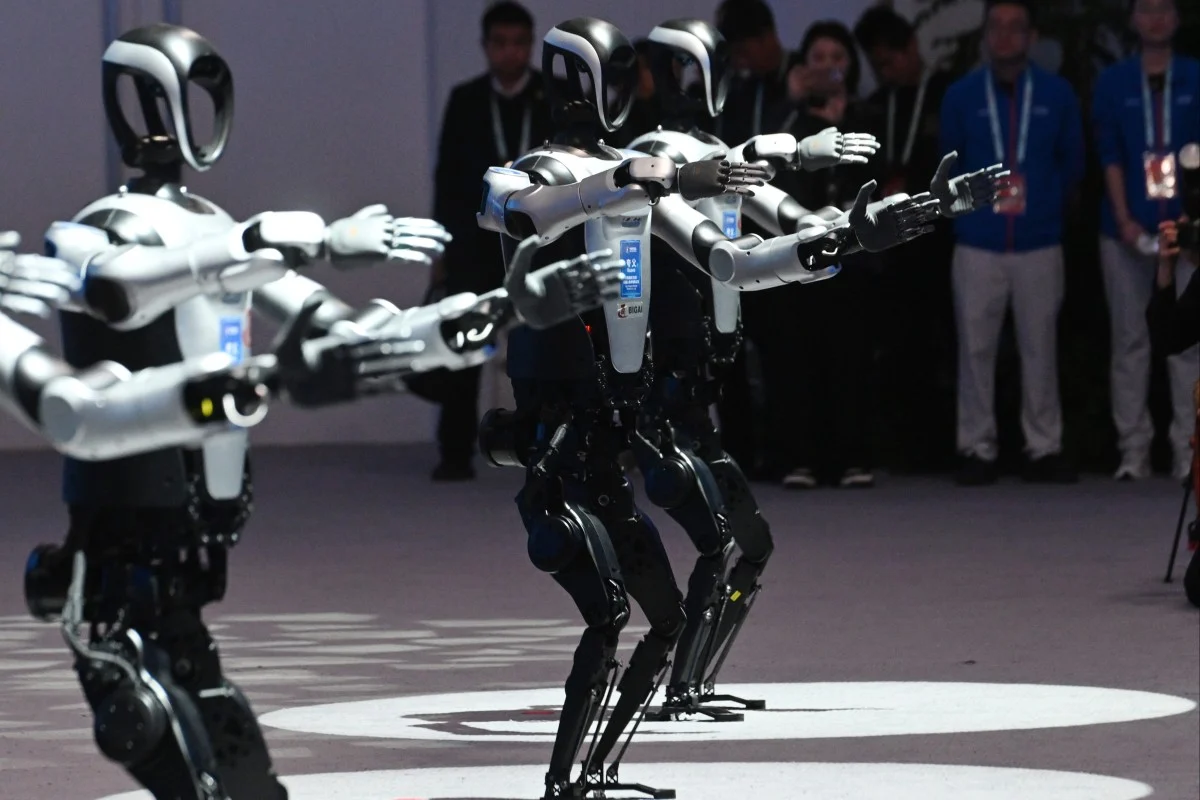
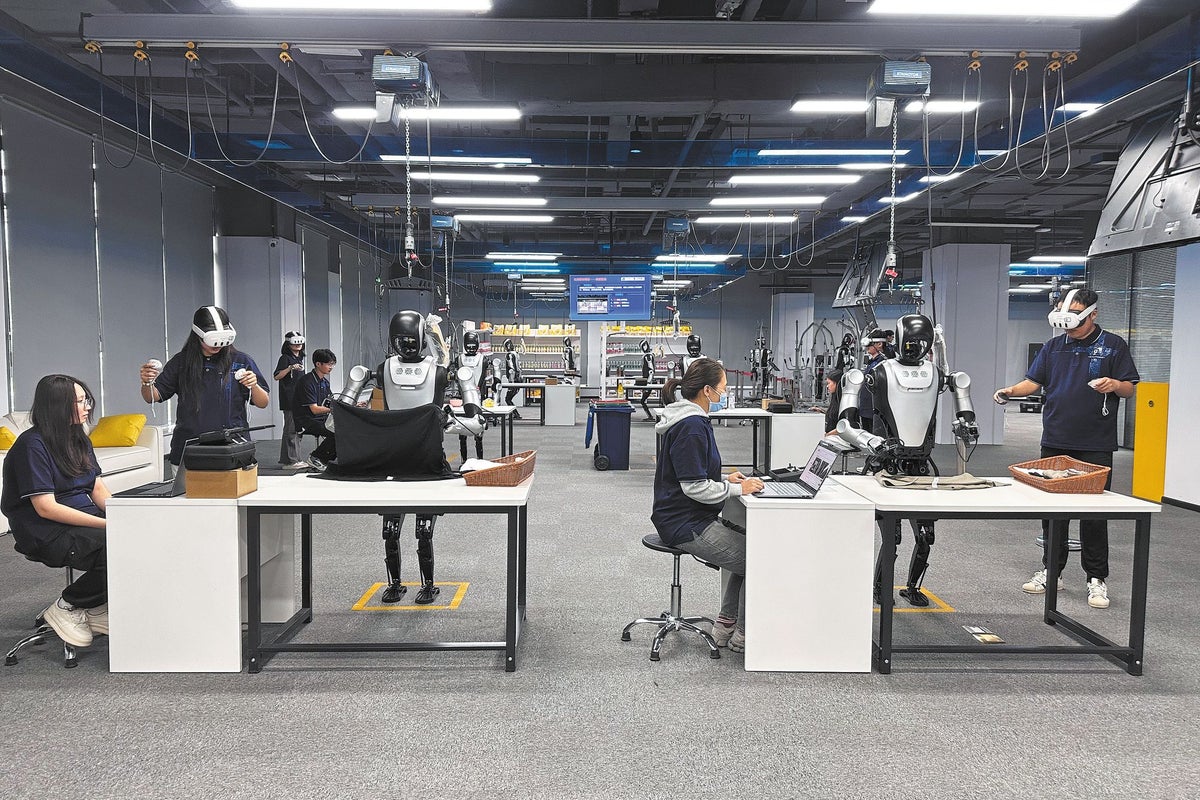
The centre, located in the Shijingshan district and co built by the local government and Leju Robotics, operates as a dedicated training environment for humanoid systems. Nearly 200 human instructors guide around 100 humanoid robots through structured tasks that mimic industrial, domestic, and service settings.
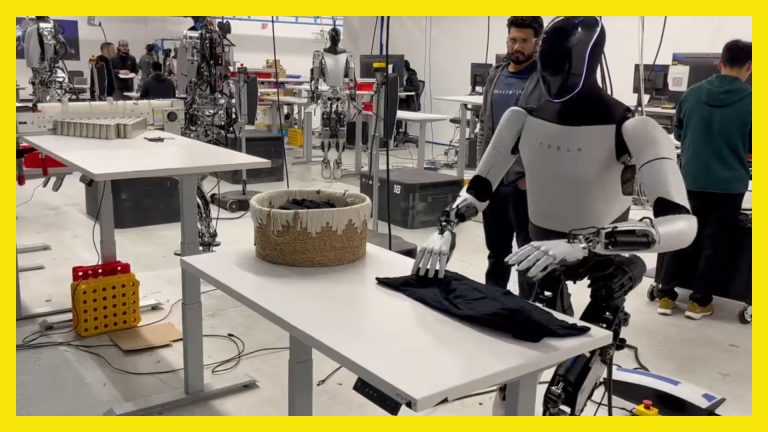
Inside the facility, trainers demonstrate actions while wearing headsets, with robots mirroring movements in real time. Tasks include handling medicine bottles, sorting parcels on conveyor systems, and navigating office workflows. The goal is to generate large volumes of multimodal data that capture both successful actions and failure cases.
According to Leju Robotics, the centre has constructed 16 scenario types covering manufacturing, smart home operations, eldercare, and connected environments. Engineers emphasize that failure data is as important as success, as it helps systems learn how to recover from errors and adapt to unpredictable conditions.
The approach reflects a broader industry focus on embodied intelligence, where AI models are trained to operate within physical systems. In this framework, the robot is often described as comprising three layers: a decision making brain, a motion coordination layer, and a physical body equipped with sensors and actuators. Progress in the first layer remains the primary bottleneck.
Facility operators report the ability to generate more than 8 million data records annually, which are used both internally and supplied to AI model developers. These datasets are intended to improve generalization, enabling robots to transfer learned skills across environments without extensive reprogramming.
Early deployment results suggest incremental progress. Robots trained at the centre have begun working in factory settings, achieving about 70 percent of the efficiency of skilled human workers in tasks such as box handling and parts sorting. Their ability to operate continuously makes them suitable for repetitive and physically demanding roles.
Despite these gains, significant gaps remain. Experts note that controlled demonstrations differ sharply from real world environments, where variability and uncertainty are much higher. Home use in particular presents safety challenges, especially given the size and weight of current humanoid platforms.
The emphasis on data centric training aligns with market projections pointing to rapid growth in humanoid robot deployments. Industry estimates cited in the report suggest global shipments reached 13,000 units in 2025, with China accounting for the majority.
As more training centres come online, the sector is shifting from isolated demonstrations toward scalable learning pipelines. The Beijing facility illustrates how structured data generation is becoming a core component of humanoid robot development, with direct implications for industrial adoption and long term autonomy.
Source: independent.co.uk