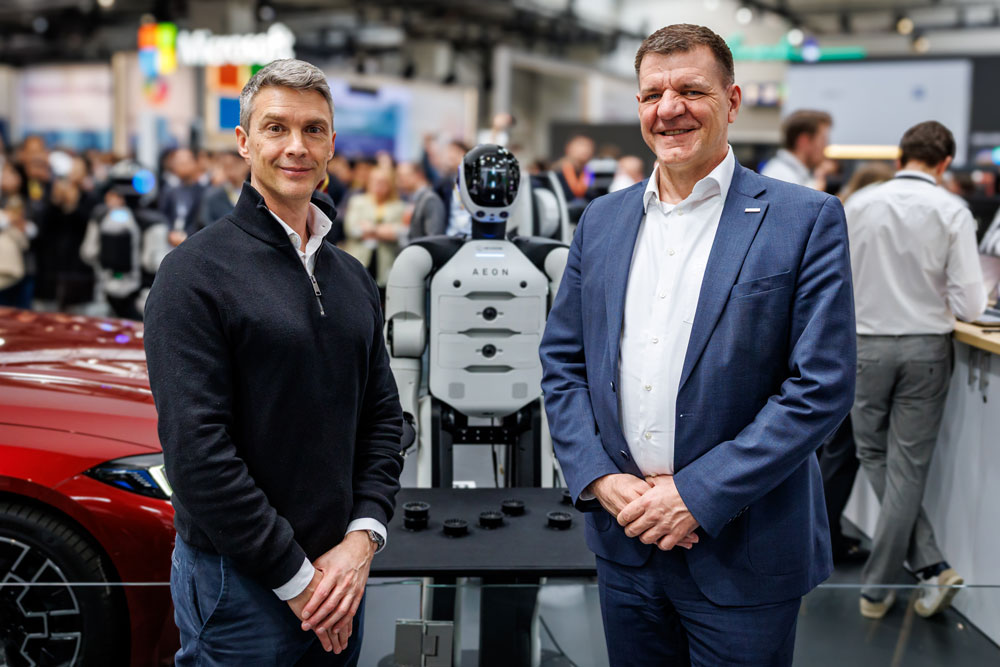
Hexagon, Schaeffler scale AEON humanoid deployment in factories
Hexagon Robotics and Schaeffler said on April 22 that they are moving an AEON humanoid deployment from pilot phase to scaled factory rollout, with a plan to place at least 1,000 units across Schaeffler’s global production network by 2032. The agreement turns a 2025 pilot into a multi-year manufacturing program and gives Hexagon a public volume target tied to a major industrial customer.
AEON humanoid deployment moves beyond the pilot
The companies described the announcement as an expansion of their strategic partnership after completing a joint pilot in 2025. Schaeffler plans to deploy the fleet over seven years, while also supplying high-precision actuators for AEON, adding a component relationship to the rollout.
According to Hexagon Robotics, the partnership is intended to increase manufacturing flexibility, improve efficiency, and reduce reliance on manual tasks. For Schaeffler, the project also fits its stated push toward more automated and data-driven production.
The scale matters because the commitment is not framed as a single-site test. The target covers Schaeffler’s global factory network, which shifts the conversation from whether AEON can perform an isolated task to whether the platform can be transferred across plants, processes, and production settings.
What AEON did in the 2025 pilot
During the pilot, AEON operated a multi-machine station in a real production environment. The robot loaded and unloaded parts and carried out inspection work, tasks that depend on precise manipulation and on fitting into existing machine layouts rather than a purpose-built demonstration cell.
Hexagon said the system combined a sensor suite with wheel-based locomotion and high-precision manipulation. That points to a platform shaped around factory floor mobility and machine tending, where travel efficiency and positioning around fixed equipment can matter as much as arm dexterity.
The companies added that AEON was shown at Schaeffler’s Global Production Forum 2025 and at Schaeffler Partner Days 2026. Building on the pilot, additional applications, including automated part inspection, are targeted for rollout starting at the end of 2026.
Schaeffler adds components and factory data
The actuator supply element may prove as important as the deployment commitment. Schaeffler said its actuator platform is intended to serve as a technology backbone for next-generation humanoid robots, and the new agreement places those components inside the same platform the company is introducing into its own plants.
A second focus is production data. The companies said they want to generate and use real-world factory data so AEON can be deployed faster in new use cases and production settings, an issue that often determines whether a humanoid project remains a pilot or becomes part of routine operations.
That emphasis reflects a practical bottleneck in industrial humanoids. Hardware capability matters, but deployment speed, task transfer, and adaptation to real factory variation are often what decide whether a fleet can scale across sites.
What the partnership signals for industrial humanoids
The announcement stands out because it is tied to specific factory work, a named customer, and a multi-year unit target. Much of the humanoid sector is still presented through prototypes or short trials, so a commitment anchored in machine loading, unloading, and inspection gives the market a clearer view of where vendors believe near-term demand exists.
Neither company disclosed how the 1,000-unit target will be sequenced across sites or how many robots will be introduced in the first wave. Those details, along with evidence on uptime, integration effort, and task expansion, will determine whether this AEON humanoid deployment becomes a repeatable manufacturing program rather than a series of bespoke installations.
The next milestone is likely to be operational rather than promotional, namely whether late 2026 inspection rollouts can show that AEON moves beyond a successful pilot into wider plant use. If that happens, the Hexagon and Schaeffler partnership will offer a concrete test of how quickly industrial humanoids can move from controlled demonstrations into factory networks with measurable production roles.
Source: robotics.hexagon.com