China Expands Robot Schools for Humanoid Training and Data Drive
China is investing in dedicated training centers designed to teach humanoid robots how to perform everyday physical tasks such as folding clothes, wiping tables, and carrying objects. The facilities, described in a recent report by Chosun Biz and highlighted by BGR, are structured as “robot schools” where humanoids repeatedly practice manipulation routines in controlled environments.
2026 Humanoid Robot Market Report
160 pages of exclusive insight from global robotics experts – uncover funding trends, technology challenges, leading manufacturers, supply chain shifts, and surveys and forecasts on future humanoid applications.

Featuring insights from
Aaron Saunders, Former CTO of
Boston Dynamics,
now Google DeepMind

2026 Humanoid Robot Market Report
160 pages of exclusive insight from global robotics experts – uncover funding trends, technology challenges, leading manufacturers, supply chain shifts, and surveys and forecasts on future humanoid applications.
The approach reflects a broader push to accelerate the transition of humanoid robots from laboratory prototypes to commercially viable systems for manufacturing and domestic assistance. Rather than focusing solely on simulation, these centers emphasize high repetition physical training to build robust manipulation skills and generate large volumes of task data.
Task repetition as a training strategy
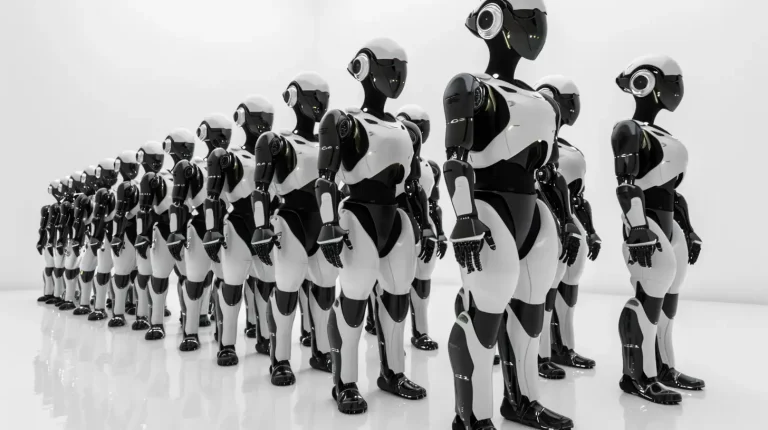
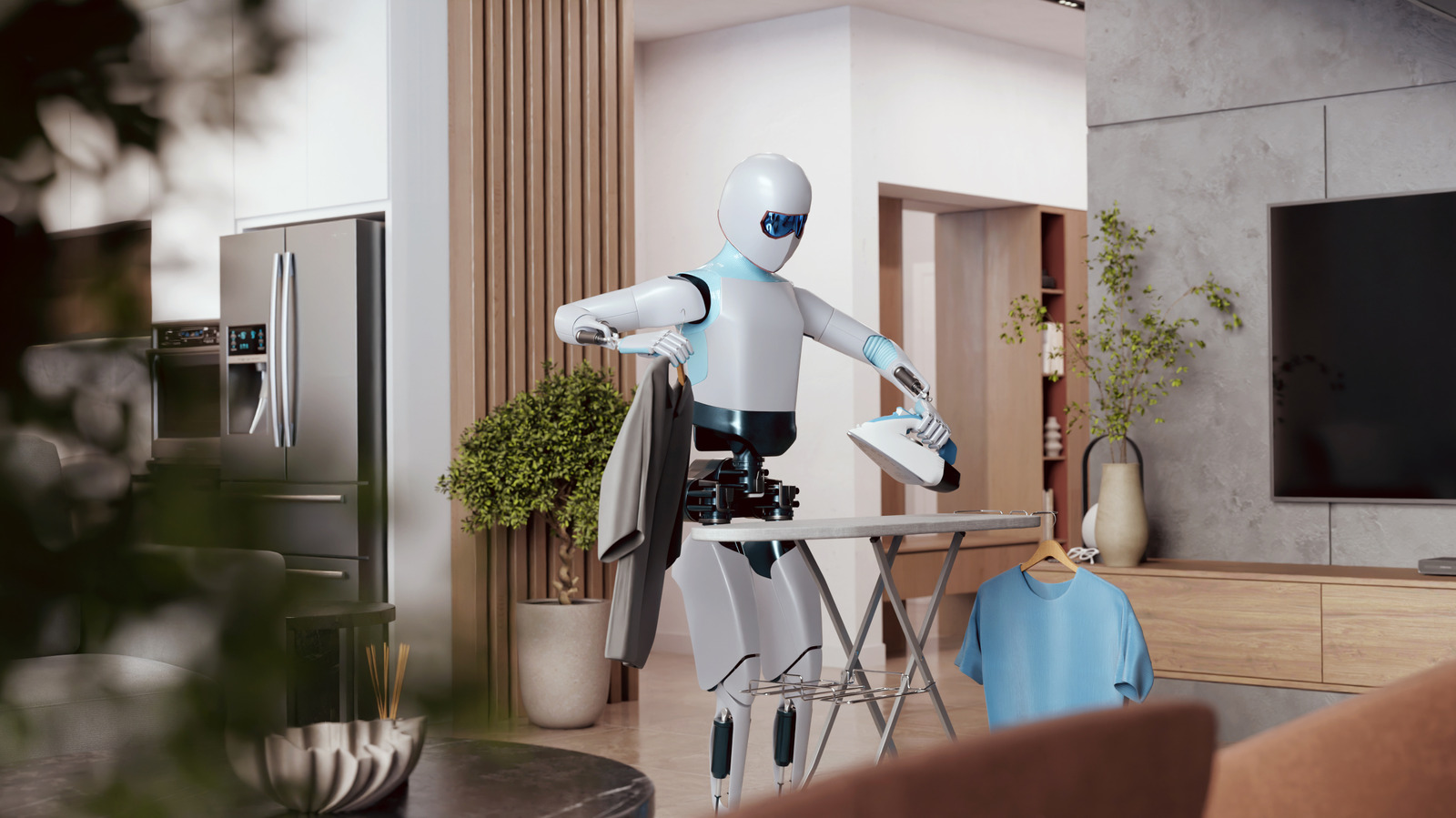
Facilities in provinces including Shandong and Hubei are reportedly equipped to train up to 100 humanoid robots at a time. Robots are assigned structured exercises such as folding laundry, ironing garments, retrieving water bottles from shelves, carrying trays, and wiping tables. Each task is repeated extensively to improve precision, grip control, and coordination.
Folding laundry in particular has emerged as a benchmark for dexterous manipulation. Deformable objects such as towels and clothing present complex challenges. Their shapes change continuously, there is no fixed grasp point, and minor errors in finger placement can cause bunching or slippage. Successful execution requires real time perception, adaptive grip force, and coordinated two hand manipulation.
Industry examples underscore the technical difficulty. In 2025, U.S. robotics company Figure detailed experiments in which its humanoid robot learned to pick up towels from a pile, fold them, correct mistakes, and perform fine manipulation actions such as tracing edges and pinching corners. The company characterized laundry folding as one of the more demanding dexterous tasks for humanoid systems.
From household chores to industrial work
Although folding clothes and wiping tables appear mundane, these tasks serve as proxies for broader manipulation capabilities required in industrial and service settings. A humanoid capable of reliably handling soft materials and fragile objects is better positioned to transition to assembly line assistance, parts sorting, packaging, and other semi structured workflows.
Recent demonstrations at CES 2026 by companies including LG and Hyundai highlighted similar trajectories. LG presented a home oriented humanoid capable of folding laundry, while Hyundai introduced a new Atlas humanoid robot developed with Boston Dynamics, intended to begin with basic sorting tasks in automotive manufacturing environments.
Large scale data generation
Beyond repetition, the Chinese robot schools are structured to generate extensive task data. A facility in Hebei province developed by Leju reportedly spans 10,000 square meters and is designed to simulate environments such as car assembly lines and smart homes. The center incorporates virtual reality systems and motion sensors to guide humanoids through defined action sequences.
According to the report, the facility enables humanoid robots to learn more than 20 functions, with task success rates above 95 percent. The center is said to generate approximately six million pieces of data annually, contributing to model refinement and performance benchmarking.
The emphasis on centralized, high throughput training infrastructure signals a scaling strategy for humanoid development. By combining physical task repetition, structured environments, and data capture, developers aim to compress learning cycles and standardize performance across fleets.
As humanoid vendors worldwide prepare for early commercial deployments, the emergence of purpose built robot schools highlights the growing industrialization of training pipelines. The ability to systematically teach and validate dexterous manipulation may become a key differentiator as humanoids move from controlled demonstrations to sustained real world operation.
Source: bgr.com