Unitree G1 Humanoid Robot Draws Crowds in NYC Park
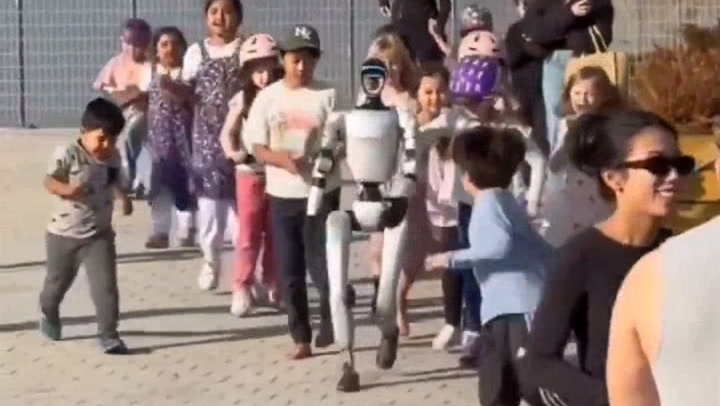
A Unitree G1 humanoid robot was seen running and playing with children at Brooklyn Bridge Park in New York City, according to footage published by The Independent on 28 March 2026. The video shows the bipedal robot moving at pace across open space while a group of children follow and interact with it, as onlookers observe from nearby.
The G1 is a humanoid platform developed by Chinese robotics company Unitree. In the park setting, the robot appears untethered and capable of dynamic locomotion, including running over flat outdoor terrain. The footage highlights balance, stride stability, and real time responsiveness in an uncontrolled public environment rather than a laboratory or staged demonstration area.
Public park appearances remain relatively uncommon for full size humanoid systems. Most demonstrations to date have taken place in controlled indoor spaces, trade shows, or company facilities. Operating in a busy urban park introduces variables such as uneven surfaces, unpredictable human movement, and ambient distractions. Even in a short clip, such conditions provide insight into perception, motion planning, and safety envelope management.
The interaction captured in Brooklyn Bridge Park centers on play rather than task execution. Children are seen chasing the robot as it runs, suggesting confidence in its obstacle avoidance and collision mitigation capabilities at low speeds. While no technical details were disclosed in the report, the scenario underscores the growing emphasis on safe human robot interaction as humanoids move closer to public deployment.
The appearance also reflects a broader shift in how humanoid robotics companies are showcasing progress. Instead of limiting exposure to industrial pilots or scripted stage presentations, developers are increasingly allowing robots to be seen in everyday environments. For operators and technical decision makers, these informal field moments can be as informative as formal benchmarks, revealing gait robustness, recovery behavior, and social acceptance factors.
As humanoid platforms such as the Unitree G1 continue to mature, public space trials will likely become more frequent. Demonstrations in parks, campuses, and pedestrian areas offer practical validation of mobility stacks and safety systems under real world conditions. The Brooklyn Bridge Park footage provides a brief but tangible example of that transition from controlled testing toward visible integration in shared human spaces.
Source: independent.co.uk