Agibot to Build Humanoid Robots in Europe Manufacturing Push
Chinese humanoid robotics startup Agibot is expanding into Europe through a manufacturing partnership with automotive supplier Minth Group, marking a significant step in its global growth strategy and its push into industrial deployments.
The agreement will see Minth serve as Agibot’s manufacturing partner in Europe, providing localized production capacity as well as factory environments where humanoid robots can be trained and validated for industrial tasks. Production at a European partner plant is scheduled to begin later this year, with shipments expected to scale within two years as automakers and suppliers test use cases across manufacturing, logistics and service operations.
Targeting Automotive Manufacturing
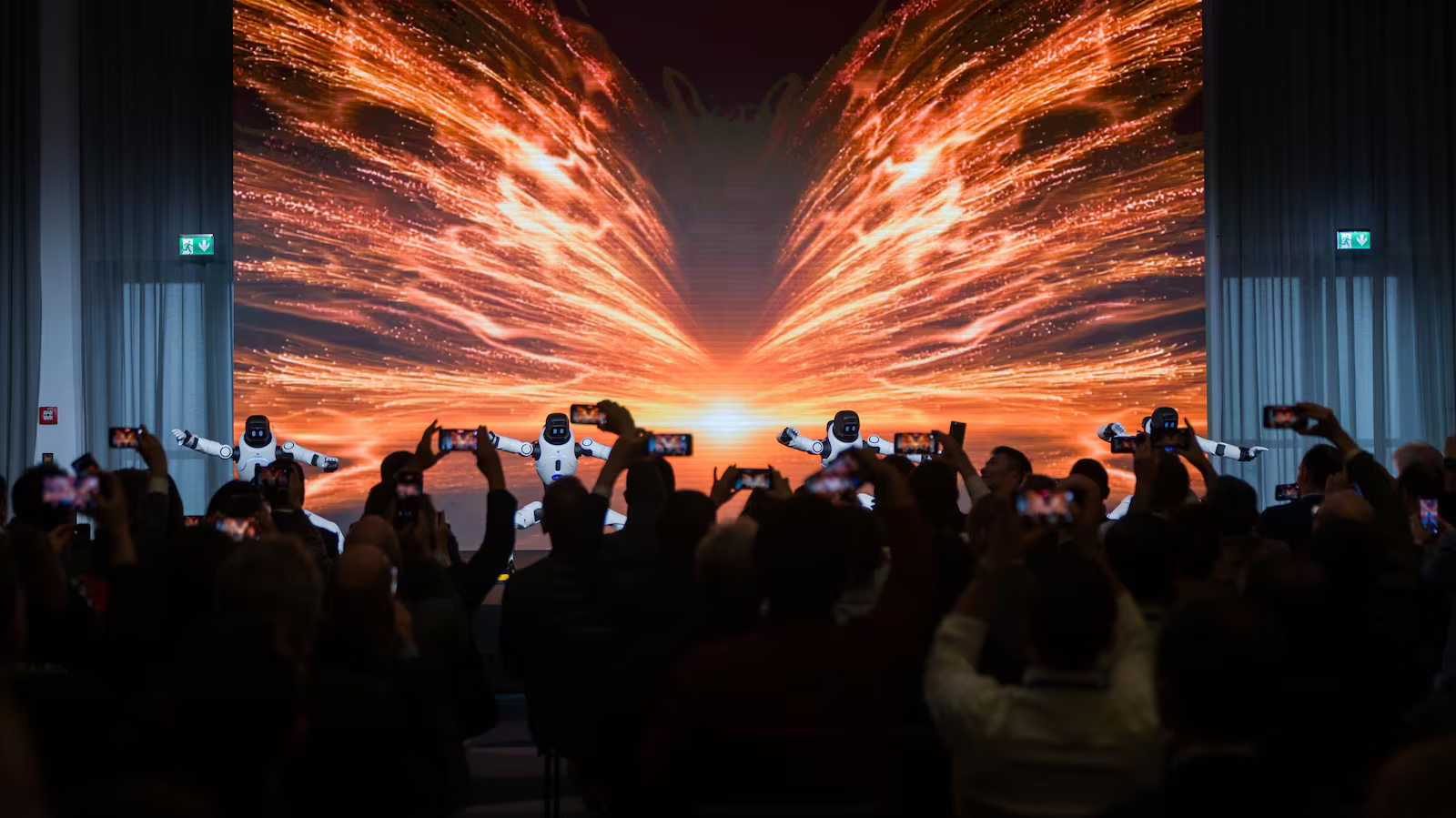
Agibot is positioning its humanoid systems as embodied AI platforms designed to operate directly in physical work environments. At a Munich event attended by roughly 400 engineers and executives, the company showcased its X2 humanoid, a compact 1.31 meter robot capable of dancing, performing acrobatics and handling front desk service tasks. In China, the X2 is currently deployed in hospitality and event roles.
The European strategy, however, is focused on industrial applications. Agibot’s G2 series is aimed at factory settings, featuring dual arm, force controlled manipulation mounted on a wheeled base for stability. The model range spans heights from 1.22 meters to 1.80 meters. The G2 uses Nvidia’s Jetson Thor T5000 computing platform as its control system and is priced at more than 117000 dollars per unit, making it the company’s highest priced offering.
The company also presented its A2 full size humanoid platform for multimodal interaction and autonomous navigation. While Agibot’s portfolio includes a D1 quadruped inspection robot and the Omnihand Pro robotic hand with 19 degrees of freedom, the European push centers on humanoid platforms tailored to automotive production requirements.
Claimed Market Position
Founded three years ago, Agibot says it has entered mass production and delivered more than 5000 humanoid robots as of early 2026. The company claims this represents about 40 percent of the global humanoid robot market, reflecting what executives describe as the early stage of industry development.
Market forecasts cited by the company suggest substantial long term growth potential. Morgan Stanley estimates annual demand for humanoid robots could reach 1.5 million units by 2035, while Bain & Co. projects a market that could be significantly larger. Agibot’s expansion into Europe positions it to compete for a share of that projected demand within the automotive sector.
Localization and Industrial Integration
Minth operates more than ten production sites across Europe, including facilities in Germany, France and the United Kingdom. The supplier produces structural body parts, aluminum components, trims and battery housings, and has established a regional manufacturing footprint over the past 15 years.
According to Minth leadership, scaling humanoid robots for industrial use requires not only advances in artificial intelligence but also strong localization capabilities, reliable manufacturing systems and long term operational support. The partnership is intended to combine Agibot’s humanoid platforms with Minth’s European production infrastructure and automotive supplier relationships.
For European automakers and tier suppliers facing cost pressures and automation demands, humanoid robots are being evaluated as flexible systems that could complement or extend existing automation. Agibot’s strategy in Europe prioritizes securing industrial partners and pilot deployments over short term sales volume, with the aim of embedding humanoid systems into real production workflows.
Source: autonews.com