Unitree and Ubtech Signal Shift Toward Robot “Brains”
The competitive dynamics in humanoid robotics are shifting from hardware execution to full stack intelligence, as leading Chinese developers rethink how robots transition from demonstrations to productive labor.
Recent disclosures from Unitree and Ubtech illustrate a growing industry consensus that motion control alone is no longer sufficient. While early success in humanoid systems has been driven by advances in locomotion and cost reduction, the next phase is increasingly defined by perception, cognition, and autonomous decision making.
Unitree, known for its strong capabilities in motion control and vertically integrated hardware, revealed in its prospectus that it plans to allocate 2 billion yuan from IPO proceeds to develop its robot “brain”. The move is notable given the company’s prior focus on efficient mechanical design and control systems, which enabled it to produce humanoid robots at costs as low as 60,000 to 70,000 yuan while maintaining strong margins.
To date, Unitree’s commercial traction has been concentrated in research, education, and performance applications. These scenarios prioritize visual impact and cost effectiveness over autonomy. However, they also represent a limited market ceiling and do not require the level of intelligence needed for continuous industrial deployment.
The company’s pivot reflects a broader realization across the sector. Industrial users are not seeking remotely operated or pre programmed machines, but systems capable of understanding instructions, adapting to environments, and executing complex workflows reliably over extended periods.
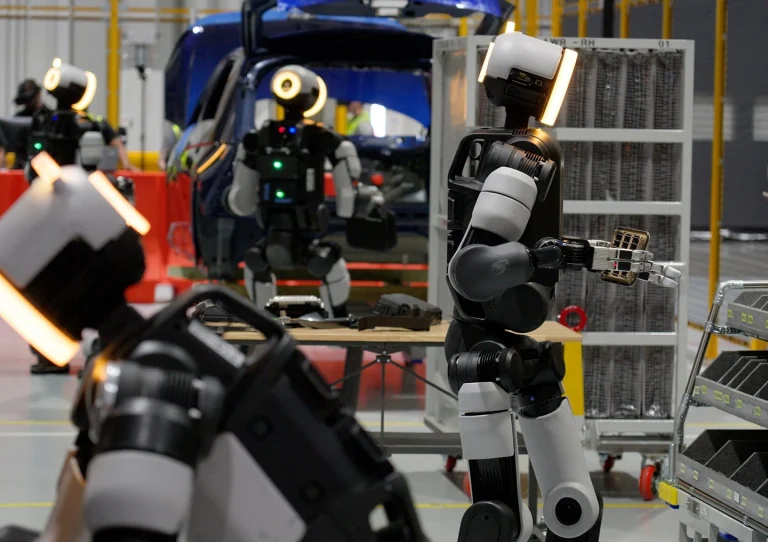
Ubtech provides a contrasting model built around long term investment in embodied intelligence. According to its latest financial report, the company generated 821 million yuan in revenue from full size humanoid robots in 2025, with more than 1,000 units sold. Around 80 percent of deployments were in industrial environments, including automotive manufacturing, electronics production, logistics, and aviation.
Customers include major global manufacturers such as BYD, Foxconn, Texas Instruments, Airbus, and Honda. These deployments focus on tasks such as material handling, sorting, and quality inspection, indicating a shift toward practical labor applications.
Ubtech’s approach centers on integrating hardware, motion control, and AI into a unified system. Its technology stack includes a vision language action model, a world model tailored for industrial scenarios, and a cloud edge architecture known as BrainNet 2.0. This system distributes high level planning to the cloud while enabling real time execution at the edge, allowing multiple robots to collaborate in coordinated workflows.
The company has also invested heavily in hardware reliability and dexterity, including binocular vision systems, hot swappable battery systems, and advanced robotic hands designed for fine manipulation. In 2025, Ubtech reported research and development spending of 507 million yuan, with a team approaching 1,000 personnel dedicated to humanoid robotics.
This sustained investment appears to be translating into commercial validation. The humanoid robotics segment achieved a gross margin of 54.6 percent, suggesting that industrial customers are willing to pay a premium for systems that deliver measurable productivity gains.
A key differentiator in this model is data accumulation. Continuous deployment in real world environments allows Ubtech to collect operational data at scale, improving model performance and expanding task capabilities over time. This creates a feedback loop that strengthens both the technology and its competitive positioning.
The contrast between Unitree and Ubtech reflects a broader strategic divergence in the industry. One path emphasizes rapid commercialization through focused hardware innovation, while the other prioritizes long term capability building across the full stack.
However, recent signals suggest convergence. Unitree’s planned investment in AI capabilities indicates recognition that humanoid robots must evolve beyond demonstration platforms to become autonomous agents. As more companies enter the market and competition intensifies, reliance on motion control alone is likely to become insufficient.
The emerging consensus is that humanoid robots will need tightly integrated systems combining perception, reasoning, and actuation. Companies that can deliver reliable performance in real world industrial settings, while continuously improving through data, are likely to define the next phase of the sector.
Source: eu.36kr.com