
1X Secures Deal to Deploy 10,000 Neo Humanoid Robots
Robotics company 1X has announced an agreement with private equity firm EQT to deploy up to 10,000 units of its Neo humanoid robot across multiple industries over the next five years. The initiative targets sectors such as manufacturing, facilities management, and healthcare, where the robots are expected to operate alongside human workers.
2026 Humanoid Robot Market Report
160 pages of exclusive insight from global robotics experts – uncover funding trends, technology challenges, leading manufacturers, supply chain shifts, and surveys and forecasts on future humanoid applications.

Featuring insights from
Aaron Saunders, Former CTO of
Boston Dynamics,
now Google DeepMind

2026 Humanoid Robot Market Report
160 pages of exclusive insight from global robotics experts – uncover funding trends, technology challenges, leading manufacturers, supply chain shifts, and surveys and forecasts on future humanoid applications.
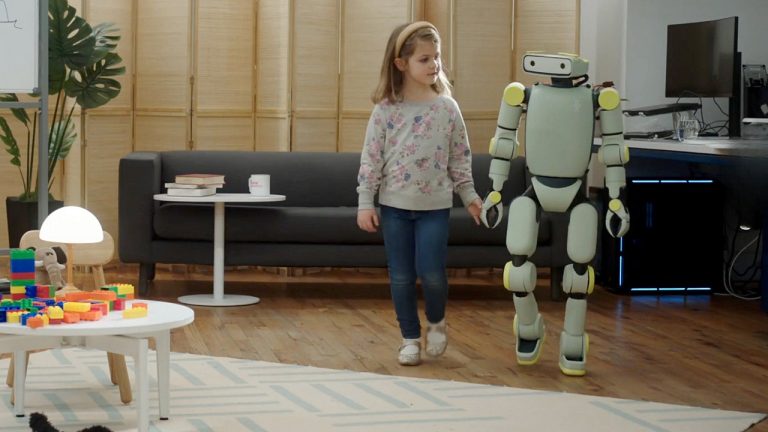
The Neo platform is designed around a humanoid form factor, allowing it to function in environments built for people. According to the company, this enables easier integration into existing workflows compared with traditional industrial automation systems that require structured settings or dedicated infrastructure.
The planned rollout represents one of the larger announced commercial deployments of humanoid robots to date. 1X intends to begin pilot programs in the United States in 2026, coinciding with initial deliveries of the Neo system. These early deployments are expected to inform further scaling decisions and operational refinements.
1X positions Neo as a collaborative system rather than a replacement for human labor. The robots are designed to assist with tasks that benefit from humanlike mobility and manipulation, particularly in dynamic or unstructured environments. The company states that the system will ship with baseline autonomous capabilities and improve over time through continued operation and learning.
The deal is supported by EQT, a Stockholm based private equity firm and existing investor in 1X. Through its network of portfolio companies, EQT is expected to play a role in facilitating real world deployment scenarios and accelerating adoption across different verticals.
The scale of the agreement highlights growing interest in humanoid robotics as a flexible automation layer. Unlike fixed industrial robots or mobile platforms with limited manipulation, humanoid systems aim to combine mobility, dexterity, and adaptability within a single platform. This positions them for use cases where task variability and human interaction are significant factors.
At the same time, the planned rollout raises operational and governance questions. Concerns cited include data collection, workplace privacy, and the broader implications of integrating autonomous systems into human centric environments. These considerations are likely to influence deployment strategies, particularly in regulated sectors such as healthcare.
Neo is also positioned at a relatively aggressive price point, with units cited at $20,000, suggesting a strategy focused on scaling through affordability as well as capability. If achieved in practice, this could lower barriers to entry for organizations evaluating humanoid automation.
The coming pilot phase will be a key indicator of how humanoid robots perform outside controlled demonstrations. For operators and technical decision makers, metrics such as reliability, task completion rates, safety performance, and integration overhead will determine whether large scale deployments can move beyond pilot programs into sustained operations.
The agreement between 1X and EQT signals a shift from prototype driven development toward commercial rollout at volume. Whether this translates into durable adoption will depend on execution in real world environments and the ability of humanoid systems to deliver consistent value alongside human workers.
Source: nationaltoday.com