Xiaomi Deploys Humanoid Robot in EV Factory for Auto Assembly
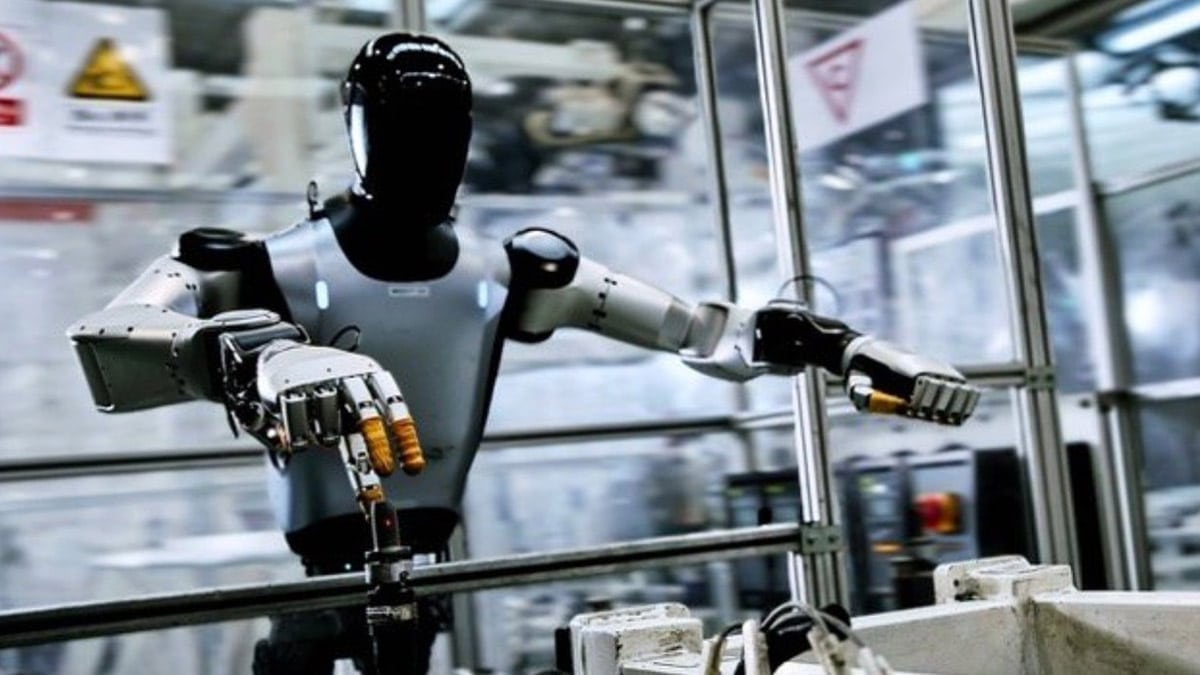
Xiaomi has deployed its humanoid robot into a live automotive production environment, marking a concrete step from laboratory development to factory floor operations. The company confirmed that the robot has been operating at a self tapping nut installation workstation inside Xiaomi EV’s die casting workshop.
2026 Humanoid Robot Market Report
160 pages of exclusive insight from global robotics experts – uncover funding trends, technology challenges, leading manufacturers, supply chain shifts, and surveys and forecasts on future humanoid applications.

Featuring insights from
Aaron Saunders, Former CTO of
Boston Dynamics,
now Google DeepMind

2026 Humanoid Robot Market Report
160 pages of exclusive insight from global robotics experts – uncover funding trends, technology challenges, leading manufacturers, supply chain shifts, and surveys and forecasts on future humanoid applications.
According to Xiaomi, the humanoid completed three consecutive hours of autonomous operation at the station. Test data showed a 90.2 percent success rate for simultaneous installation tasks on both sides of the workstation. The system also met the production line’s fastest cycle time requirement of 76 seconds.
Assembly Task and Production Constraints
The workstation requires the robot to pick self tapping nuts from an automatic feeding device and place them onto positioning fixtures. It must then coordinate with slide conveyors and automated positioning systems to complete tightening operations on floor components following integrated die casting.
Xiaomi identified precise alignment and reliable engagement of the self tapping nuts as the main technical challenges. The spline structure inside the nuts, variable gripping posture, and magnetic interference increase the difficulty of maintaining consistent insertion and fastening performance under industrial cycle time constraints.
Control Architecture and Learning Framework
To address these constraints, Xiaomi implemented an end to end data driven control approach built around its in house 4.7 billion parameter vision language action model, Xiaomi Robotics 0. The company combined this foundation model with reinforcement learning to reduce reliance on large volumes of teleoperation data.
The training framework is designed to enable rapid adaptation to diverse operating conditions and continuous learning from physical interactions. Xiaomi reported that the robot integrates multimodal inputs including vision, tactile feedback, and joint proprioception to reduce state estimation errors in complex assembly scenarios.
For full body motion control, the humanoid uses a hybrid architecture that combines optimization based control with reinforcement learning. Xiaomi stated that the optimization controller solves each iteration in under 1 millisecond to maintain real time responsiveness. The reinforcement learning controller was trained through hundreds of millions of simulated random perturbations, supporting balance under disturbance and zero shot transfer from simulation to the physical robot.
Path Toward Broader Industrial Deployment
Xiaomi described the self tapping nut station as the first step in scaling humanoid applications across its automotive manufacturing operations. The company is conducting validation at additional workstations, including bin picking and front badge installation.
A stated focus is overcoming bottlenecks related to production cycle time and yield rate, two metrics that determine whether humanoid systems can operate alongside conventional automation in high throughput automotive environments. Sustained performance within takt time and acceptable defect rates remains a key benchmark for industrial adoption.
The deployment places Xiaomi among a growing group of electric vehicle manufacturers investing in humanoid robotics for in house production tasks. As automotive OEMs pursue embodied intelligence strategies, factory level pilots such as this provide measurable data on autonomy duration, task success rates, and integration with existing production infrastructure.
While the reported three hour autonomous run represents a limited time window, it signals a shift from proof of concept demonstrations to task specific validation under real manufacturing conditions. Continued expansion to additional stations will determine whether Xiaomi’s humanoid platform can meet the reliability and scalability requirements of full scale automotive assembly.
Source: cnevpost.com