Xiaomi Deploys Humanoid Robot in EV Assembly Line
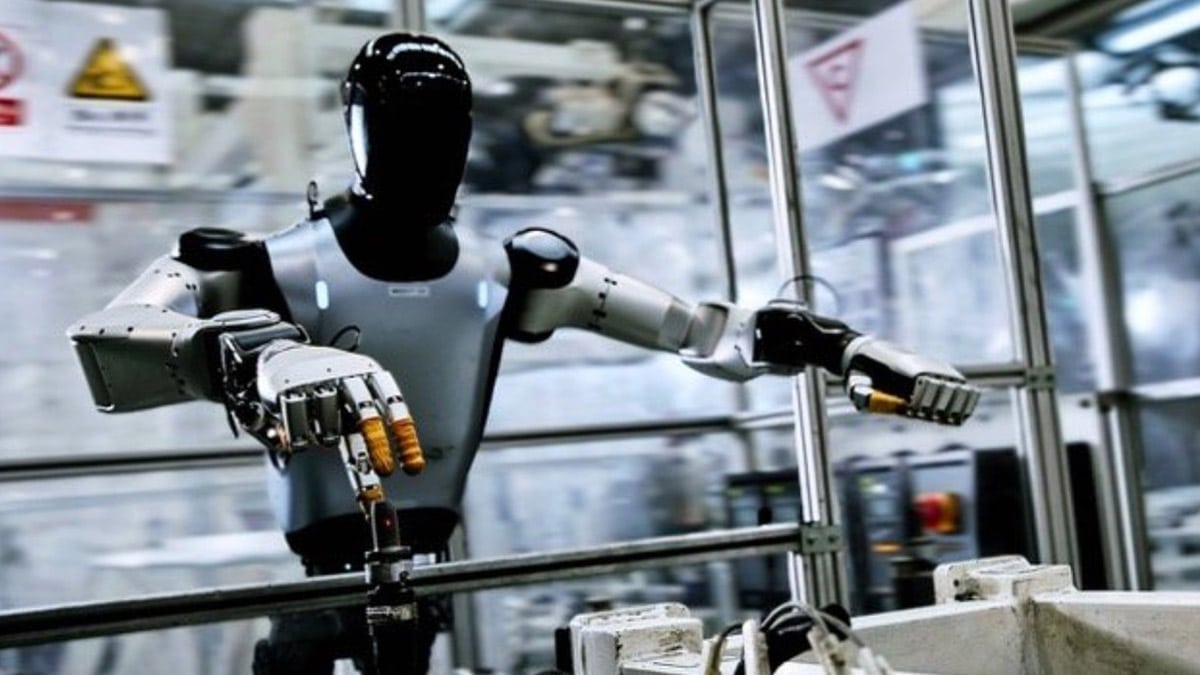
Xiaomi has moved its humanoid robotics program from the lab to the production floor, deploying a humanoid robot at an electric vehicle factory to carry out complex component assembly tasks.
2026 Humanoid Robot Market Report
160 pages of exclusive insight from global robotics experts – uncover funding trends, technology challenges, leading manufacturers, supply chain shifts, and surveys and forecasts on future humanoid applications.

Featuring insights from
Aaron Saunders, Former CTO of
Boston Dynamics,
now Google DeepMind

2026 Humanoid Robot Market Report
160 pages of exclusive insight from global robotics experts – uncover funding trends, technology challenges, leading manufacturers, supply chain shifts, and surveys and forecasts on future humanoid applications.
According to a company statement posted on Weibo, the robot completed three consecutive hours of autonomous operation at a self tapping nut installation workstation inside Xiaomi EV’s die casting workshop. During the trial, the system achieved a 90.2 percent success rate for simultaneous installation on both sides of the workstation while meeting the production line’s fastest cycle time requirement of 76 seconds.
From Pilot to Production Environment
The deployment marks Xiaomi’s first disclosed use of a humanoid robot in a real automotive manufacturing setting. The specific task involves picking self tapping nuts from an automatic feeding device, placing them onto positioning fixtures, and coordinating with slide conveyors and automatic positioning systems to complete tightening operations on floor components after integrated die casting.
While the operation may appear routine, Xiaomi identified several technical challenges. The spline structure inside the nuts, non fixed gripping postures, and interference from magnetic forces increased the complexity of alignment and reliable engagement. Precise positioning is essential to avoid cross threading, incomplete tightening, or component damage, all of which directly affect yield rates.
End to End Learning and VLA Integration
To address these constraints, Xiaomi implemented what it describes as an end to end data driven control approach built on its in house 4.7 billion parameter Vision Language Action model, Xiaomi Robotics 0. The model is combined with reinforcement learning to reduce reliance on large volumes of real world teleoperation data.
The company states that this joint training framework enables rapid adaptation to diverse operating conditions and supports continuous learning through interaction with the physical environment. By integrating multimodal inputs including vision, tactile feedback, and joint proprioception, the robot is designed to reduce state misjudgment in complex assembly scenarios and improve robustness.
For full body motion control, Xiaomi uses a hybrid architecture that combines optimization based control with reinforcement learning. The optimization controller reportedly solves each iteration in under one millisecond, supporting real time responsiveness. The reinforcement learning controller was trained through hundreds of millions of simulated random perturbations in a virtual environment, with the goal of maintaining balance under extreme disturbance conditions and enabling zero shot transfer to physical hardware.
Cycle Time and Yield as Core Metrics
Xiaomi framed the self tapping nut workstation as a first step toward scaling humanoid robot applications in automotive manufacturing. The company is conducting deployment and validation at additional workstations, including bin picking and front badge installation.
Central to this expansion is overcoming what Xiaomi described as the bottleneck of production cycle time and yield rate. For industrial operators, these metrics determine whether a humanoid system can move beyond demonstration status and justify integration alongside established fixed automation and industrial robots.
The reported 76 second cycle time alignment with existing production requirements is notable. Matching takt time without degrading quality is a prerequisite for any humanoid robot seeking a sustained role in high volume manufacturing.
Competitive Landscape in China and Beyond
Xiaomi’s progress comes amid intensified competition in humanoid robotics from both domestic and international players. Lei Jun, founder, chairman, and CEO of Xiaomi, stated separately that large numbers of humanoid robots could begin working in Xiaomi factories within the next five years.
Tesla has previously indicated that its Optimus humanoid robot is expected to perform more complex tasks by the end of 2026, with a mass produced third generation version planned for launch in the first quarter of this year. Chinese EV maker Xpeng is also advancing its robotics initiative and has announced plans to build what it calls the industry’s first humanoid robot mass production base in Guangzhou, targeting large scale production by late 2026.
The convergence of automotive manufacturing and humanoid robotics is strategic. Automakers operate structured, repetitive, and quality critical environments that provide clear performance benchmarks. Success in such settings could accelerate broader industrial adoption.
Implications for Industrial Deployment
Xiaomi’s factory deployment highlights a shift in embodied intelligence from research prototypes to task specific industrial validation. The emphasis on end to end learning, multimodal perception, and hybrid control reflects a trend toward tightly integrated software and hardware stacks optimized for real world manipulation.
For robotics practitioners and manufacturing decision makers, the key questions remain consistent: sustained uptime, integration cost, safety compliance, and scalability across workstations. A three hour autonomous run with defined success metrics is an early but concrete data point.
As Xiaomi expands trials to additional assembly tasks, the next indicators to watch will include longer duration operation, performance under variable production conditions, and measurable impact on throughput and defect rates. These factors will determine whether humanoid robots transition from pilot programs to standard equipment within automotive plants.
Source: share.google