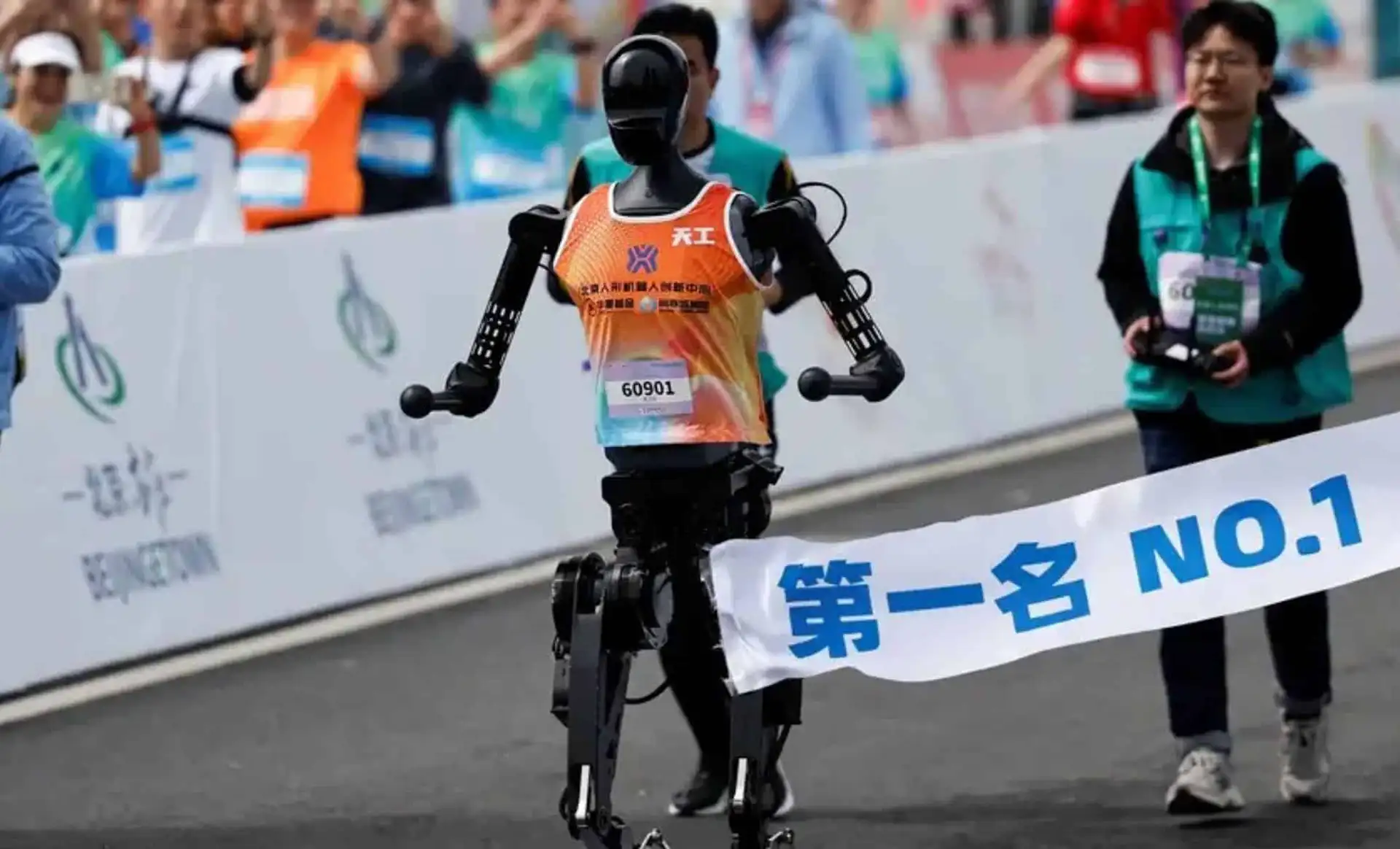
The Race That Wasn’t About Speed: What a Half-Marathon Revealed About Humanoid Robots
Technology observers believe that this half-marathon may accelerate innovation in robotics more than any lab trial ever could. Chinese humanoid robots showcased both impressive strength and critical weaknesses: Tiangong Ultra reached a world-leading top speed of around 12 km/h, while smaller robots exposed their struggles with overheating and balance. Described as a “technological stress test” for humanoids, the event celebrated a “culture of tolerant failure”—where falls and system glitches were met with applause, not disappointment. In short: this wasn’t a race for medals—it was a milestone in robotics evolution.
The Significance of the World’s First Humanoid Half-Marathon
2026 Humanoid Robot Market Report
160 pages of exclusive insight from global robotics experts – uncover funding trends, technology challenges, leading manufacturers, supply chain shifts, and surveys and forecasts on future humanoid applications.

Featuring insights from
Aaron Saunders, Former CTO of
Boston Dynamics,
now Google DeepMind

2026 Humanoid Robot Market Report
160 pages of exclusive insight from global robotics experts – uncover funding trends, technology challenges, leading manufacturers, supply chain shifts, and surveys and forecasts on future humanoid applications.
On April 19, 2025, Beijing became the stage for a historic milestone: the world’s first half-marathon dedicated to humanoid robots. While 12,000 human runners took part in the standard race, 20 humanoid robot teams from across China participated in a parallel, high-stakes challenge—running 21.1 kilometers under real-world outdoor conditions.
The event wasn’t about competition, but about pushing the boundaries of what humanoid robots can endure in a live environment. Unlike lab tests or obstacle courses with predictable parameters, this was an open road filled with slopes, curves, heat, and vibrations. Robots faced it all: uneven terrain, shifting weather, and mechanical fatigue.

As one organizer put it, the marathon acted as a “maximum stress test” for humanoid systems. It tested everything at once: locomotion control, power management, real-time obstacle response, cooling efficiency, and decision-making under pressure. For the first time, robots were placed under the same chaotic conditions as human athletes—and their creators were there every step of the way, often jogging beside them, tools in hand.
Only 6 of the 20 robots finished the course. But this wasn’t seen as failure. Instead, it highlighted the “tolerant innovation culture” that China is fostering. Robots that fell were applauded for standing up again. The crowd shouted words of encouragement like “Come on, robots!” as the machines tripped, overheated, or staggered off-balance. One robot even lost its head near the finish line and kept running without it—literally.
This emphasis on effort over perfection is rare in robotics, where public demos are often carefully scripted. Here, errors were expected—and welcomed—as opportunities to learn. According to officials, the race was not just a media spectacle, but a deliberate push to uncover the weak links in current humanoid systems, and to inspire the development of more resilient, efficient, and adaptable robots.
Real-World Lessons Learned
Among the discoveries:
- Completing a half-marathon requires up to 250,000 leg movements—a major challenge for any dynamic balancing system.
- Most robots overheated, revealing the urgent need for better cooling solutions.
- Some lost balance on curves or slopes, showing the limitations of their current motion algorithms.
- Battery life remains a critical barrier: several robots required multiple battery swaps or full replacements mid-race.
- One team changed their robot five times along the course.
Despite these setbacks, the achievements were remarkable. Tiangong Ultra, developed by the Beijing Humanoid Robot Innovation Center and UBTECH, finished the race in under 3 hours with just one battery swap—running consistently at around 8–9 km/h. Another standout, the N2 robot by Songyan Dynamics, was the only robot to complete the race entirely autonomously, with no human guide.
These breakthroughs demonstrate that humanoids are inching closer to operating in real-world environments. Engineers used the race not only to test systems but to collect real-time feedback for future iterations. The open and transparent nature of the event—streamed live with no editing—reflected a new phase of confidence in robotics R&D in China.
A Cultural Shift in Robotics
Beyond the technology, this event marks a cultural shift. It signals a growing belief that progress in robotics requires public trial, error, and iteration, not just private perfection. It also underlines a broader ambition: building robots that are not just impressive in labs, but robust, autonomous, and adaptable enough for the everyday world—be it in logistics, healthcare, education, or the home.
The humanoid half-marathon made visible the invisible labor of roboticists: the years of coding, fine-tuning, and mechanical refinement behind each seemingly simple step. For spectators, it was entertaining. For engineers, it was essential. And for robots, it was a chance to prove they’re more than just prototypes—they’re future collaborators.
Top 6 Finishers – Humanoid Robot Half-Marathon (Beijing, April 19, 2025):
| Rank | Team (Robot Name) | Time | Developer / Institution | Robot Link |
|---|---|---|---|---|
| 1st | Tiangong Team (Tiangong Ultra) | 2:40:42 | Beijing Humanoid Robot Innovation Center / UBTECH | Tiangong Ultra |
| 2nd | Little Naughty Team (Xiaowantong / N2) | 3:37:50 | Songyan Dynamics | N2 Robot |
| 3rd | Xingzhe No. 2 Team (Xingzhe 2) | 4:25:56 | DroidUp (Shanghai Zhuoyide Robotics) | Xingzhe 2 |
| 4th | Tornado Boy Team (Xuanfeng Xiaozi) | 4:51:55 | Independent (custom build) | — |
| 5th | EAI Team (EAI) | 5:10:27 | Zhongyu Embodied AI Lab | EAI |
| 6th | Half-Awake Team (Banxing) | 5:27:19 | Independent (custom build) | — |
Sources:
- Global Times: https://www.globaltimes.cn/page/202504/1332512.shtml
- SZNS Government News: http://www.szns.gov.cn/
- Xinhua News Agency, Sina Finance, CCTV
- UBTECH, Songyan Dynamics, DroidUp, Zhongyu Embodied Intelligence