
TARS
$ 95 000

TARS Robotics (Shanghai)
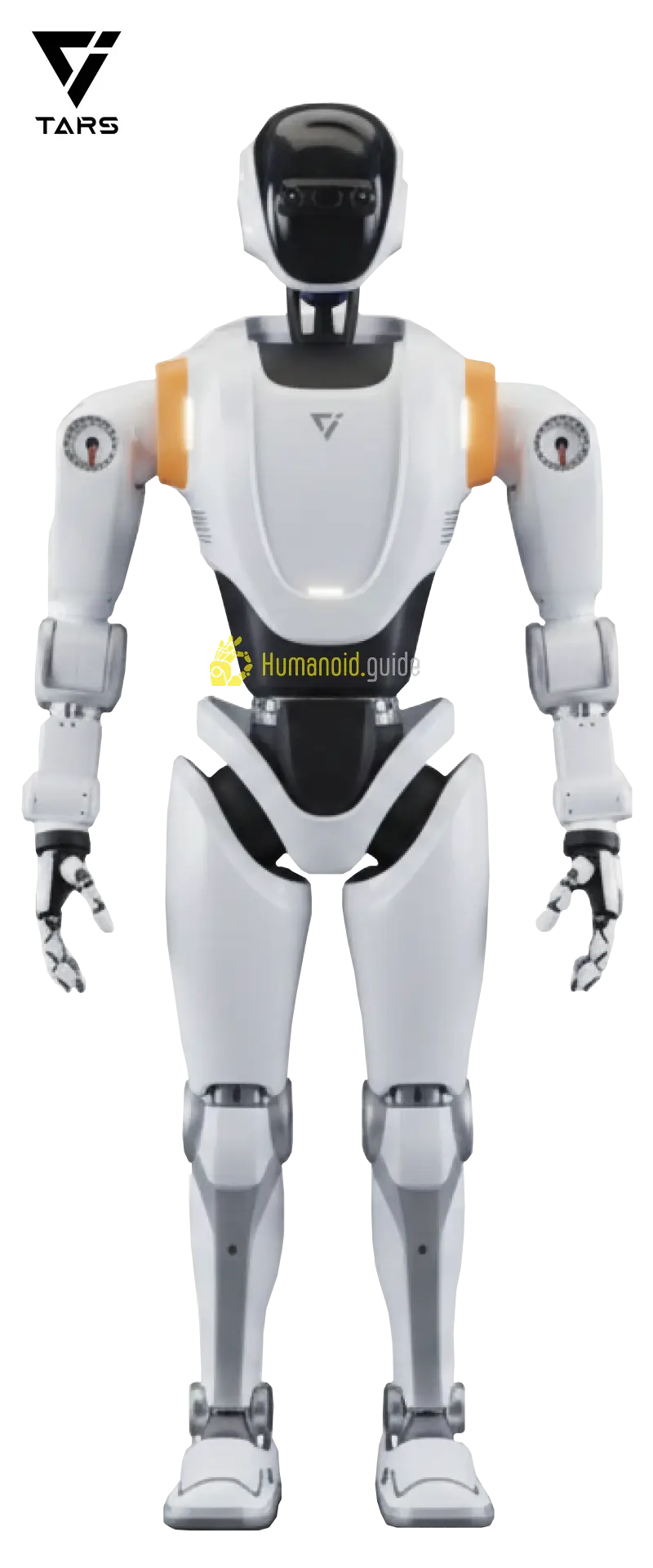
TARS is a next-generation humanoid robot by Chinese startup TARS Robotics. It combines AI with dexterous physical control and recently demonstrated world-first two-hand stitching, showing advanced fine-motor capabilities that could transform precision manufacturing.
Skill Score
 4
4

Specifications and details:
| Availability | Prototype |
|---|---|
| Nationality | China |
| Degrees of freedom, overall | Assumed 30–40+ |
| Degrees of freedom, hands | Assumed 10–20 (bi-manual manipulation) |
| Height [cm] | 160 to 175 cm |
| Max speed (km/h) | 3–5 km/h |
| Strength [kg] | ~15–20 kg payload (assumed) |
| Weight [kg] | 80 |
| Runtime pr charge (hours) | 3 |
| Safe with humans | Yes |
| CPU/GPU | Assumed AI acceleration hardware onboard |
| Ingress protection | IP20 |
| Camera resolution | RGB + depth, ~1080p |
| Connectivity | 5G-A support for remote control, Ethernet, Wi‑Fi |
| Operating system | Linux-based industrial OS / ROS |
| LLM integration | Possible via external system integration |
| Latency glass to action | 150–250 ms |
| Motor tech | Electric servo actuators |
| Gear tech | Harmonic / planetary gears (assumed) |
| Main structural material | Aluminum + plastic composites |
| Number of fingers | 5 per hand |
| Main market | Industrial automation, Industrial logistics, Manufacturing |
| Verified | Not verified |
| Walking Speed [km/h] | 3 |
| Shipping Size | N/A |
| Color | Black, Grey |
| Manufacturer | TARS Robotics (Shanghai) |
| Website | https://www.tarsupv.com/ |
Description
The TARS humanoid robot represents a bold step in China’s robotics landscape. It blends artificial intelligence with real-world physical skills, enabling it to interact with objects in a human-like way. TARS aims to close the gap between digital AI models and physical performance.
2026 Humanoid Robot Market Report
160 pages of exclusive insight from global robotics experts – uncover funding trends, technology challenges, leading manufacturers, supply chain shifts, and surveys and forecasts on future humanoid applications.

Featuring insights from
Aaron Saunders, Former CTO of
Boston Dynamics,
now Google DeepMind

2026 Humanoid Robot Market Report
160 pages of exclusive insight from global robotics experts – uncover funding trends, technology challenges, leading manufacturers, supply chain shifts, and surveys and forecasts on future humanoid applications.
Unlike many robots built only for simple tasks, TARS performs detailed work that requires fine motor control. For example, it recently demonstrated sewing a logo by threading a needle and stitching fabric with both hands. This task tests both coordination and precision far beyond basic robotic motion.
While still in early stages of public deployment, TARS is designed with adaptability in mind. It uses advanced sensors and AI systems to adjust its actions in changing environments. The company plans to expand its use from industrial settings into more complex logistics and service roles.

I’m Olivia, Humanoid Analyst at Humanoid.Guide
My mission, together with the team, is to help your organization understand the landscape, compare solutions, and move toward successful robot deployments.
In the long term, engineers expect TARS to handle a wider range of tasks in factories, laboratories, and even everyday settings. Its developers focus on embodied intelligence—meaning the robot doesn’t just calculate actions, it learns how to execute them in the real world. This approach brings AI models closer to practical use in many industries.
Download the Humanoid Robot Market Report here